The Inner Anchor of the Solar System
By standard positional order, Mercury holds the title of the closest planet to the Sun. Moving along an inner track in the solar system, it circles our star at an average distance of roughly 36 million miles (58 million kilometers), or 0.39 Astronomical Units (AU).
To put that scale into perspective, Mercury orbits less than half as far from the Sun as Earth does.
However, looking strictly at “average distance” hides the chaotic dynamics of Mercury’s eccentric orbit and its extreme relationship with solar radiation.
The Most Eccentric Planetary Path
While worlds like Earth follow nearly circular orbits, Mercury travels along a stretched, highly elliptical oval. This oval path produces drastic changes in its distance from the Sun throughout a single year:
- Perihelion (Closest Approach): Shrinks to just 28.5 million miles (46 million km) from the solar surface.
- Aphelion (Farthest Distance): Expands to 43.5 million miles (69.8 million km).
Because of this intense gravitational proximity, Mercury is forced to travel faster than any other world. The planet hurtles through space at an astonishing average speed of 29 miles per second (47 km/s), completing a full orbit around the Sun in just 88 Earth days.
The Distance Paradox: Is Mercury Closest to Earth Too?
Ask a room of people which planet is closest to Earth, and most will answer Venus or Mars. Mathematically, that answer is usually wrong.
In 2019, a team of engineers and astrophysicists from NASA and Los Alamos National Laboratory published a study analyzing thousands of years of planetary position data. They used a point-vector method to calculate the average distance between any two planets over time.
Their findings revealed a counterintuitive cosmic rule: because Mercury has the smallest orbital radius, it remains closer to every other planet in the solar system longer than any other world.
When Venus or Mars are positioned on the far side of the Sun relative to Earth, Mercury is frequently the nearest neighbor.
Sunlight Dynamics on a Scorched World
Standing on the rocky surface of Mercury—assuming a human could survive the extreme vacuum and temperature radiation—presents a bizarre solar spectacle.
Because of its proximity:
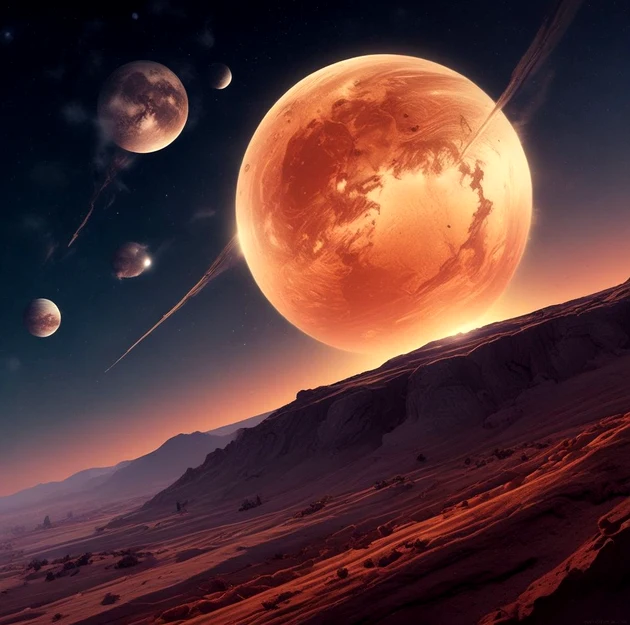
- The Sun Appears Huge: The Sun looks more than three times larger in Mercury’s sky than it does from Earth.
- Solar Intensity: The planet receives roughly seven times more direct sunlight and radiation than our home world.
- Double Sunrises: Due to a unique 3:2 spin-orbit resonance (the planet rotates three times on its axis for every two orbits around the Sun), an observer at specific locations on Mercury would watch the Sun rise, stop, reverse direction in the sky, and then set again—all within a single day.
Research & Astronomical References
- Physics Today: “Which Planet is Closest to Earth?” (Point-Vector Distance Analysis)
- NASA Solar System Exploration: Mercury In-Depth Statistics
- Celestial Mechanics and Dynamical Astronomy Journal: Spin-Orbit Coupling of Mercury