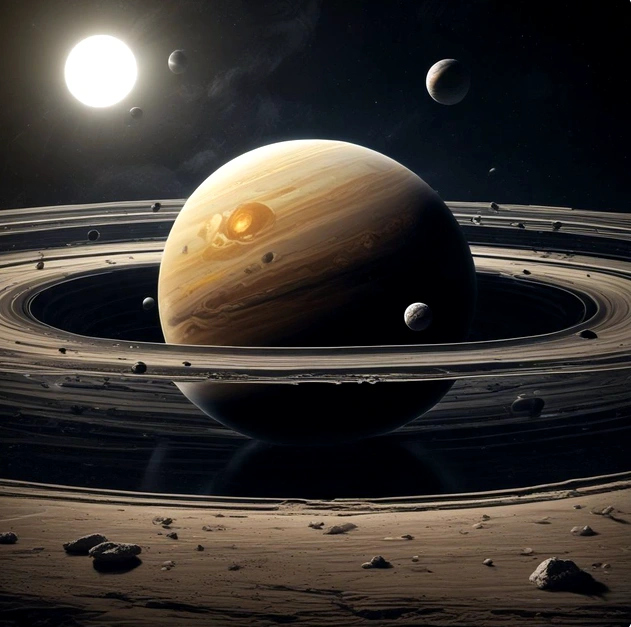
The Ongoing Battle for the Cosmic Crown
Crowns change hands quickly in outer space, especially when modern ground-based observatories scan the outer solar system with advanced imaging algorithms. For years, Jupiter held the top spot as the solar system’s most crowded neighborhood. Today, that title belongs decisively to Saturn, which boasts an astounding official count of 146 confirmed moons.
This planetary moon race isn’t static. As optical technology improves, astronomers continuously discover tiny, irregular moonlets orbiting our gas giant neighbors.
Here is how the solar system’s moon scoreboard currently stands among the major worlds:
- Saturn: 146 moons
- Jupiter: 95 moons
- Uranus: 28 moons
- Neptune: 16 moons
- Mars: 2 moons (Phobos & Deimos)
- Earth: 1 moon
- Mercury & Venus: 0 moons
Why Do Gas Giants Capture So Many Moons?
An accumulation of dozens or hundreds of moons requires two essential ingredients: immense mass and vast gravitational real estate.
Saturn and Jupiter formed in the outer regions of the protoplanet disk where icy debris was abundant. Because both worlds grew exceptionally massive, their gravitational spheres of influence (known as their Hill spheres) extended tens of millions of miles into space.
Over billions of years, as comets, icy asteroids, and planetary fragments strayed too close, the intense gravitational wells of these gas giants snared them into permanent orbits.
Regular Satellites vs. Captured Irregulars
Not all 146 moons of Saturn are giant, round worlds like Titan. Astronomers divide Saturn’s massive satellite network into two distinct families:
- Regular Moons: Spherical or near-spherical bodies like Titan and Enceladus that orbit close to Saturn’s equatorial plane in neat, circular paths. They formed directly alongside Saturn from the same primordial cloud of dust and ice.
- Irregular Moons: Small, potato-shaped icy objects that travel in elongated, tilted, and often retrograde (backward) orbits far from the planet. These are captured space rocks that were pulled into orbit long after Saturn fully formed.
In 2023 alone, an international team of astronomers using the Canada-France-Hawaii Telescope discovered dozens of tiny irregular moons orbiting Saturn, pushing its count far past Jupiter’s 95 known satellites.
The Two Crown Jewels of Saturn’s Fleet
While most of Saturn’s moons are small, cratered chunks of ice measuring just a few miles across, two worlds stand out as major targets for astrobiology:
- Titan: Saturn’s largest moon—bigger than the planet Mercury. It is the only moon in the solar system with a dense, nitrogen-rich atmosphere and surface lakes filled with liquid methane and ethane.
- Enceladus: A small, snow-white moon wrapped in a global ice shell. Deep beneath its frozen crust lies a warm saltwater ocean. Hydrothermal vents on its ocean floor regularly blast giant geysers of water ice and organic compounds into space through cracks near its south pole.
Data Records & Citation Archives
- International Astronomical Union (IAU) Minor Planet Center: Satellite Discovery Announcements
- NASA Cassini-Huygens Mission Data: Saturnian System & Ring-Moon Dynamics
- The Planetary Science Journal: Population Estimates of Irregular Satellites around Outer Planets