Evolving Beyond Gliding and Gravitational Limits
Across the vast mammalian class, several species—such as flying squirrels, sugar gliders, and colugos—can traverse significant air distances by leaping from high canopy perches and deploying specialized skin membranes. These creatures execute controlled passive gliding, falling steadily under gravity’s pull.
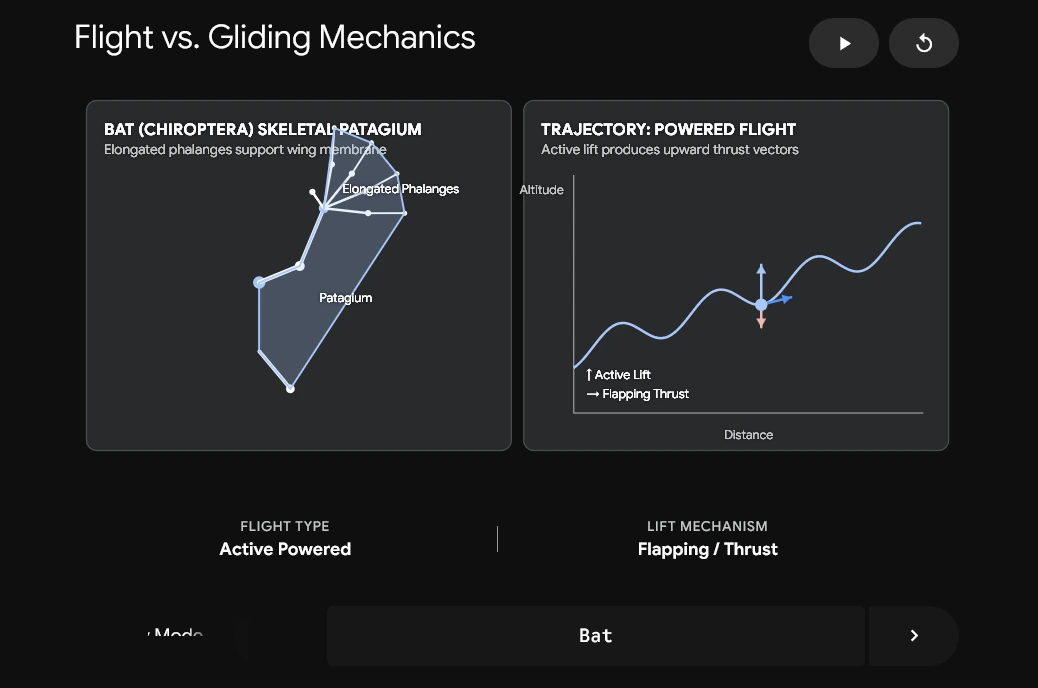
Bats (order Chiroptera) stand entirely alone as the only mammals capable of true, self-sustained powered flight.
Unlike passive gliders that require initial altitude and momentum, bats generate active aerodynamic lift and thrust using continuous muscular wingbeats, allowing them to gain altitude, hover, and execute complex aerial maneuvers.
| Locomotion Category | Mammalian Examples | Anatomical Adaptations | Flight Dynamics |
| True Powered Flight | Bats (Chiroptera) | Elongated hand digits supporting patagium | Generates active lift, gains altitude, hovers |
| Passive Gliding | Flying Squirrels, Sugar Gliders | Patagium stretched between fore and hind limbs | Gravity-assisted descent, controlled steering |
| Passive Gliding | Colugos (Flying Lemurs) | Full body webbed membrane down to tail | Long-distance canopy gliding, no upward propulsion |
The Anatomical Architecture of the Bat Wing
Translating mammalian bone structure into an effective flying wing required radical evolutionary modifications to the forelimbs.
The order name Chiroptera translates directly from Ancient Greek as “hand-wing” (kheir + pteron), perfectly describing the anatomical adaptation:
- Hyper-Elongated Digits: Unlike bird wings, which feature fused bones and primary feathers, a bat’s wing framework consists of greatly lengthened phalanges (finger bones).
- The Patagium Membrane: A thin, flexible, multi-layered skin membrane containing elastic fibers, blood vessels, and nerves stretches across these spread-out hand digits, extending down to the hind limbs.
- Multi-Jointed Control: Because bat wing structures retain individual finger joints, bats manipulate the wing curvature (camber) and angle of attack independently at multiple points during each wingbeat cycle.
Aerodynamic Superiority Over Avian Models
Empirical flight research reveals that bat wings generate higher lift coefficients and lower drag ratios compared to rigid bird wings of similar scale.
The high flexibility of the patagium allows the membrane to billow under air pressure, creating dynamic vortices along the leading edge of the wing during the downstroke. During the upstroke, bats collapse their fingers inward toward the body, reducing aerodynamic drag by up to 35% compared to fully extended movement.
Metabolic Demands of Mammalian Powered Flight
Flapping flight requires immense metabolic expenditure compared to terrestrial running or aquatic swimming.
To supply sufficient oxygen to large pectoral flight muscles during sustained flight, bats evolved hyper-adapted cardiovascular systems:
- Heart Rates: Peak flight heart rates in small microbats can exceed 1,000 beats per minute.
- Relative Heart and Lung Size: Bat hearts and lung capacities are disproportionately larger relative to total body mass than those of ground-dwelling mammals of similar size.
- High Metabolic Conversion: Bats rapidly convert ingested dietary sugars (from fruit, nectar, or insects) directly into flight fuel within minutes of digestion.
Zoological Sources & Evolutionary Biology Archives
- Journal of Experimental Biology: Aerodynamics and Kinematics of Chiropteran Flight
- Mammalian Species Roster (American Society of Mammalogists: Order Chiroptera Morphology)
- Nature Communications: Comparative Biomechanics of Avian vs. Mammalian Flight Mechanics