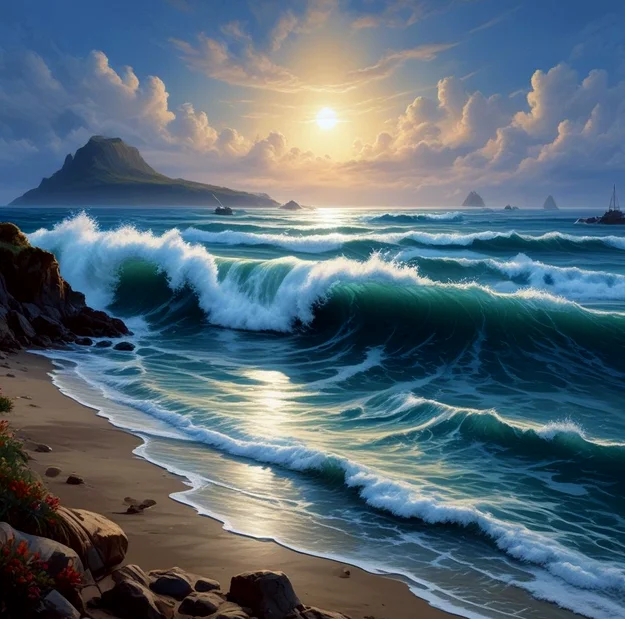
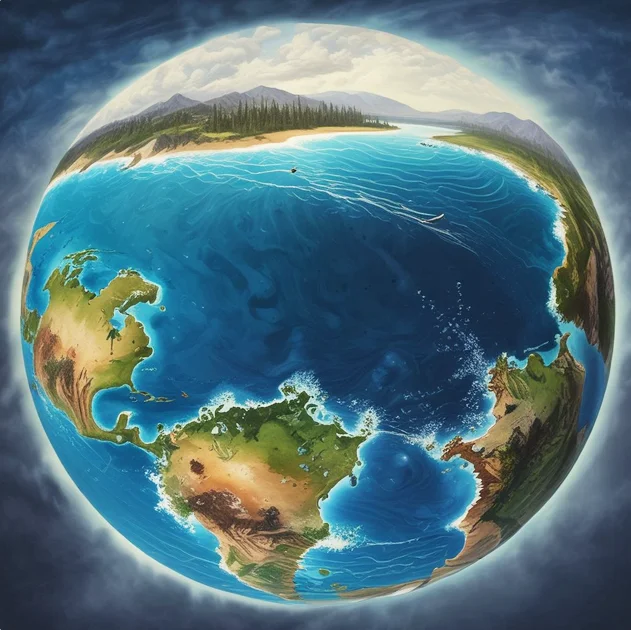
A Water Hemisphere Big Enough to Swallowed Every Continent
Map projections painted on flat paper often distort the real proportions of our planet. If you spin a 3D globe to face the central region of the Pacific Ocean, land virtually disappears from view, revealing a vast body of water that spans almost an entire hemisphere.
The Pacific Ocean is undisputed as the largest, deepest, and most voluminous ocean basin on Earth.
Covering more than 63 million square miles (165 million square kilometers), the Pacific accounts for roughly 30% of the Earth’s total surface area—meaning it could easily submerge all seven continents combined with millions of square miles of open water to spare.
Here is how the Pacific compares against Earth’s major marine basins:
- Pacific Ocean: ~63.8 million sq miles (165.2 million sq km)
- Atlantic Ocean: ~41.1 million sq miles (106.5 million sq km)
- Indian Ocean: ~27.2 million sq miles (70.5 million sq km)
- Southern Ocean: ~7.8 million sq miles (20.3 million sq km)
- Arctic Ocean: ~5.4 million sq miles (14.1 million sq km)
The Ring of Fire: Geological Engine of the Basin
The Pacific Ocean isn’t just a massive body of water; it sits atop a violent tectonic battleground.
Encircling the basin is the Ring of Fire, a 25,000-mile (40,000 km) horseshoe-shaped belt of oceanic trenches, volcanic arcs, and shifting fault lines. Rough estimates show that roughly 75% of the world’s active volcanoes and 90% of all global earthquakes occur along the borders of the Pacific Plate as it grinds underneath surrounding continental rocks.
This relentless tectonic subduction continuously pulls the ocean floor downward, creating the deepest underwater abyssal zones discovered on the planet.
Diving into the Challenger Deep
Beyond its vast surface area, the Pacific holds the record for absolute planetary depth.
Located near Guam in the western Pacific, the Mariana Trench plunges miles beneath the sunlit surface. Its deepest surveyed point, known as the Challenger Deep, drops down to approximately 36,000 feet (10,994 meters)—a depth so extreme that if you placed Mount Everest inside the trench, its peak would still sit more than a mile underwater.
At the bottom of this trench, the water pressure reaches staggering levels:
- Pressure: Over 1,000 atmospheres (roughly 8 tons per square inch), equivalent to balancing an elephant on your thumb.
- Temperature: Hovers barely above freezing, between 34°F to 39°F (1°C to 4°C).
- Life Form Adaptations: Despite absolute darkness and crushing weight, specialized amphipods, sea cucumbers, and giant single-celled xenophyophores thrive around deep hydrothermal vents.
Is the Largest Ocean Slowly Shrinking?
While the Pacific reigns supreme today, planetary geology is never static.
Because of the slow movement of Earth’s tectonic plates, the Pacific Ocean is actually shrinking by roughly one inch (2.5 cm) per year on three sides as the Americas, Asia, and Australia slide closer together. Conversely, the Atlantic Ocean is expanding at a similar rate as magma rises along the Mid-Atlantic Ridge, driving tectonic plates apart.
In roughly 250 million years, geologists predict that the continuous shrinkage of the Pacific will force the continents to merge once again into a supercontinent, tentatively named Amasia.
Geographic Archives & Oceanographic Sources
- National Oceanic and Atmospheric Administration (NOAA) Ocean Explorer Database
- USGS Real-time Tectonic Plate Boundaries and Ring of Fire Data
- Scripps Institution of Oceanography: Bathymetric Mapping of the Challenger Deep