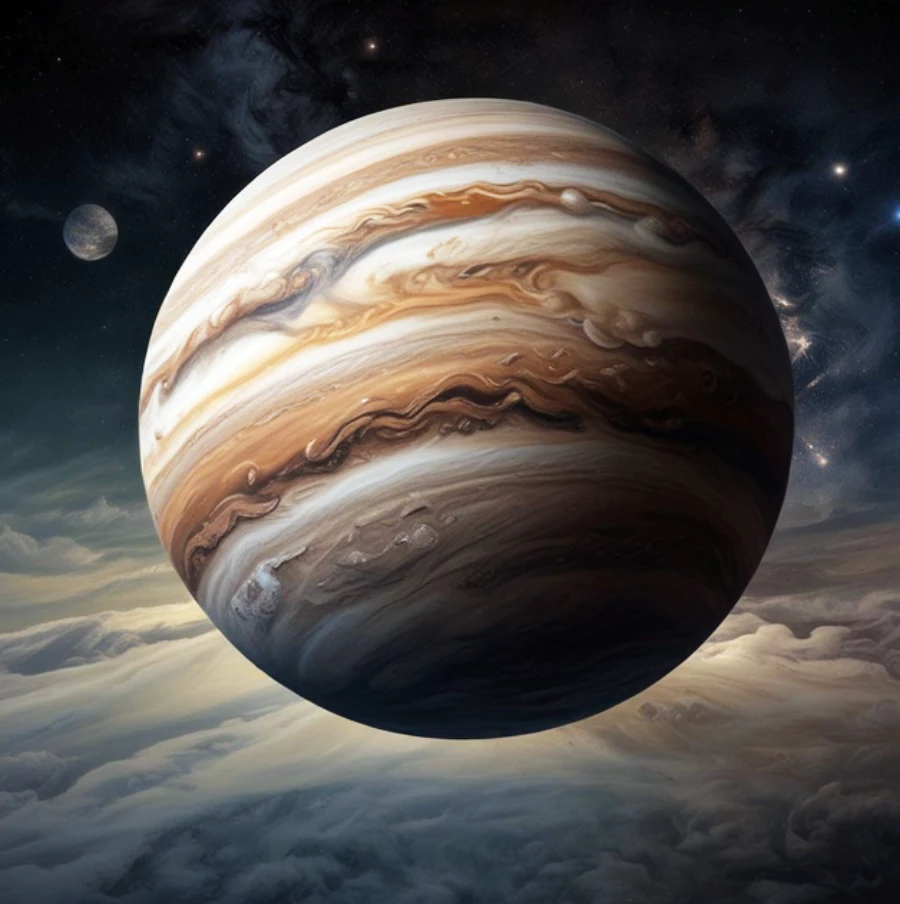
The Giant That Outweighs Everything Else Combined
To grasp the scale of Jupiter, it helps to stop thinking of it as just a large planet and start viewing it as the gravitational anchor of our entire solar system.
Jupiter is so colossal that it contains more than twice the combined mass of every other planet, dwarf planet, asteroid, and comet orbiting the Sun. If you were to hollow out Jupiter like a beach ball, you could pack roughly 1,300 Earths inside it.
Here is how Jupiter breaks down in sheer numbers compared to our home world:
- Mean Radius: 43,440 miles (69,911 km) — over 11 times wider than Earth.
- Surface Area: 23.7 billion square miles — roughly 120 times Earth’s total surface.
- Mass: 1.898 × 10²⁷ kg — 318 times more massive than Earth.
- Equatorial Circumference: 272,946 miles (439,264 km) — a trip around Jupiter’s equator equals 11 journeys around Earth.
Failed Star or Successful Planet?
Because Jupiter is composed almost entirely of hydrogen and helium—the exact same elements that power the Sun—a common myth suggests that Jupiter is a “failed star.”
While the composition matches, Jupiter falls drastically short in weight class. To ignite nuclear fusion at its core and become a red dwarf star, Jupiter would need to absorb roughly 75 to 80 times its current mass.
However, its immense gravity does exert a powerful force on its surroundings. Jupiter’s gravitational footprint is large enough that its center of mass with the Sun (the barycenter) actually lies roughly 30,000 miles above the solar surface. It is the only planet in the system that doesn’t strictly orbit the center of the Sun itself.
The Great Red Spot: A Storm Larger Than Earth
Jupiter’s atmosphere is a chaotic canvas of ammonia ice clouds, dark belts, and high-pressure zones driven by internal heat. The defining feature of this atmospheric chaos is the Great Red Spot, an anticyclonic storm that has been raging for at least 350 years.
At its peak in the late 19th century, astronomers measured the storm at roughly 25,000 miles wide—large enough to swallow three Earths side-by-side. While recent data from NASA’s Juno spacecraft shows the storm is shrinking and changing shape, it still measures about 10,000 miles across, easily fitting our entire planet inside its turbulent winds.
A Planetary Shield for the Inner Worlds
Jupiter’s immense size carries heavy consequences for the rest of the solar system. Actively sweeping through space with its deep gravitational well, Jupiter alters the paths of incoming comets and asteroids.
Scientists long debated whether Jupiter acts as a cosmic shield—absorbing or deflecting icy impactors that might otherwise hit Earth—or if its gravity occasionally flings dangerous debris toward the inner terrestrial worlds. Modern computer simulations show it does a mix of both, fundamentally shaping the orbital safety of our planet over billions of years.
Data Sources & Further Reading
- NASA Juno Mission: Deep Atmosphere and Gravity Measurements
- Journal of Geophysical Research: Planetary Atmospheres and Dynamics
- Harvard-Smithsonian Center for Astrophysics: Solar System Barycenter Calculations