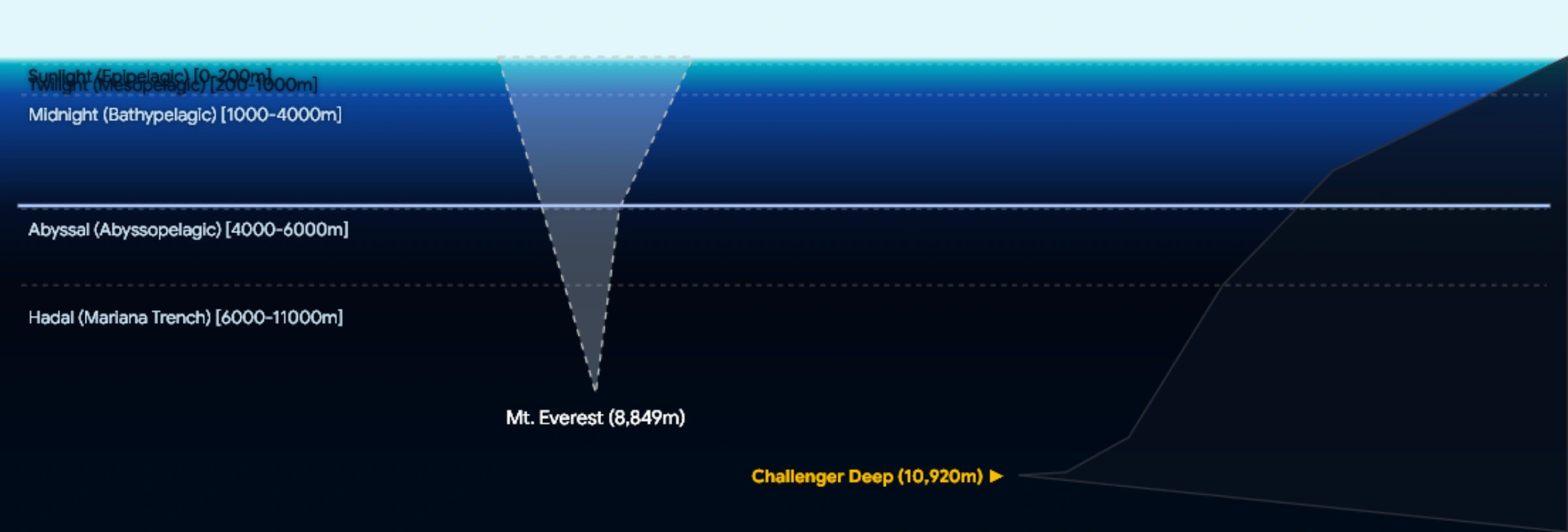
Plunging Almost Eight Miles Beneath the Pacific Wave Tops
Hydrographic soundings and deep-sea bathymetric mapping confirm that the most sunken feature on the planet sits hidden within the Western Pacific Ocean. Known as Challenger Deep, this abyssal chasm forms the southernmost valley of the Mariana Trench, descending roughly 35,814 feet (10,916 meters) below the surface.
If you detached Mount Everest from the Himalayas and dropped it into this underwater canyon, more than a mile of open ocean would still sit above its summit.
| Depth Comparison Metric | Physical Measurement |
| Challenger Deep Maximum Depth | ~35,814 ft / 10,916 m |
| Mount Everest Summit Elevation | 29,031 ft / 8,848 m |
| Average Depth of Global Oceans | ~12,100 ft / 3,688 m |
| Hydrostatic Pressure at Floor | ~1,086 bar (15,750 psi) |
The Tectonic Collision That Carved the Canyon
Extremely deep ocean trenches do not occur by chance. Challenger Deep owes its existence to a colossal geological process known as subduction.
Along the western rim of the Pacific, two massive tectonic plates—the older, denser Pacific Plate and the smaller Mariana Plate—collide head-on. As the Pacific Plate grinds westward, its immense weight causes it to dive steeply beneath the Mariana Plate, bending the ocean floor downward to form an extreme, V-shaped subduction trough.
Surviving Atmospheric Pressure Equivalent to 1,000 Times Sea Level
Descending into the abyssal depths introduces physical environmental conditions that instantly destroy standard underwater machinery.
At the floor of Challenger Deep:
- Crushing Water Column Weight: The water exerts over 8 tons of pressure per square inch. That equals having the weight of an elephant concentrated on the area of a thumb.
- Freezing Thermal Baselines: Temperatures hover constantly between 34°F and 39°F (1°C to 4°C), kept slightly above absolute freezing by thermal venting from nearby subduction zones.
- Absolute Light Deprivation: Sunlight is entirely absorbed within the top 3,200 feet (1,000 meters) of the ocean column, leaving the floor in permanent darkness.
The Unexpected Ecology of the Hadal Zone
For decades, oceanographers theorized that the Hadal zone (depths exceeding 20,000 feet) was a desolate, lifeless desert due to intense pressure and zero sunlight. High-resolution submersibles and remote landers proved those theories wrong.
Organisms at the bottom of Challenger Deep rely on “marine snow”—a continuous drift of organic debris falling from the upper water column—or chemosynthetic bacteria that break down minerals emitted by seafloor vents. Specialized life forms documented at the floor include:
- Giant Amphipods: Crustaceans related to sand fleas that grow up to 13 inches long—many times larger than their shallow-water relatives—due to deep-sea gigantism.
- Mariana Snailfish: The deepest known living fish, possessing translucent skin and specialized cellular proteins (trimethylamine N-oxide) that prevent their proteins and cell membranes from collapsing under extreme pressure.
- Xenophyophores: Giant single-celled organisms measuring up to 4 inches across that build complex shells from mineral particles on the sea floor.
Oceanographic Sources & Bathymetric Records
- NOAA Ocean Exploration: Bathymetric Mapping of the Mariana Trench
- Schmidt Ocean Institute: Hadal Zone Submersible Expeditions and Environmental Data
- Deep-Sea Research Journal: Biological Adaptations in Extreme Pressure Environments