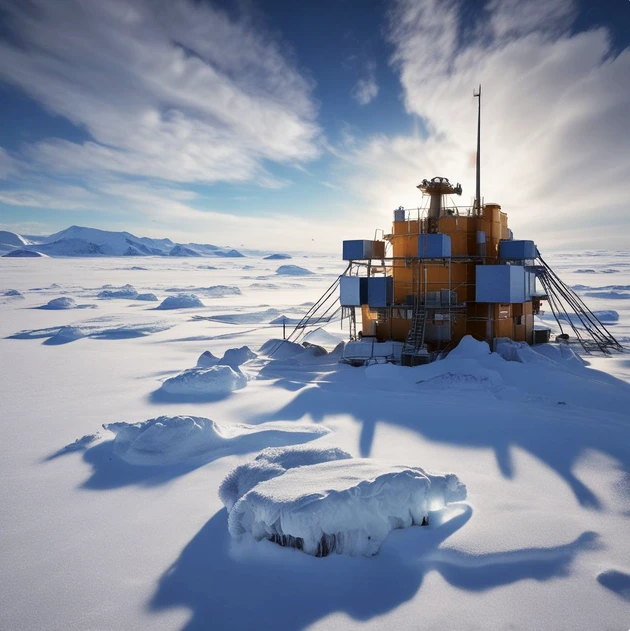
Surpassing the Freezing Point of Dry Ice
Mercury drops to levels on our planet where traditional liquid thermometers fail completely and breathing unprotected air causes internal lung tissue hemorrhaging. While localized mountain peaks and subarctic regions routinely record brutal winter freezes, the absolute coldest places on Earth sit isolated atop the frozen dome of the East Antarctic Ice Sheet.
| Location | Region / Geographic Feature | Measurement Type | Minimum Record Metric | Data Source / Method |
| East Antarctic Plateau | High Ridge (Dome Argus to Dome Fuji) | Surface Skin (Thermal IR) | -144.4°F (-98.0°C) | NASA Landsat 8 / MODIS |
| Vostok Station | Central Antarctica | Air Temperature (Shade 2m) | -128.6°F (-89.2°C) | WMO Ground Thermometer (1983) |
| Oymyakon | Siberia, Russia | Inhabited Town Air Record | -90.0°F (-67.8°C) | Official Weather Station (1933) |
Vostok Station: The Traditional Air Temperature Benchmark
On July 21, 1983, researchers at the Soviet Russian station Vostok logged the lowest official ambient air temperature ever measured directly by a surface thermometer: -128.6°F (-89.2°C).
Located roughly 800 miles from the Geographic South Pole and elevated 11,444 feet (3,488 meters) above sea level, Vostok experiences a punishing combination of high altitude, total solar absence during the polar winter, and extreme distance from warming ocean currents.
The East Antarctic Plateau: Infrared Satellite Discoveries
Deploying high-resolution thermal sensors aboard polar-orbiting satellites allowed scientists to analyze surface conditions across remote Antarctic high points previously inaccessible to physical expedition teams.
Analysis led by the National Snow and Ice Data Center (NSIDC) revealed shallow depressions along a high ridge between Dome Argus and Dome Fuji where snow surface temperatures regularly plunge lower than Vostok’s 1983 mark.
During clear, windless winter nights, satellite sensors registered ground skin temperatures dropping to an astonishing -144°F (-98°C).
The Atmospheric Recipe for Sub-Zero Extremes
Plunging into temperatures capable of freezing carbon dioxide gas directly into dry ice requires three distinct atmospheric conditions occurring simultaneously over several consecutive days:
- Elevation and High Latitude: The Antarctic Plateau sits above 11,000 feet, placing the surface in thin, dry tropospheric air that radiates heat outward toward deep space at elevated speeds.
- Prolonged Polar Darkness: Months without direct solar radiation prevent any thermal replenishment of the ice sheet.
- Persistently Calm, Clear Skies: Cloud layers act as thermal traps. When clouds clear and winds fall completely still, heavy cold air drops into shallow surface hollows, trapping stagnant pockets of air that radiate their remaining heat into the upper atmosphere.
Oymyakon: The Coldest Continuously Inhabited Human Settlement
While Antarctica claims the absolute physical records, humans do not live there permanently. The title for the coldest continuously inhabited place on Earth belongs to the Siberian village of Oymyakon, situated in eastern Russia.
In February 1933, Oymyakon recorded an official temperature of -90°F (-67.8°C).
Approximately 500 residents adapt to these subarctic valley conditions, where municipal heating plants run continuously, vehicle engines are kept idling for hours to prevent liquid fuels and lubricants from solidifying, and the ground remains frozen in thick permafrost layers year-round.
Glaciological Sources & Polar Record Archives
- National Snow and Ice Data Center (NSIDC): Satellite Remote Sensing of Antarctic Surface Temperatures
- World Meteorological Organization (WMO): World Weather & Climate Extremes Committee
- Journal of Geophysical Research: Physical Dynamics of Ultracold Air Depressions on the Antarctic Ice Sheet