Surpassing the Mathematical Ideal of Twenty-Four Bands
Dividing Earth’s 360-degree sphere into equal 15-degree longitudinal wedges yields an intuitive mathematical sum: exactly 24 time zones corresponding to the hours in a solar day. Geopolitical boundaries, national economic priorities, and localized fractional offsets distort this idealized grid entirely.
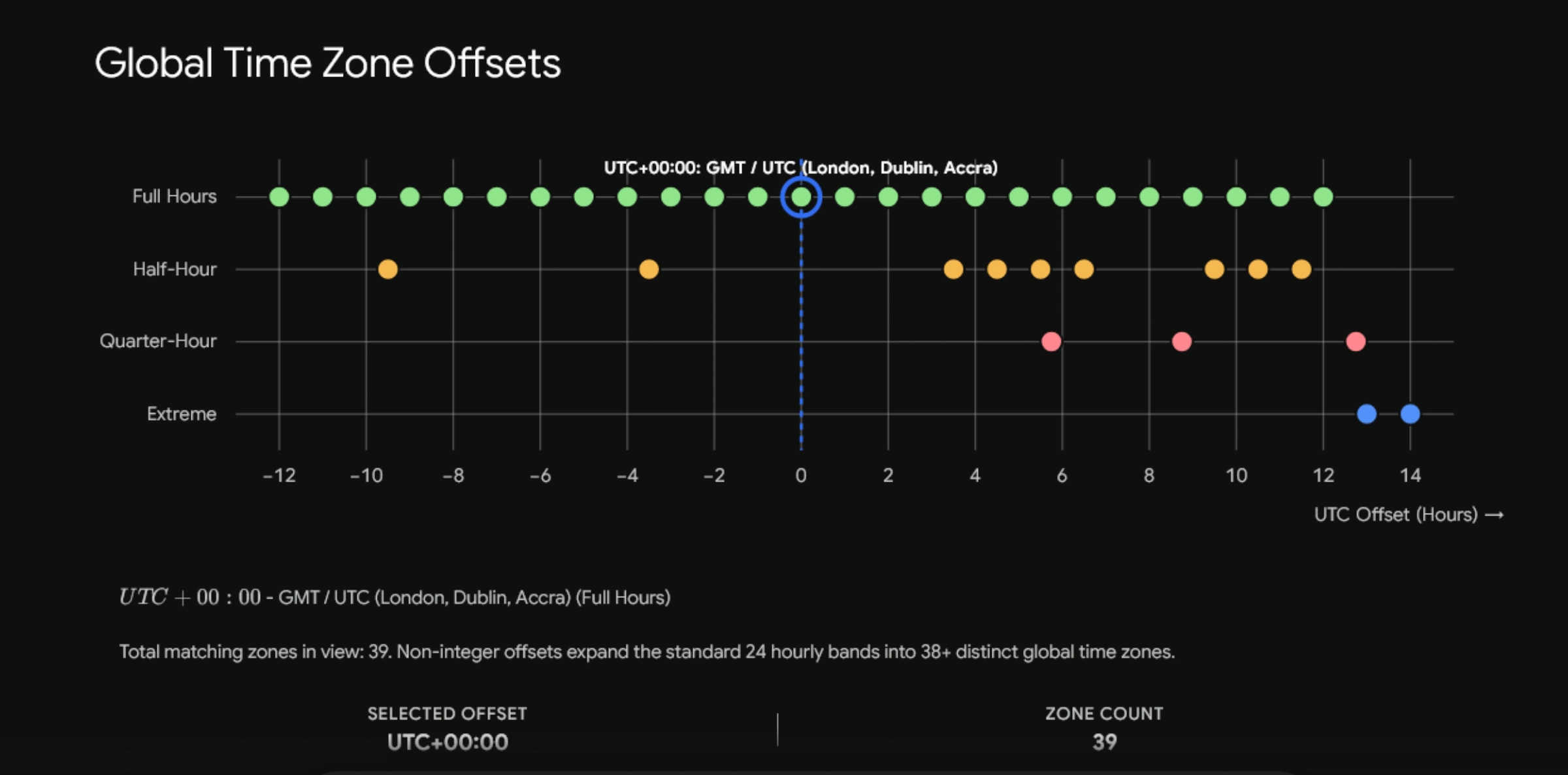
Accounting for all active standardized offsets across international borders reveals that 38 distinct time zones are currently utilized around the globe.
| Time Zone Category | Total Variations | Specific Offset Examples | Primary Regions Represented |
| Standard Hourly Offsets | 25 Zones | UTC-12:00 through UTC+12:00 | USA, Europe, China, Brazil |
| Half-Hour Fractional Offsets | 10 Zones | UTC+03:30, UTC+05:30, UTC+09:30 | India, Iran, Central Australia, Newfoundland |
| Quarter-Hour Fractional Offsets | 3 Zones | UTC+05:45, UTC+08:45, UTC+12:45 | Nepal, Eucla (Australia), Chatham Islands |
| Extreme Eastern Offsets | 2 Zones | UTC+13:00, UTC+14:00 | Kiribati (Line Islands), Samoa |
Coordinated Universal Time (UTC) as the Baseline
Global time tracking relies on Coordinated Universal Time (UTC), a highly precise atomic standard anchored to Prime Meridian longitude in Greenwich, London.
If world nations strictly adhered to geometric solar time, each zone would span exactly 15 degrees of longitude (360 degrees divided by 24 hours). Under this model, moving west subtracts hours while moving east adds hours.
Governments frequently adjust their legal time boundaries to avoid splitting major metropolitan areas, align trade networks with neighboring trade partners, or optimize daylight utilization.
Why Fractional Time Zones Exist
Not every sovereign nation aligns its clocks with full-hour intervals relative to UTC. Ten nations and territories implement 30-minute fractional offsets, while three isolated regions utilize 45-minute fractional offsets:
- India (UTC+05:30): Rather than splitting its vast geographic expanse into two distinct hourly time zones, the Indian government established a single unified national time offset positioned midway between UTC+05:00 and UTC+06:00.
- Nepal (UTC+05:45): To maintain timekeeping distinct from neighboring India and align with the meridian passing through Mount Gaurishankar, Nepal adopted a unique 45-minute offset.
- Newfoundland, Canada (UTC-03:30): This eastern Canadian island province maintains its own half-hour ahead offset relative to neighboring Atlantic Standard Time (UTC-04:00).
The Kiribati Shift: Reaching UTC+14:00
Because the International Date Line traditionally snaked through the central Pacific Ocean, the island nation of Kiribati once found its eastern and western island clusters separated by an entire calendar day.
In 1995, Kiribati unilaterally pushed the International Date Line thousands of miles eastward around its easternmost Line Islands. This adjustment created two unprecedented time zones: UTC+13:00 and UTC+14:00.
As a direct result of this shift, Kiribati’s Line Islands are the very first inhabited landmasses on Earth to welcome each new calendar day and Gregorian New Year.
Which Country Controls the Most Time Zones?
Territorial possessions scatter a single nation’s sovereignty across multiple oceans. Despite spanning a continuous landmass across 11 standard hourly zones within Eurasia, Russia does not hold the world record.
France holds the planetary record for the most time zones under a single nation’s jurisdiction, controlling 12 distinct time zones (13 including its claim in Antarctica). France achieves this total through its far-flung overseas departments and territories, including French Polynesia, Guadeloupe, Réunion, New Caledonia, and French Guiana.
Chronometric Sources & Geographic Standards
- International Earth Rotation and Reference Systems Service (IERS) Standard UTC Protocols
- IANA Time Zone Database (TZDB) Global Geographic Region Roster
- Royal Observatory Greenwich: History and Physics of the Prime Meridian and Date Line