Navigating the Geopolitical Maze of Statehood
Tallying the precise number of nations on Earth appears straightforward until you examine the complex criteria defining modern sovereignty. Depending on whether you consult the United Nations, diplomatic observer rosters, or international sports federations, the official total shifts dramatically.
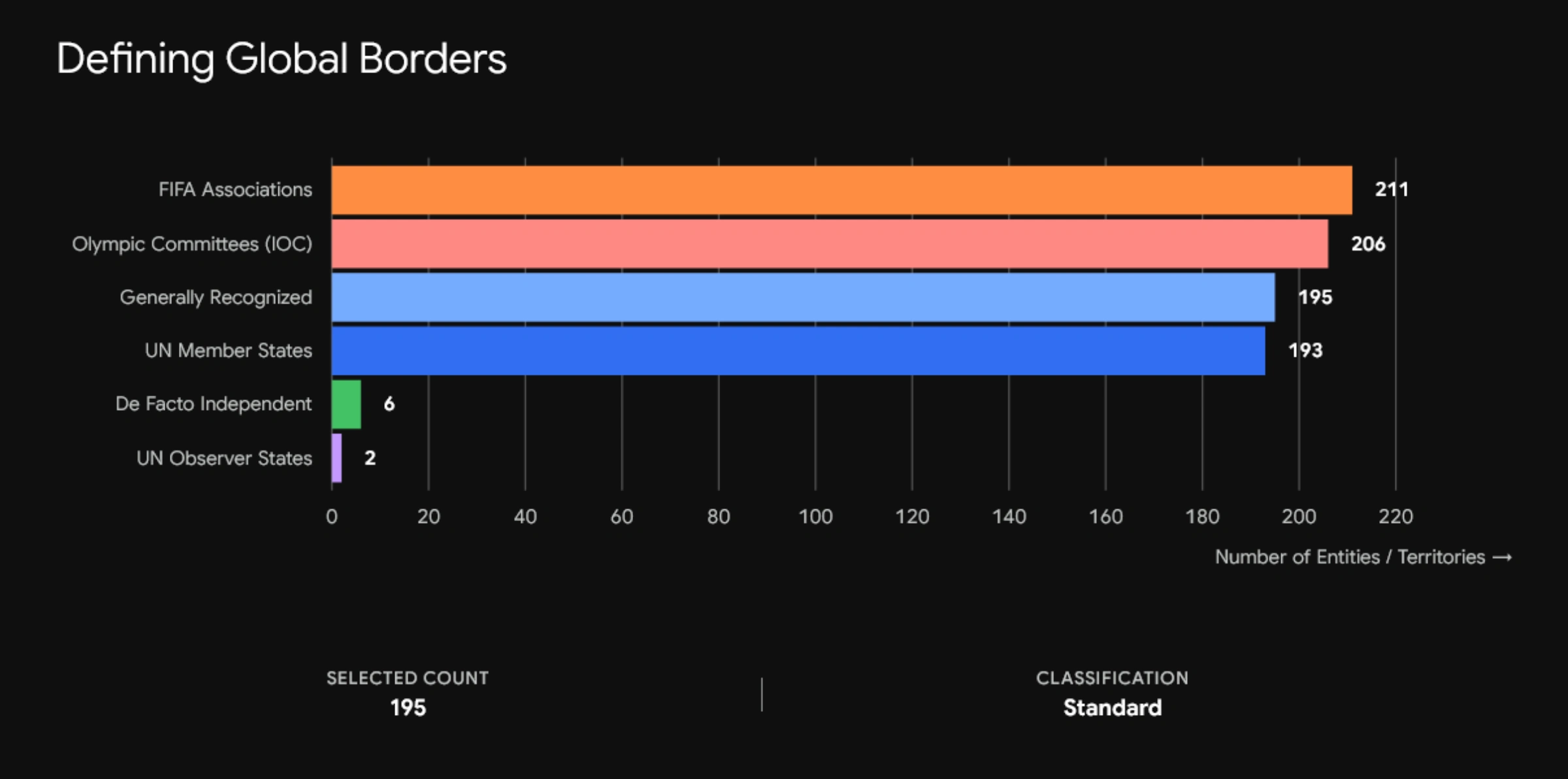
| Recognition Category | Total Count | Key Inclusions & Exclusions | Primary Authority |
| UN Member States | 193 | Full voting members of the General Assembly | United Nations Charter |
| UN Observer States | 2 | Holy See (Vatican City) and State of Palestine | UN General Assembly Resolutions |
| Widely Accepted Standard | 195 | 193 UN Members + 2 Permanent Observers | Global Diplomatic Consensus |
| IOC Olympic Committees | 206 | Includes dependent territories (e.g., Puerto Rico, Guam) | International Olympic Committee |
| FIFA Associations | 211 | Includes constituent nations (e.g., Scotland, Wales) | FIFA Governing Council |
The United Nations Baseline: 193 + 2
Most international law authorities cite 195 as the standard number of independent sovereign states.
This baseline consists of two distinct tiers within the United Nations system:
- 193 Full Member States: Nations with complete voting power and undisputed legal standing under international law, ranging from giant landmasses like Canada and China to microstates like Nauru and Tuvalu.
- 2 Permanent Observer States: Vatican City (Holy See) and the State of Palestine. Both hold official UN observer status, granting them access to proceedings without voting privileges.
Sovereignty requires more than declaring independence; it demands reciprocal recognition from other sovereign governments. Under the Montevideo Convention on the Rights and Duties of States, a legitimate country must possess a permanent population, a defined territory, a functioning government, and the capacity to enter into relations with other states.
The Complexity of Limited Recognition
Discrepancies arise when territories function as fully independent nations in practice (de facto statehood) but lack widespread diplomatic recognition (de jure statehood).
- Taiwan (Republic of China): Operates its own government, military, currency, and democratic elections while maintaining global trade relationships. However, due to diplomatic pressure from Beijing, it is not a member of the UN and maintains official diplomatic ties with only a dozen nations.
- Kosovo: Declared independence from Serbia in 2008 and holds recognition from over 100 UN member states, yet lacks full UN membership due to veto threats from permanent Security Council members.
- Somaliland: Has maintained its own stable government, currency, and border controls in the Horn of Africa since 1991, but receives no formal international recognition from any UN member state.
Why Sports Governing Bodies Count Differently
Global sporting organizations frequently report higher country counts because their entry criteria focus on regional governing bodies rather than legal statehood.
The International Olympic Committee (IOC) recognizes 206 National Olympic Committees. This figure includes independent nations alongside self-governing territories like Puerto Rico, Bermuda, and American Samoa, which compete under their own flags.
Similarly, FIFA includes 211 national associations. FIFA permits individual constituent countries of a single sovereign state to compete separately—which is why the United Kingdom competes as four distinct entities: England, Scotland, Wales, and Northern Ireland.
Diplomatic Sources & International Law References
- United Nations Member States & Permanent Observer Roster (UN Protocol and Liaison Service)
- Montevideo Convention on the Rights and Duties of States (1933 International Law Digest)
- International Olympic Committee (IOC) & FIFA Official Membership Directories