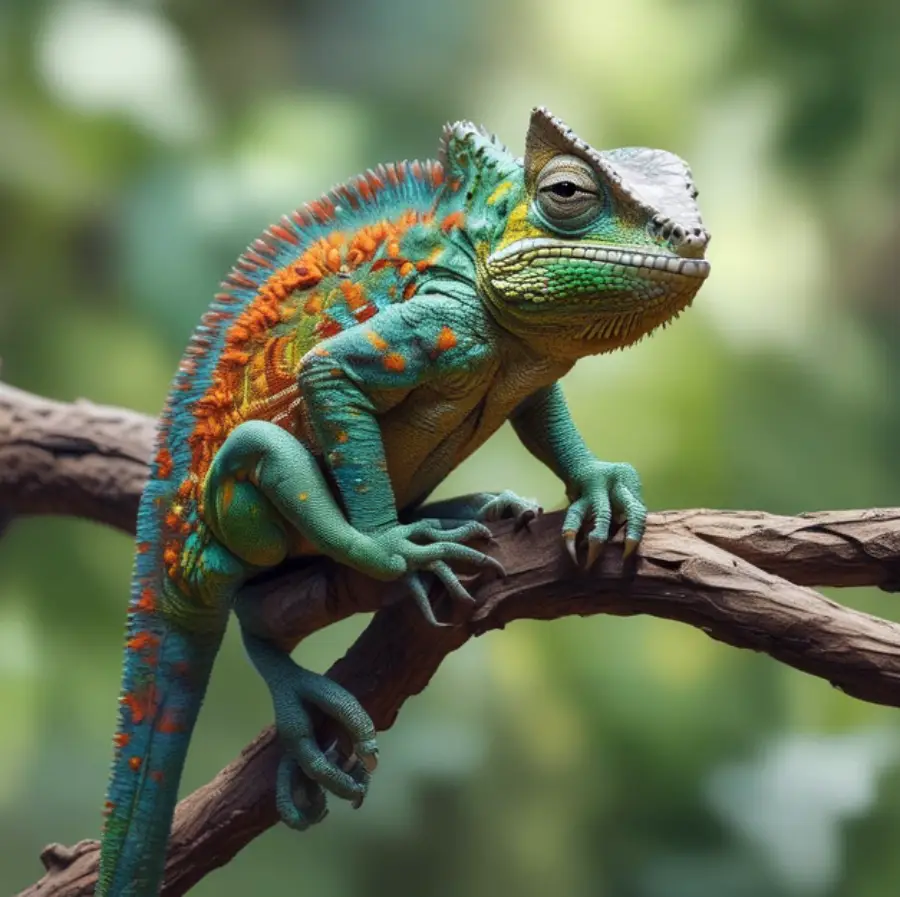
When people talk about animals that can do incredible things, cheetahs and peregrine falcons usually get most of the attention. But there’s another animal with a pretty amazing trick that often gets overlooked: the chameleon. It may move slowly, but its body has adapted in some surprisingly clever ways that make it one of the more fascinating reptiles around.
While many know chameleons for their camouflage, their true superpower lies in their mouth. A chameleon’s tongue can stretch to nearly double the total length of its body—reaching speeds from 0 to 60 mph in just a hundredth of a second. But how does an animal move a biological structure so quickly, and what keeps it from injuring itself in the process?
The Physics and Anatomy of a High-Speed Tongue

For a long time, scientists believed chameleons simply forced blood into their tongue tissue to inflate and propel it forward. Modern high-speed imaging revealed a much more sophisticated mechanism resembling a crossbow or a catapult.
The tongue mechanism relies on three distinct anatomical components:
- The Hyoid Bone: A rigid structure at the base of the mouth that acts as the launching pad.
- Accelerator Muscles: Ring-shaped muscles that tightly coil around the hyoid bone, storing elastic energy.
- Telescoping Collagen Tissues: Spring-like sheaths layered between the muscle and the bone that release stored energy instantaneously.
Instead of relying solely on muscle contraction at the moment of the strike, the chameleon pre-loads energy into these elastic collagen sheaths prior to hunting. When a prey item comes into range, the muscle slips off the bone, releasing the stored energy all at once—similar to pulling back a bowstring and letting go.
Smaller Species, Faster Tongues
An intriguing discovery in reptile biology is that larger chameleon species do not hold the record for the fastest or longest tongue relative to their size. Research published by Brown University shows that smaller species—such as Rhampholeon spinosus (the rosette-nosed pygmy chameleon)—produce far greater tongue acceleration and length ratio than their larger relatives.
Because smaller reptiles have a higher metabolic rate relative to their body mass, they require more efficient hunting tools to survive. A tiny chameleon’s tongue can accelerate at over 2,500 m/s², launching outward at up to 2.5 times its snout-to-vent body length.
How the Prey Actually Sticks
Launching a tongue at high speed solves only half the problem; capturing a heavy or struggling insect without dropping it is the second challenge. For years, researchers debated whether the chameleon used suction, interlocking surface structures, or sticky mucus.
A joint study by French and Belgian researchers demonstrated that chameleon saliva is extraordinarily viscous. The mucus on the tip of a chameleon’s tongue is roughly 400 times thicker than human saliva. Upon impact, the tip of the tongue deforms around the insect, maximizing the surface contact area while the super-sticky fluid creates a powerful adhesive seal.
Evolutionary Advantages of a Long Range Attack
Being slow-moving creatures, chameleons cannot run down grasshoppers or crickets. Moving through tree branches alerts both potential prey and nearby predators. By evolving an elastic, long-range ballistic tongue, the chameleon eliminates the need to move close to its target, securing nourishment while remaining perfectly still and camouflaged.
References & Scientific Reading
- Brown University Research on Chameleon Acceleration (Biology Letters Journal)
- Nature Communications: Viscous adhesion in chameleon prey capture mechanisms
- National Geographic Animal Encyclopedia: Chameleon Adaptations