
Distinguishing Native Demographics from Global Second-Language Reach
Evaluating global language scale produces two drastically different leaderboards depending on whether you count only native first-language ($L1$) speakers or include total native plus non-native ($L2$) speakers. While Mandarin Chinese dominates the native-born demographic worldwide, English holds the definitive record as the most spoken language globally by total speakers.
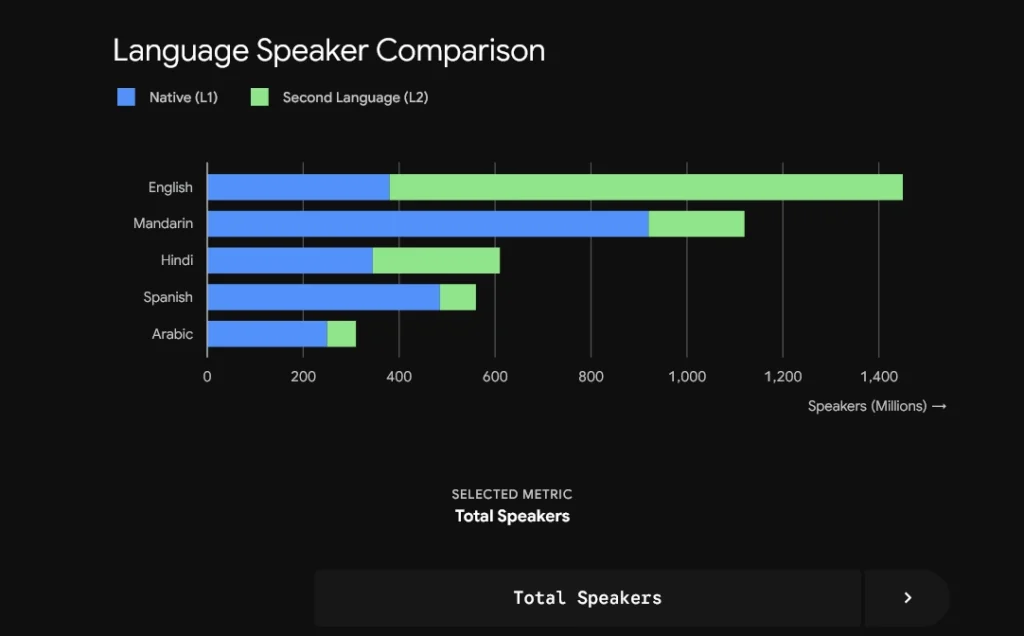
| Language Family | Primary World Regions | Native Speakers (L1) | Second-Language (L2) | Total Global Speakers |
| English | Global / International | ~380 Million | ~1.07 Billion | ~1.45 Billion |
| Mandarin Chinese | East Asia (China, Singapore) | ~920 Million | ~200 Million | ~1.12 Billion |
| Hindi | South Asia (India) | ~345 Million | ~265 Million | ~610 Million |
| Spanish | Americas, Spain | ~485 Million | ~75 Million | ~560 Million |
| Standard Arabic | Middle East, North Africa | ~270 Million | ~40 Million | ~310 Million |
English as the Modern Global Lingua Franca
Driven by historical trade expansion, international diplomacy standards, aviation controls, scientific publishing, and global digital networks, English functions as the planet’s primary bridge language.
Unlike regional languages where growth depends on population demographics, English relies heavily on second-language acquisition:
- Second-Language Ratio: Roughly 73% of all English speakers are non-native ($L2$), learning it as an additional language for international business, education, or web technology.
- Polycentric Spheres: English serves as an official language in over 60 sovereign nations, facilitating cross-border communication across multilingual hubs like India, Nigeria, and Singapore.
Mandarin Chinese: The Native Demographic Titan
Shifting the evaluation criteria exclusively to native ($L1$) speakers places Mandarin Chinese far ahead of all other tongues.
With roughly 920 million native speakers, Mandarin boasts more than double the native population of English (~380 million) or Spanish (~485 million).
- Dialectical Standardization: Mandarin (Putonghua) serves as the official standardized national language of China, uniting diverse regional Sinitic branches such as Wu, Yue (Cantonese), and Min under a unified written logographic character system.
- Concentrated Geography: Unlike the globally dispersed English-speaking footprint, the overwhelming majority of native Mandarin speakers reside within China, Taiwan, and Southeast Asian diaspora communities.
Hindi and Spanish: Emerging Demographic Clusters
Following English and Mandarin, Hindi ranks as the third most spoken language by total speakers (~610 million), benefiting from massive multilingual populations across India who utilize Hindi alongside regional state languages.
Conversely, Spanish holds the second-largest native speaker base globally (~485 million), anchored by high demographic growth throughout Central and South America.
Linguistic Data & Demographic Archives
- Ethnologue: Languages of the World (Global Speaker Demographics Database)
- UNESCO Atlas of the World’s Languages in Danger and Language Statistics
- Cambridge University Press: The Evolution of Global English as an L2 Lingua Franca