
Why One Small European Country Speaks Four Completely Different Languages
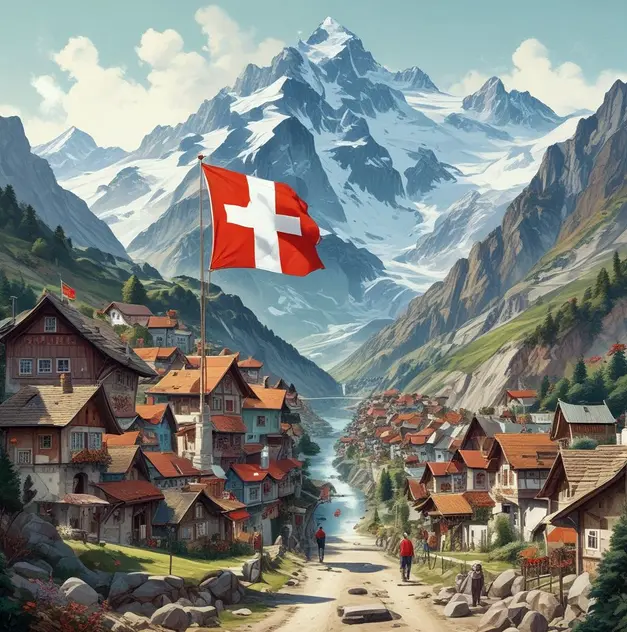
Which European country is divided into four main linguistic regions?
Switzerland doesn't get nearly enough credit for how unusual its internal setup actually is. Most countries build their national identity around a shared language. Switzerland looked at that idea and essentially said, we'll pass — and somehow it's worked for centuries.
The country is split into four linguistic regions, each tied to a different part of its borders and its history. German is the big one, spoken by roughly two-thirds of the population, concentrated mainly in the north, center, and east — cities like Zurich, Bern, and Basel operate primarily in Swiss German, which itself is a spoken dialect distinct enough from Standard German that even German tourists sometimes struggle to follow casual conversation. French dominates the western part of the country, in what's often called Romandy, home to Geneva and Lausanne, where the language and cultural rhythm feel noticeably closer to France than to Zurich. Italian holds the south, particularly the canton of Ticino, bordering Italy, with a Mediterranean pace of life that feels like a different country entirely compared to the Alpine north. And then there's Romansh, the quiet fourth language, spoken by a small population in the canton of Graubünden, descended from Vulgar Latin and one of the last surviving remnants of the languages that once spread across the Roman Empire's northern frontier.
What makes this arrangement remarkable isn't just that four languages exist within one country — plenty of countries have linguistic minorities. It's that all four are officially recognized at the national level, with German, French, and Italian carrying full official status in federal government, and Romansh holding a partial official status, used specifically when communicating with Romansh speakers. Government documents, road signs, and even currency reflect this multilingual reality. Swiss franc banknotes carry text in multiple languages, and federal law requires certain communications to be available across all four.
This didn't happen by accident. Switzerland's structure as a confederation of cantons, each with significant autonomy, allowed different linguistic communities to essentially govern themselves locally while still participating in a shared federal system. Rather than forcing one dominant culture onto the whole country, the Swiss model let each region maintain its own language, customs, and even legal nuances, while cooperating on defense, currency, and foreign policy at the national level. It's part of why Swiss identity is often described as more about shared institutions and values than about a shared language or ethnicity.
Daily life reflects the divide in small but telling ways. Move from Zurich to Geneva and you're not just changing scenery, you're switching the language people expect you to greet them in, the school curriculum children study under, and even the accent of French or German-language television you'll find on local channels. Swiss students typically learn at least one other national language in school, alongside English, partly out of practicality and partly as a way of keeping the country's internal communication functioning smoothly.
Romansh remains the most fragile of the four, spoken by less than one percent of the population and facing the slow erosion that many minority languages deal with as younger generations shift toward German for practical reasons. Yet its official status persists, treated less as a functional necessity and more as a deliberate act of cultural preservation — a small but symbolic reminder that in Switzerland, being outnumbered doesn't mean being erased.
It's a strange kind of national glue: four languages, four cultural temperaments, one passport. Somehow it holds.