Visual IQ Test: 10 Picture Matrix and Odd One Out Puzzles
This visual IQ test uses pictures instead of words, with 3 by 3 grids where one cell is missing, odd one out figures, turning arrows, colored stars and dot puzzles, in the style of the famous Raven's Progressive Matrices created by John C. Raven, a student of Charles Spearman. It is a fun practice set, not an official test. Ten picture questions.
Start Visual IQ Test
🎯 Daily Trivia Challenge • 🧠 10 Questions • ⏱️ 90 Seconds
Matrix
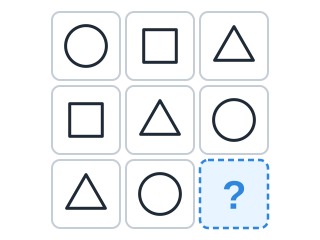
Each row and each column contains a circle, a square and a triangle. Which shape is missing?
Matrix
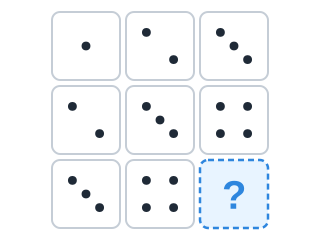
How many dots belong in the empty cell?
Odd one out
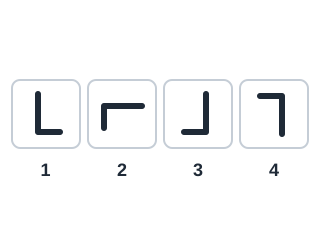
Three of these figures are the same shape turned around. Which figure is different?
Matrix
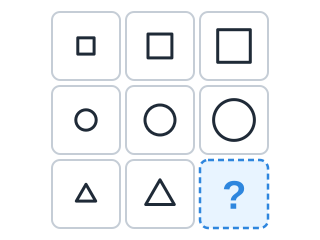
Each row shows a shape getting bigger. What belongs in the empty cell?
Matrix
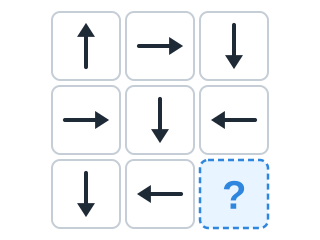
The arrows follow a turning rule. Which arrow is missing?
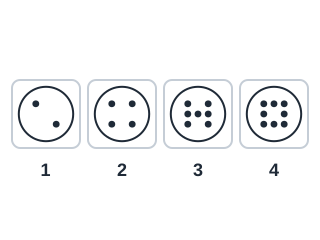
Odd one out
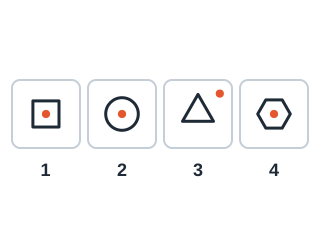
Which figure is the odd one out?
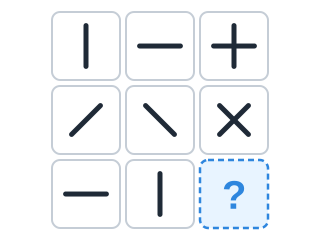
Matrix
In each row, the third picture combines the first two. What belongs in the empty cell?
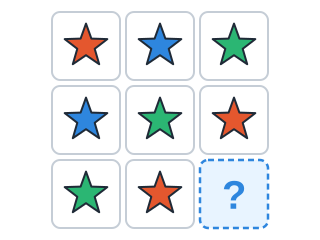
Matrix
Each row and each column has one red, one blue and one green star. Which star is missing?
Odd one out
Which figure is different from the others?
Matrix
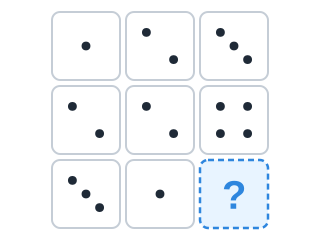
In each row, the dots in the first two cells add up to the dots in the third. How many dots are missing?
Your score
0/10
Scroll down to see the explanation for each question.
Explanations: answer key for all 10 questions
- Q1: Each row and each column contains a circle, a square and a triangle. Which shape is missing?
Answer: A square
The bottom row already has a triangle and a circle, and the right-hand column already has a triangle and a circle. The only shape left is a square.
- Q2: How many dots belong in the empty cell?
Answer: Five dots
Each row adds one dot from left to right, and each new row starts one dot higher. The bottom row reads 3, 4 and then 5.
- Q3: Three of these figures are the same shape turned around. Which figure is different?
Answer: Figure 3
Figures 1, 2 and 4 are the same L shape rotated. Figure 3 is a mirror image, which cannot be made by turning the L shape on a flat surface.
- Q4: Each row shows a shape getting bigger. What belongs in the empty cell?
Answer: A large triangle
Every row goes small, medium and large, and the bottom row uses triangles. So the missing picture is a large triangle.
- Q5: The arrows follow a turning rule. Which arrow is missing?
Answer: An arrow pointing up
Each arrow turns a quarter turn clockwise from the one on its left, and each row starts one quarter turn later. After down and left comes up.
- Q6: Which figure is the odd one out?
Answer: Figure 3
The figures hold 2, 4, 7 and 8 dots. Figure 3 is the only one with an odd number of dots, so it does not belong.
- Q7: In each row, the third picture combines the first two. What belongs in the empty cell?
Answer: A plus sign
The first two pictures in each row are laid on top of each other to make the third. A horizontal line plus a vertical line makes a plus sign.
- Q8: Each row and each column has one red, one blue and one green star. Which star is missing?
Answer: A blue star
The bottom row already has green and red, and the right-hand column already has green and red. The missing star must be blue.
- Q9: Which figure is different from the others?
Answer: Figure 3
In figures 1, 2 and 4, the red dot is inside the shape. In figure 3, the dot sits outside the triangle.
- Q10: In each row, the dots in the first two cells add up to the dots in the third. How many dots are missing?
Answer: Four dots
The rows read 1 plus 2 equals 3 and 2 plus 2 equals 4. In the bottom row, 3 plus 1 equals 4 dots.
Visual IQ Test – Reasoning With Pictures
A visual reasoning test uses shapes, colors and patterns instead of words or numbers. Each puzzle hides a rule, and your task is to find the rule and use it to fill a gap or spot the odd one out. Because no reading is needed, picture puzzles are popular all over the world and can be tried by people of almost any age or language.
The best-known puzzles of this kind are matrix puzzles. A 3 by 3 grid shows eight pictures and one empty cell. The pictures change across each row and down each column, often following two rules at once. The British psychologist John C. Raven made this format famous in 1938 with Raven's Progressive Matrices. Raven had studied under Charles Spearman, who proposed the idea of a general thinking ability.
Common rules include shapes that appear once in every row and column, objects that grow or turn, dots that add up and pictures that combine. Odd one out puzzles add another twist: three figures share a hidden feature, and one does not. Mirror images are a favorite trap, because a flipped shape can look almost identical to a turned one.
A helpful method is to describe each picture in words, then compare rows and columns one feature at a time. If you find a rule, check it on every row before choosing an answer.
Remember that this page is a set of practice puzzles, not a measured test. Real assessments are given by trained professionals under controlled conditions, and no online quiz can measure intelligence.
Practicing visual puzzles sharpens attention to detail, strengthens patience and makes pattern questions in school and job tests feel much more familiar.
What This Quiz Teaches
This quiz is perfect for puzzle lovers, students and visual thinkers.
- How 3 by 3 matrix puzzles work
- Rows and columns with one of each shape
- Growing, turning and combining pictures
- Spotting mirror images
- Odd one out with hidden features
- John C. Raven and his matrices
Quick Facts About Visual Reasoning Puzzles
- Raven's Progressive Matrices first appeared in 1938.
- Colored versions of the matrices were later made for children.
- Picture puzzles are often called nonverbal reasoning.
- Nonverbal reasoning is part of some school entrance exams.
- A mirror image cannot be made by simply turning a flat shape.
- Many puzzle apps use matrix-style questions.
Related Quizzes
Ready for another round?
Jump to a random quiz from the archive.