
Two Completely Different Survival Bets Animals Make Every Winter
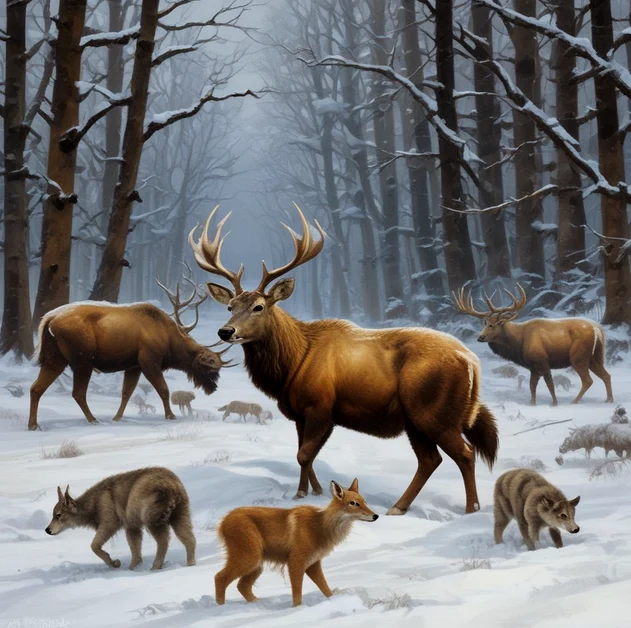
Winter Poses the Same Problem, But Not the Same Solution
Every animal living in a region with cold winters faces the same basic threat, dropping temperatures and disappearing food sources make survival considerably harder for months at a stretch. What's genuinely interesting is how differently various species have evolved to handle that shared problem. Some shut their bodies down almost entirely and wait the season out. Others simply leave, traveling enormous distances to reach warmer, more resource-rich environments. Both strategies solve the same underlying issue, but they represent fundamentally different evolutionary bets, shaped heavily by an animal's specific biology, size, and metabolic needs.
Hibernation: Betting Everything on Staying Put
Hibernation is essentially a controlled, dramatic slowdown of an animal's entire metabolism, allowing it to survive for extended periods without eating, drinking, or being meaningfully active. During true hibernation, body temperature drops significantly, heart rate slows dramatically, sometimes to just a handful of beats per minute, and overall metabolic activity decreases enough that an animal can survive for months relying purely on fat reserves built up before winter began. Ground squirrels, some species of bats, and groundhogs are commonly cited examples of animals that undergo this kind of deep, extended metabolic shutdown, entering a state so physiologically different from normal activity that waking a true hibernator prematurely can actually be dangerous, since the process of returning to normal body temperature and metabolic function requires the animal's body to burn through a significant portion of its remaining energy reserves.
Why Hibernation Works Better for Certain Body Types
Hibernation tends to be a more viable strategy for smaller animals with the physiological capacity to dramatically lower their body temperature and metabolic rate without causing lasting damage. Smaller mammals generally lose heat faster relative to their body size than larger animals do, making sustained activity through a cold winter considerably more energy-expensive for them proportionally, which makes the alternative, essentially powering down entirely, a more efficient survival strategy. Building up sufficient fat reserves before winter becomes critical for these animals, many spend the weeks leading up to hibernation eating far more intensively than usual specifically to store enough energy to survive an extended period of near-total inactivity.
Migration: Betting Everything on Distance
Migration takes a completely different approach to the same underlying problem, rather than adapting the body to endure harsh conditions in place, migratory animals simply relocate entirely, traveling to regions where food remains available and temperatures stay survivable throughout the winter months. Birds are the most commonly recognized migratory animals, with some species traveling truly extraordinary distances, the Arctic tern, for example, makes an annual round-trip migration between the Arctic and Antarctic regions, covering a distance that can exceed 70,000 kilometers in a single year, one of the longest migratory journeys of any animal on the planet.
Why Migration Works Better for Certain Species
Migration tends to be a more practical strategy for animals capable of covering significant distances relatively efficiently, generally species with strong flight capability or, in some cases, the physical endurance for extended overland or aquatic travel. Birds are particularly well suited to migration because flight allows them to cover enormous distances using considerably less relative energy than land-based travel would require, making long-distance seasonal relocation a genuinely efficient survival strategy rather than an exhausting, energy-draining ordeal. Certain land mammals, like caribou, and some marine animals, including various whale species, also undertake substantial seasonal migrations, though generally over shorter distances or through different mechanisms than the long-range flights typical of migratory birds.
Navigation: How Migrating Animals Actually Find Their Way
One of the more genuinely remarkable aspects of migration involves how animals manage to navigate such enormous distances accurately, often returning to the exact same specific breeding or feeding locations year after year. Research suggests migratory animals rely on a combination of navigational tools, including the position of the sun and stars, Earth's magnetic field, which many species appear able to sense directly, and, in some cases, learned landmarks or environmental cues picked up through experience or, in certain species, passed down through social learning from older, more experienced individuals within a group.
A Middle Ground: Torpor Instead of Full Hibernation
Not every winter survival strategy falls neatly into either the full hibernation or full migration category, some animals rely on a less extreme adaptation called torpor, a shorter-term, less dramatic reduction in metabolic rate and body temperature compared to true hibernation, sometimes lasting just hours or a single day rather than an entire season. Certain birds and small mammals use torpor specifically to survive particularly cold nights or brief periods of food scarcity, dropping their metabolic rate temporarily before returning to normal activity once conditions improve, essentially a scaled-down, more flexible version of the same underlying survival principle behind full hibernation.
Why Neither Strategy Is Objectively "Better"
It's tempting to think of hibernation and migration as competing survival strategies, one somehow more effective or advanced than the other, but evolutionarily speaking, each approach simply represents the best available solution given a specific species' physical capabilities, ecological niche, and evolutionary history. A ground squirrel isn't physically or metabolically equipped to migrate thousands of kilometers the way a bird can, and a small songbird capable of long-distance flight would gain little advantage from attempting to hibernate through a harsh winter rather than simply relocating somewhere warmer. Both strategies persist today specifically because each one continues to work well enough for the particular animals that rely on it, shaped by millions of years of evolutionary pressure specific to each species' unique biology and ecological circumstances.
Two Strategies, One Shared Evolutionary Goal
Hibernation and migration ultimately represent two dramatically different evolutionary answers to an identical seasonal challenge, cold, scarcity, and survival, solved either by physically enduring harsh conditions through an extraordinary metabolic shutdown, or by leaving those conditions behind entirely through often extraordinary feats of long-distance travel. Neither strategy is simpler or more sophisticated than the other, they're both remarkably specific, finely tuned solutions, refined over immense evolutionary timescales, to the same basic, unavoidable problem every animal living through a cold season eventually has to solve one way or another.