
Those Blue Veins in Your Cheese Are Actually Mold, and That's the Whole Point
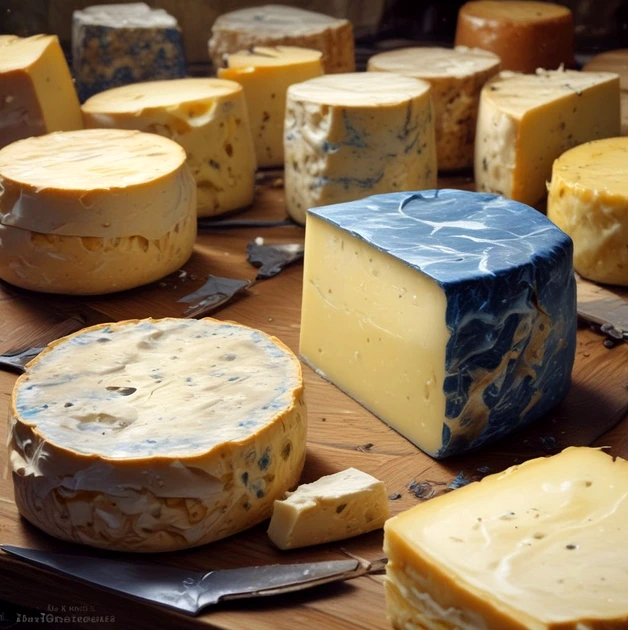
What gives blue cheese its distinctive blue-green veins?
Cut into a wedge of blue cheese and the first thing that stands out is exactly what gives the cheese its name — those streaks and pockets of blue-green running through the pale body of the cheese like something you'd normally associate with spoilage rather than an expensive deli purchase. And in almost any other food context, that instinct would be correct. Blue cheese is one of the rare cases where deliberately cultivated mold isn't a defect, it's the entire point of the product.
The mold responsible for those distinctive veins belongs to the genus Penicillium, specifically strains like Penicillium roqueforti or Penicillium glaucum depending on the specific cheese being made. Yes, that's the same broad family of mold that gave the world penicillin antibiotics, though the specific strains used in cheesemaking are selected and cultivated for very different purposes, chosen over centuries specifically for the flavor and texture they produce rather than any medicinal property.
Cheesemakers don't just hope mold happens to show up naturally, they introduce it deliberately, either by adding mold spores directly into the milk or curds during the early stages of production, or by using tools to pierce the forming cheese with fine needles once it's been shaped, creating small channels that let air reach deep into the interior of the cheese. That air exposure matters enormously, because Penicillium mold requires oxygen to grow and spread, which is exactly why those blue-green veins tend to follow the specific paths created by those needle punctures, branching outward from tiny air pockets rather than growing randomly or uniformly throughout the entire block.
As the mold grows inside the cheese over weeks or months of aging, it breaks down fats and proteins in the surrounding curd through enzymatic activity, and this process is directly responsible for blue cheese's famously sharp, tangy, sometimes almost peppery flavor profile. The mold isn't just sitting there for visual effect, it's actively transforming the cheese's chemistry as it spreads, which is why blue cheese tastes dramatically different from a fresh, unaged cheese made from otherwise similar ingredients. The specific flavor compounds produced during this breakdown process are largely responsible for the pungent, distinctive taste people either love or can't stand, there's rarely much middle ground with blue cheese as a flavor experience.
Different blue cheese varieties end up with noticeably different characteristics depending on the specific mold strain used, the type of milk involved, and the particular aging conditions each cheese undergoes. Roquefort, made in France specifically from sheep's milk and aged in natural limestone caves near the town of Roquefort-sur-Soulzon, has a distinctly different flavor and texture than something like Gorgonzola, made in Italy primarily from cow's milk, or Stilton, produced in England under strict regional guidelines that dictate exactly how and where authentic Stilton can legally be made. Each of these cheeses relies on the same basic mold-driven principle, but centuries of regional tradition, specific environmental conditions, and closely guarded production techniques have pushed them in noticeably different directions.
The aging environment plays a significant role too, particularly humidity and temperature, both of which need to be carefully controlled to encourage the right kind of mold growth while discouraging other, less desirable microorganisms from taking over. Traditional cave aging, still used for cheeses like Roquefort, provides naturally stable humidity and temperature conditions that happen to be close to ideal for Penicillium growth, which is part of why certain regions became historically associated with specific blue cheese varieties long before anyone fully understood the underlying microbiology involved.
There's a reasonable question of food safety buried in all of this too, since most people are taught from a young age that moldy food generally belongs in the trash. Blue cheese mold is considered safe specifically because it's a controlled, intentionally cultivated strain grown under monitored conditions, distinctly different from the unpredictable, potentially harmful molds that develop when food spoils unintentionally outside a controlled environment. Commercial and artisanal blue cheese production follows specific food safety standards precisely because not all mold behaves the same way, and the entire industry exists on the understanding that some strains are not only safe to eat, but genuinely desirable.
They're evidence of a process that's been deliberately guided from the very beginning, air pockets, introduced spores, careful aging, all working together to produce something that looks, to an untrained eye, uncomfortably close to spoilage, but is in reality one of cheesemaking's more sophisticated and intentional achievements.