
This Bird Buries 30,000 Snacks a Year and Somehow Remembers Where
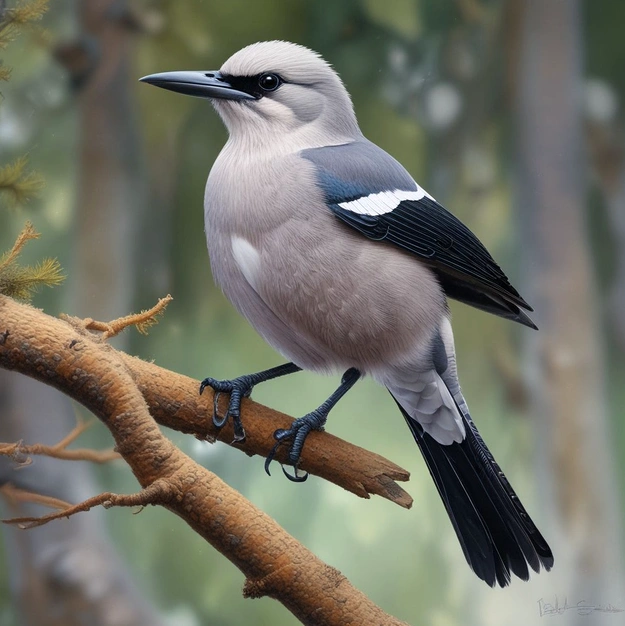
Which bird can remember thousands of locations where it has hidden food?
Somewhere in the mountain forests of the American West, a gray-and-black bird about the size of a crow is quietly performing a memory feat that would humble most humans holding a shopping list. The Clark's Nutcracker spends a few frantic weeks each autumn burying tens of thousands of pine seeds across dozens of square miles of terrain, scattering them individually into thousands of separate hiding spots, and then, months later, buried under snow, with the landscape looking nothing like it did in autumn, the bird goes back and finds an astonishing number of them.
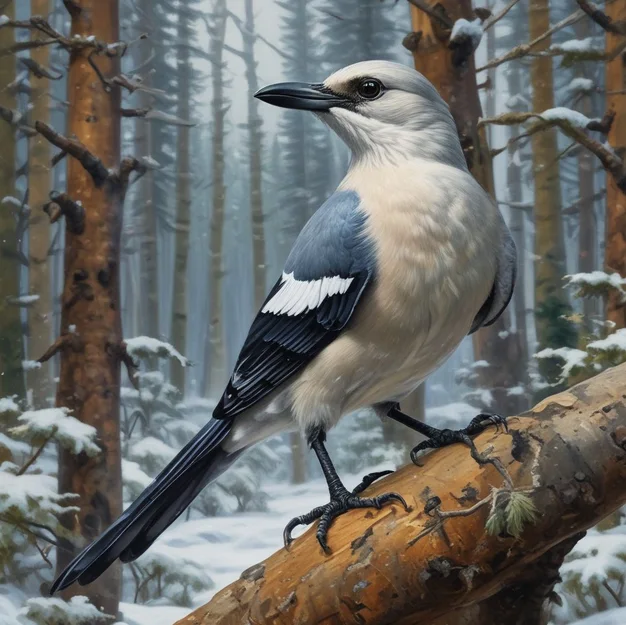
The scale of this behavior is what makes it genuinely remarkable rather than just a mildly interesting bird fact. A single Clark's Nutcracker can cache somewhere in the range of twenty to thirty thousand seeds in a single season, hiding them in small clusters buried a few centimeters underground, spread across a home range that can stretch for many miles in every direction. Unlike squirrels, which often rely heavily on scent to relocate buried food, nutcrackers depend primarily on spatial memory, meaning they're essentially recalling the actual geographic location of thousands of individual hiding spots, months after burying them, often after the entire visual landscape has been buried under feet of snow.
Researchers have spent decades trying to understand exactly how a brain the size of a walnut manages this. The leading explanation centers on how the bird encodes location information at the moment it buries each seed. Rather than relying on a single landmark, nutcrackers appear to use multiple environmental reference points simultaneously, essentially triangulating each cache location relative to several surrounding features, like specific rocks, trees, or slopes, rather than fixating on any one marker that might change or disappear. This layered referencing system seems to make their spatial memory considerably more resilient to environmental changes than it would be if the bird were relying on a single visual cue.
Laboratory studies have reinforced just how specialized this ability actually is. When researchers tested Clark's Nutcrackers against other bird species in controlled memory experiments involving hidden food, the nutcrackers consistently outperformed species that don't rely on cached food to survive, suggesting the skill isn't just generally good bird memory, but a specifically evolved cognitive adaptation shaped by the bird's particular ecological lifestyle. Some studies examining brain structure have found that the hippocampus, the region heavily associated with spatial memory in birds and mammals alike, tends to be notably larger relative to body size in food-caching species like the Clark's Nutcracker compared to closely related birds that don't rely on the same survival strategy.
The evolutionary pressure behind all this is fairly straightforward once you consider where these birds actually live. Clark's Nutcrackers inhabit high-elevation forests, often centered around whitebark pine trees, where food availability swings dramatically between seasons. Winters at altitude can be brutal and prolonged, with the ground frozen and snow-covered for months, making fresh foraging unreliable at best. By caching enormous quantities of seeds during the brief autumn abundance and then retrieving them steadily through winter and into spring, the bird essentially builds itself a distributed pantry system spread across the landscape, one that has to survive not just physically intact underground, but mentally intact inside the bird's memory for months at a stretch.
Which bird can remember thousands of locations where it has hidden food?
Not every cached seed gets recovered, and that turns out to matter for reasons well beyond the bird itself. Seeds the nutcracker forgets or never returns to often end up germinating, and Clark's Nutcrackers are considered one of the primary natural planters of whitebark pine forests across much of their range, since the tree's seeds are heavy and don't disperse well on their own without an animal actively carrying and burying them. In a strange ecological loop, the bird's memory lapses, however rare, end up doing more for forest regeneration than its successful retrievals do, making an imperfect memory system quietly essential to sustaining the very food source the bird depends on.
What makes the whole system so compelling scientifically isn't just the sheer number of locations involved, it's the combination of scale, accuracy, and duration happening simultaneously. Plenty of animals cache food. Very few do it at this volume, across this much terrain, while maintaining functional recall months later under drastically changed environmental conditions. The Clark's Nutcracker isn't just hiding food, it's running a spatial memory system precise enough that researchers still study it today as one of the most impressive examples of non-human memory anywhere in the animal kingdom.