
The Sound of a Punch in a Movie Was Never Actually a Punch
Why are movie sound effects sometimes recorded separately from the actual filming? Watch a well-made action scene and the sound feels seamless, footsteps landing exactly when a boot hits pavement, fabric rustling in perfect sync with a character's movement, a punch connecting with a satisfying, meaty thud that seems to arrive precisely on impact. Almost none of it was actually recorded during filming. Most of what audiences hear as "natural" sound in a finished film was built afterward, in a completely different room, often by someone standing over a pile of props that have nothing obviously in common with what's happening on screen.
This process is called foley, named after Jack Foley, a sound artist working at Universal Studios starting in the late 1920s who pioneered many of the techniques still used today. The core problem foley solves is fairly straightforward once you understand how film production actually works: audio recorded on set during filming is rarely usable for most sound effects, for a whole range of practical reasons that have very little to do with the quality of the original performance.
Production sets are noisy, chaotic environments, filled with camera equipment, crew movement, air conditioning systems, and general ambient noise that makes it extremely difficult to capture clean, isolated sound effects during actual filming. Microphones on set are also typically positioned and calibrated to prioritize capturing dialogue clearly, which means the specific frequencies and details needed for a convincing footstep, punch, or fabric rustle often simply aren't recorded with enough clarity or accuracy to use in a final mix, even when a scene's dialogue turned out perfectly usable.
There's also a more fundamental issue: many sounds needed in a finished film simply don't correspond to anything physically happening on set at all. Actors performing a fight scene are usually not actually striking each other with enough force to generate a realistic-sounding impact, doing so would be dangerous and impractical, meaning whatever sound the actual physical contact produces on set bears little resemblance to what a convincing punch is supposed to sound like in the final film. The same logic applies to countless other sounds, sword clashes, explosions, footsteps on surfaces that don't match the actual studio floor, all requiring effects that have to be constructed separately rather than captured as-is during filming.
This is where foley artists come in, watching the final edited footage carefully and recreating appropriate sounds in perfect synchronization with on-screen action, often using props and techniques that would look bizarre or completely unrelated out of context. Snapping celery convincingly mimics the sound of breaking bones. Coconut shells knocked together have famously stood in for horse hoofbeats since the earliest days of the technique. Leather gloves punched into a piece of raw meat can produce a convincingly visceral fight sound. Walking in specific shoes across trays filled with gravel, sand, or broken glass, recorded in careful sync with an actor's on-screen footsteps, produces footstep sounds tailored precisely to whatever surface a character appears to be walking across, regardless of what the actual soundstage floor was made of during filming.
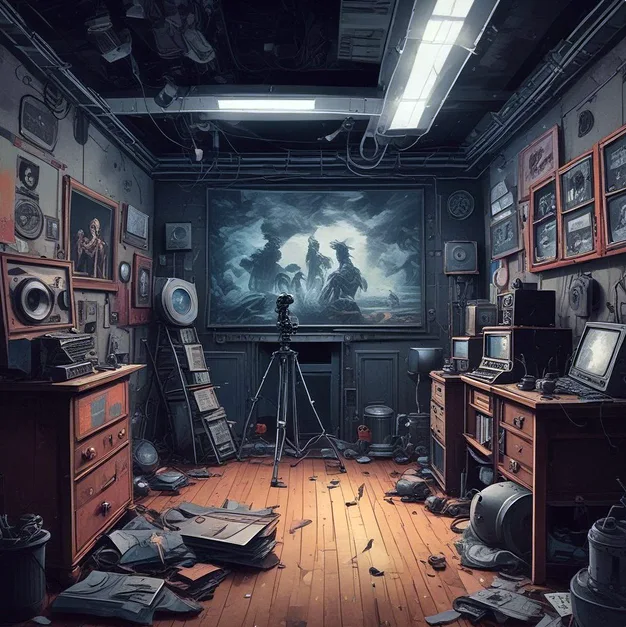
Foley work happens in a specialized recording space, often called a foley stage, equipped with a wide variety of surfaces and materials specifically chosen to replicate different textures, wood, concrete, gravel, water, that an artist can walk across, strike, or manipulate while watching the film play on a screen in front of them, timing every movement to match on-screen action with frame-precise accuracy. This isn't a passive or mechanical process either, skilled foley artists develop genuine performance instincts, adjusting pacing, weight, and intensity to match not just the physical action shown, but the emotional tone of a given scene, a tense, careful footstep sounding meaningfully different from a rushed, panicked one, even if the actual footwork looks similar on screen.
Beyond foley specifically, plenty of other sound elements in a finished film are also assembled after the fact, ambient background noise, specific mechanical or vehicle sounds, and various sound design elements drawn from extensive sound effect libraries or custom-recorded specifically for a project. Dialogue itself sometimes gets rerecorded too, through a process called automated dialogue replacement, when on-set audio wasn't clean enough to use, meaning even the words audiences hear aren't always the exact audio captured during the original take, despite appearing seamlessly synchronized in the finished film.
All of this happens specifically because film is, at a technical level, an illusion built from carefully assembled separate pieces, image and sound rarely originate together the way they seem to when watching a finished product. What feels like a single, unified moment on screen, a boot striking pavement in perfect sync with visible footfall, is often the product of an entirely separate performance, recorded in a completely different room, sometimes years after the original footage was filmed, by someone who has never set foot on the original film set at all, carefully working to make audiences believe otherwise.