
The Jellyfish That Found a Loophole Around Death Itself
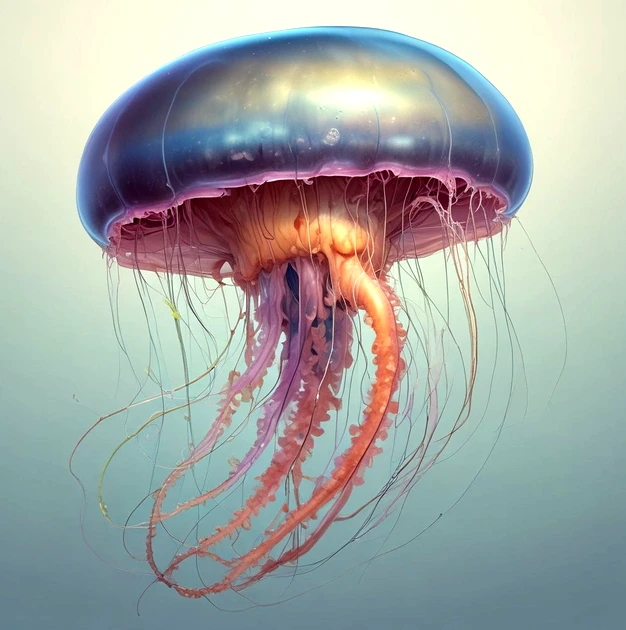
What natural process allows some jellyfish to return to an earlier stage of their life cycle?
Every living thing follows a life cycle that moves in one direction. Birth, growth, maturity, decline, death — the order doesn't change, even for organisms with wildly different lifespans. Except, apparently, nobody told Turritopsis dohrnii, a tiny jellyfish species that discovered a biological trick most of the animal kingdom would consider impossible: the ability to hit reverse on its own aging process.
Under normal circumstances, jellyfish, like most animals, follow a fairly linear life cycle. They start as free-floating larvae, settle down and grow into a stationary polyp stage attached to the seafloor, and eventually develop into the free-swimming, bell-shaped adult form most people picture when they hear the word "jellyfish." Once an individual reaches that adult medusa stage, it's supposed to be a one-way trip toward eventual death, whether from predation, environmental stress, or simple old age.
Turritopsis dohrnii breaks that rule through a process called transdifferentiation. When the jellyfish experiences physical damage, starvation, or severe environmental stress, instead of dying, its cells can essentially reprogram themselves. Specialized adult cells revert to a more basic, unspecialized state and then reorganize into an entirely different cell type, allowing the jellyfish's body to collapse back down into the polyp stage it originally started from as a juvenile. In practical terms, an adult jellyfish that should be facing death instead shrinks, restructures itself at a cellular level, and effectively starts its life cycle over again from an earlier developmental point.
This is a fundamentally different phenomenon from simply living a long time. Plenty of animals have impressively long lifespans without doing anything like this — certain tortoises, deep-sea clams, and some whales live for many decades or even centuries, but they're still aging in a conventional, one-directional sense. Turritopsis dohrnii isn't just surviving longer, it's biologically undoing its own maturity when circumstances call for it, then growing back up into an adult again afterward, in a cycle that researchers believe could theoretically repeat indefinitely.
That's exactly why the species picked up the nickname "immortal jellyfish" in popular science coverage, though biologists are usually quick to add an asterisk to that label. Immortality in this context doesn't mean invincibility. These jellyfish are still extremely vulnerable to predation, disease, and environmental hazards throughout their lives, and the vast majority never get the chance to reverse their aging even once before something else kills them. What makes them scientifically remarkable isn't that they can't die, but that biological aging itself, at least in this one narrow sense, isn't necessarily a fixed, irreversible process the way it appears to be in most other complex animals.
Researchers studying Turritopsis dohrnii are particularly interested in the cellular mechanisms behind transdifferentiation because of what it might reveal about aging more broadly. Human cells are generally understood to specialize permanently once they differentiate into things like skin cells, muscle cells, or neurons, losing the flexibility to become something else again. Understanding how this jellyfish manages to reverse that kind of specialization, at least at a cellular level, has real relevance to fields like regenerative medicine and stem cell research, where scientists are constantly looking for ways to coax mature cells back into more flexible, adaptable states.
The species itself is unassuming to look at — small, translucent, easy to overlook among the countless other tiny organisms drifting through warm ocean waters worldwide. It doesn't look like a biological anomaly. But tucked inside its simple bell-shaped body is a trick that challenges one of biology's most basic assumptions: that once an organism moves forward through its life cycle, there's no going back. Turritopsis dohrnii is quiet, unglamorous proof that at least one branch of life on Earth never got that memo.