
The "Fruit" That's Actually a Bouquet Turned Inside Out
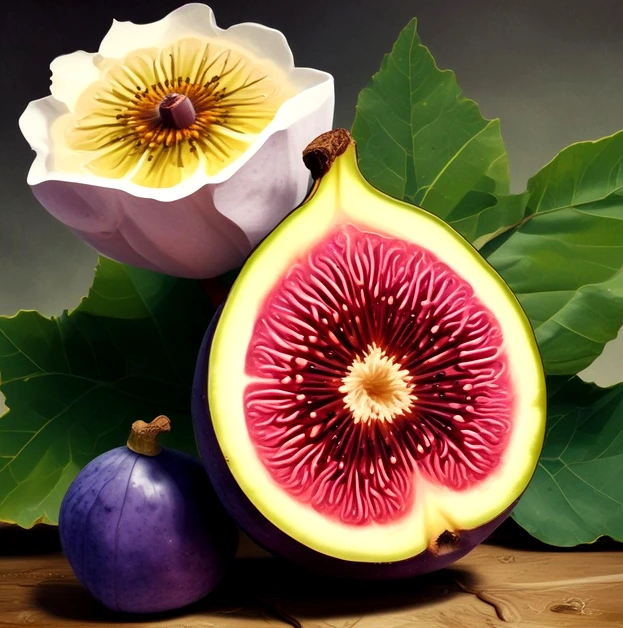
Which fruit has tiny flowers hidden inside what most people think of as the fruit itself?
Cut open a fig and look closely at that soft, seed-flecked interior, and you're not actually looking at fruit flesh the way you'd find it in an apple or a peach. You're looking at flowers. Hundreds of them, packed together, blooming entirely out of sight, inside a structure most people have spent their whole lives calling a fruit without ever realizing it's technically something else entirely.
Botanically speaking, what we call a fig isn't a true fruit in the conventional sense at all. It's what's known as a syconium, essentially an inverted flower cluster where the plant has turned its blossoms inward instead of outward. Rather than growing petals on display for pollinators to find easily, the fig plant folds an entire tiny garden of flowers into a hollow, enclosed pouch, with only a small opening at the bottom, called the ostiole, connecting that internal world to the outside environment.
This inside-out design creates an obvious problem for the plant. Flowers exist to get pollinated, and pollination usually depends on something, wind, insects, or animals, being able to physically reach the flower. Hiding hundreds of blossoms inside a sealed chamber seems like it should be an evolutionary dead end. Instead, figs solved this through one of the most specific and genuinely bizarre pollination partnerships found anywhere in the plant kingdom, involving a tiny insect called the fig wasp.
A female fig wasp, small enough to squeeze through that narrow ostiole opening, often losing her wings and antennae in the process due to how tight the passage actually is, crawls inside the fig specifically to lay her eggs among the internal flowers. In doing so, she inevitably transfers pollen she's carrying from the fig she previously hatched in, fertilizing the flowers inside her new host. After completing this task, in many fig species the wasp dies inside the fig, her offspring eventually hatching, mating within that same enclosed space, and the newly emerged females then repeating the entire cycle by seeking out a different fig to enter and lay eggs in themselves.
This relationship is so tightly specific that many fig species rely on one particular wasp species, and only that species, to achieve pollination, an evolutionary partnership that developed together over tens of millions of years. Without its specific wasp counterpart, a given fig species generally can't reproduce sexually at all, which makes it one of the more extreme examples of mutual dependency between a plant and an insect anywhere in nature.
A detail that tends to unsettle people once they learn it is the fact that, technically, trace amounts of wasp remains can end up incorporated into the fig as it ripens and matures. In practice, this isn't something anyone eating a fig actually encounters in any meaningful sense, since the fruit produces an enzyme called ficin that breaks down and essentially dissolves the wasp's body as the fig continues to develop, long before the fruit reaches anyone's plate. Commercially cultivated figs sold in grocery stores also frequently come from varieties that don't require wasp pollination at all, relying instead on other reproductive methods entirely, which sidesteps the issue altogether for most figs people actually buy and eat.
The flowers themselves, once pollinated, are what eventually transform into the small, crunchy seed-like structures found scattered throughout a fig's interior, each one technically representing an individual, fully fertilized flower that has matured into its own tiny fruit. What looks like a single fruit with a lot of texture is, structurally speaking, actually hundreds of individual fruiting bodies fused together inside one shared outer skin, a detail that reframes the entire eating experience once you know what you're actually looking at.
It's a strange bit of botany hiding in plain sight, tucked into something as ordinary as a snack or a dessert topping. The fig never abandoned the basic biological requirement of flowering and being pollinated, it just turned the entire process inward, building a self-contained, insect-dependent reproductive system disguised as one of the most familiar fruits in the world.