
The Desert So Dry NASA Tests Mars Equipment There
Which country contains a desert where some areas can go years with almost no measurable rainfall?
When people imagine the driest place on the planet, the Sahara usually comes to mind first, mostly because it's the desert pop culture talks about the most. But the Sahara actually gets more rain in a bad year than parts of Chile's Atacama Desert get in a decade. Some sections of the Atacama have gone without any recorded rainfall for periods stretching well over a decade, and certain weather stations in the region have essentially no rainfall on record at all since measurements began.
The Atacama runs along a narrow strip of northern Chile, squeezed between the Andes mountains to the east and the Pacific coastline to the west, and that geography is exactly why it's so brutally dry. The Andes block moisture coming from the Amazon basin on the other side of the continent, while a cold ocean current running along the Chilean coast, called the Humboldt Current, cools the air above it and suppresses the kind of evaporation that normally feeds coastal rain systems. The result is a rain shadow effect stacked on top of an oceanic dry zone, creating something close to a perfect storm of dryness, if that phrase can even apply to a place defined by the total absence of storms.
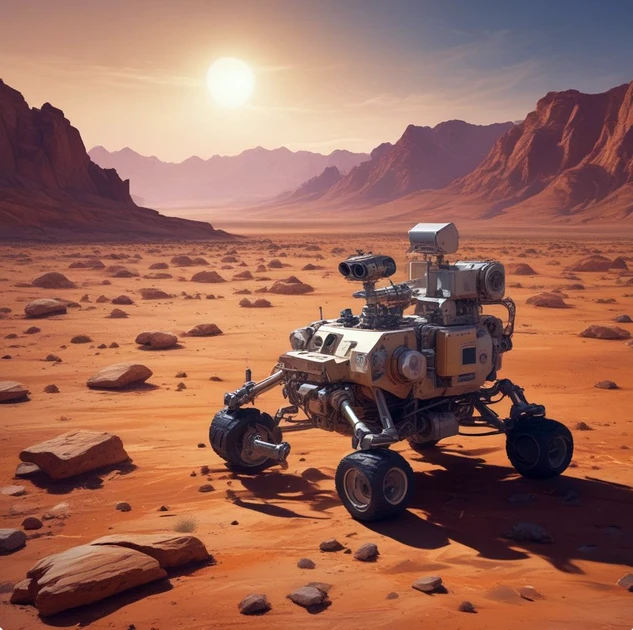
What makes the Atacama especially strange isn't just the lack of rain, but how alien the landscape looks because of it. Vast stretches are covered in cracked, reddish-brown terrain, salt flats, and volcanic rock formations that look far closer to the surface of Mars than anything typically associated with Earth. That resemblance isn't just poetic exaggeration either — NASA and other space agencies have actually used the Atacama as a testing ground for Mars rover technology, since the soil composition, extreme dryness, and high UV exposure closely mimic Martian conditions in ways almost nowhere else on the planet can match.
Despite the hostility of the environment, the Atacama isn't lifeless. Certain microorganisms have adapted to survive in some of the driest micro-regions, drawing moisture from fog rather than rainfall, and scientists studying these organisms have used them as a reference point for understanding how life might theoretically survive in similarly extreme conditions elsewhere in the solar system. Along parts of the coast, a phenomenon called camanchaca, a thick fog rolling in from the Pacific, provides one of the only reliable sources of moisture for local plants and wildlife, leading to unusual fog-harvesting systems where local communities set up giant mesh nets specifically designed to catch water droplets out of the air.
Human life has adapted around the desert's extremes for a surprisingly long time. Indigenous communities have inhabited parts of the Atacama for thousands of years, developing agricultural techniques centered around oases and underground water sources rather than rainfall. Later, the region became an economic hub for an entirely different reason: mineral wealth. The Atacama sits on massive deposits of copper and lithium, and today it's one of the most important mining regions on the planet, supplying raw materials that feed everything from electronics manufacturing to electric vehicle batteries.
There's also a darker, quieter side to the desert's extreme dryness. Because of the near-total absence of moisture and decomposition-friendly conditions, the Atacama has preserved archaeological remains remarkably well, including some of the oldest known mummified human remains in the world, predating even ancient Egyptian mummification practices by thousands of years. The same conditions that make the desert nearly uninhabitable have turned it into an accidental time capsule.
It's a strange kind of extremity — a landscape so dry it borders on otherworldly, yet stitched into human history for millennia, mined for the technology of the future, and used by scientists quite literally as a stand-in for another planet. Most deserts test human endurance. The Atacama tests the very definition of how little water an environment can have and still, somehow, sustain life.