
The Conductor Isn't Just Waving Their Arms Around Up There
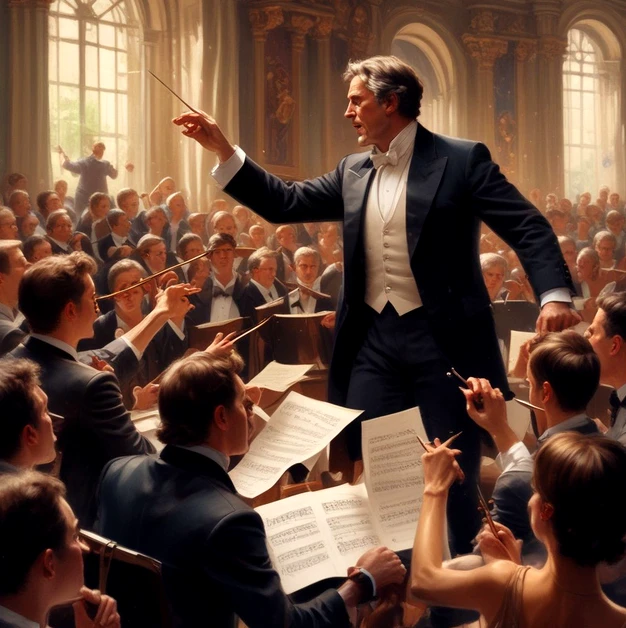
Watch an orchestra conductor from a distance, without any musical training, and the whole performance can look faintly absurd, someone standing at the front of a large group of skilled musicians, waving their arms in patterns that don't obviously correspond to anything audible happening on stage. No sound comes directly out of a conductor's hands. And yet remove that person entirely, and most orchestras, especially larger ones performing complex repertoire, would genuinely struggle to stay cohesively together. What looks like arm-waving is actually a dense, continuous stream of precise information, communicated silently and in real time to dozens of musicians simultaneously.
The most fundamental piece of information a conductor communicates is tempo and beat pattern, typically demonstrated through the right hand, often holding a baton for visibility, moving through specific, standardized patterns that indicate exactly where each beat within a measure falls. Different time signatures correspond to different conducting patterns, a four-beat measure follows a distinct downward, inward, outward, upward motion, while a three-beat measure follows its own separate triangular pattern, these patterns aren't arbitrary or improvised, they're a shared, standardized visual language that trained musicians learn to read instinctively, similar to how written musical notation itself functions as a shared, universally understood system.
The downbeat specifically, the first, typically strongest beat within each measure, carries particular importance and is usually marked by a distinct, clear downward motion, giving musicians an unambiguous visual reference point for exactly where a new measure begins. This matters enormously in large ensembles, where dozens of musicians reading different instrumental parts need a single, shared, precisely timed reference point to stay synchronized with each other, rather than relying purely on their own internal sense of rhythm, which, as any musician will readily admit, tends to drift over the course of a long, complex piece without some kind of external, unifying reference.
While the right hand generally handles tempo and beat pattern, the conductor's left hand typically takes on a broader, more expressive range of communicative functions, separate from strict timekeeping duties. Dynamics, how loud or soft a passage should be played, get communicated through hand height, gesture size, and overall physical intensity, a small, contained gesture generally signaling quieter, more restrained playing, while broader, more expansive movement signals a build toward louder, more powerful dynamics. Cueing specific sections or individual musicians, indicating precisely when a particular instrument or group needs to enter during a passage, often happens through direct eye contact combined with a targeted hand gesture pointed toward the specific section about to play, giving that musician or group a clear, individualized signal separate from the ongoing general beat pattern being maintained for the rest of the orchestra.
Facial expression and overall body language layer additional interpretive information on top of these more technical hand signals, communicating emotional tone, phrasing, and musical intention in ways that pure beat-pattern gestures alone can't fully capture. A conductor might use a softer, more flowing physical gesture to indicate a lyrical, legato passage should be played smoothly and connectedly, while sharper, more angular movement signals a more staccato, detached articulation, this kind of physical communication essentially translates abstract musical interpretation into visible, readable movement that an entire ensemble can pick up on simultaneously without needing any verbal instruction mid-performance.
Tempo changes, ritardandos slowing down gradually, accelerandos speeding up, and sudden tempo shifts all get communicated through subtle adjustments in how quickly or slowly a conductor's beat pattern itself moves, requiring considerable precision and consistency since dozens of musicians are actively watching and adjusting their own playing in direct response to exactly how the conductor's physical tempo is shifting in real time. Fermatas, moments where a note or rest is held beyond its normal written duration, typically get indicated through a conductor simply pausing their beat pattern entirely, holding a static gesture until deciding, through their own musical judgment, precisely when to resume the regular beat and cue the ensemble to continue forward together.
Beyond these more universally recognized gestures, individual conductors frequently develop their own personal, somewhat idiosyncratic physical vocabulary over years of work with specific ensembles, subtle, personalized gestures that regular orchestra members learn to recognize and respond to through repeated rehearsal and performance experience together, essentially building a shared, ensemble-specific physical language layered on top of the more standardized, universally taught conducting techniques every conductor learns during formal training. This is part of why an orchestra's relationship with a specific conductor, developed and refined over an extended period working together, often produces a noticeably tighter, more responsive ensemble performance compared to a conductor leading an unfamiliar orchestra for the very first time, even when every individual musician involved is highly skilled and technically proficient on their own.
What ultimately makes conducting such a demanding, specialized skill isn't simply keeping a steady beat visible to a large group, it's the ability to simultaneously communicate technical timing information alongside genuine interpretive, emotional musical direction, all conveyed silently, continuously, and in real time to potentially over a hundred individual musicians at once, each one needing to receive, interpret, and immediately respond to that same stream of physical information while simultaneously managing the technical demands of actually playing their own individual instrumental part. It's a strange kind of wordless leadership, an entire performance's cohesion depending substantially on how clearly and expressively one person can translate abstract musical intention into precise, readable physical movement, silently guiding dozens of trained musicians toward a single, unified musical result.