
That Pop Isn't Your Bones, It's a Bubble Collapsing Inside Your Joint
A Sound With a Surprisingly Complicated Backstory
Cracking a knuckle produces a distinct, satisfying pop that most people have heard thousands of times without ever really questioning what's actually happening physically inside the joint to produce it. For a surprisingly long time, the scientific explanation for that sound wasn't fully settled either, researchers genuinely debated the precise mechanism for decades, and it took modern imaging technology to finally provide clear, direct evidence for what's really going on the moment a knuckle cracks.
Inside a Joint: Fluid, Not Bone Touching Bone
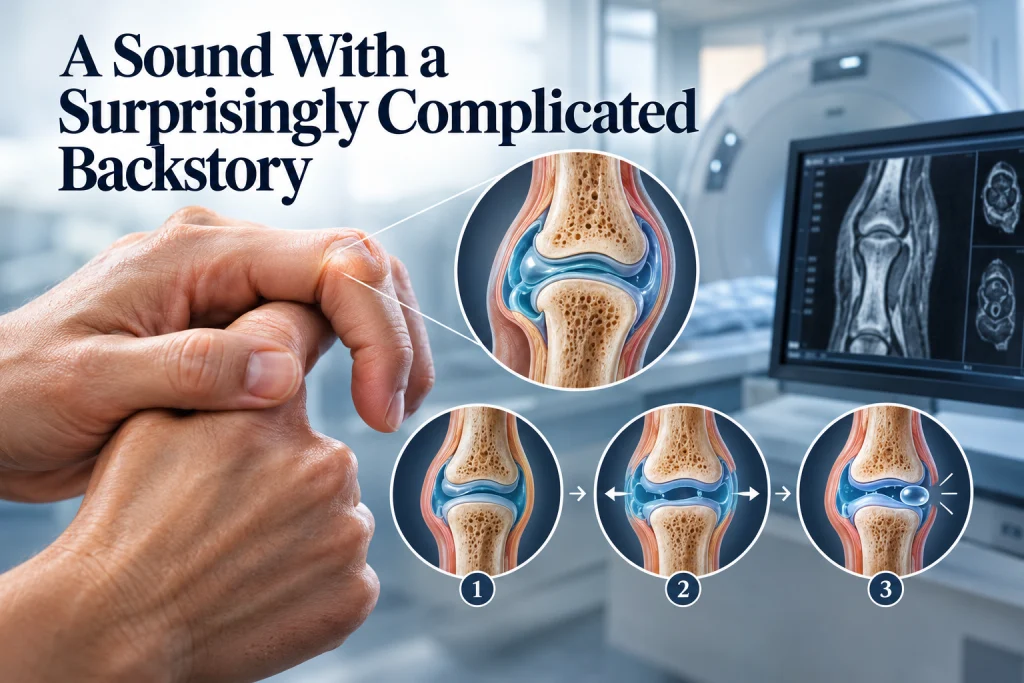
Every joint capable of producing a cracking sound, knuckles, knees, backs, is surrounded by a capsule containing synovial fluid, a thick, lubricating liquid that reduces friction between the bones forming that joint and helps keep movement smooth and comfortable. This fluid also contains dissolved gases, primarily carbon dioxide, existing in solution within the liquid much the way carbon dioxide exists dissolved within a sealed bottle of soda before it's opened. Understanding what happens to that dissolved gas turns out to be the entire key to understanding where the cracking sound actually comes from.
Stretching the Joint Changes the Pressure Inside It
When a knuckle gets pulled, bent, or stretched in the specific way people typically do to crack it, the joint capsule expands slightly, and that expansion increases the overall volume of space inside the joint capsule while the amount of synovial fluid itself stays essentially the same. Increasing volume while keeping the same amount of fluid causes pressure inside the joint capsule to drop suddenly, and that pressure drop is significant enough to cause some of the dissolved carbon dioxide gas within the synovial fluid to rapidly come out of solution, forming a small gas bubble, in a process fundamentally similar to what happens when a carbonated drink is opened and dissolved gas suddenly begins forming visible bubbles.
The Actual Debate: Does the Bubble Form or Collapse?
For a long time, researchers debated whether the audible pop was caused by that gas bubble forming in the first place, or alternatively, by the bubble subsequently collapsing back down. More recent research, notably a 2015 study using real-time MRI imaging to directly observe finger joints during the cracking process, provided clearer evidence supporting the bubble formation itself as the actual source of the sound, the imaging captured a visible cavity, essentially the bubble, forming rapidly within the joint fluid at precisely the same moment the audible crack occurred, rather than the sound coinciding with the bubble subsequently disappearing or collapsing afterward.
Why You Can't Immediately Crack the Same Knuckle Again
This explanation also accounts for a detail nearly everyone who cracks their knuckles has noticed personally, once a knuckle has been cracked, it typically can't be cracked again immediately afterward, usually requiring a refractory period of around twenty minutes or so before it's able to produce another audible pop. This delay makes sense specifically because the dissolved gas that escaped into bubble form needs time to fully redissolve back into the synovial fluid before another meaningful pressure drop and subsequent bubble formation can occur again, essentially the joint needs time to reset its dissolved gas balance before the same underlying physical process can repeat itself.
Does Cracking Knuckles Actually Cause Arthritis?
A persistent popular belief holds that habitually cracking knuckles leads to arthritis later in life, a claim that's been studied directly on multiple occasions, and the available research consistently fails to find a meaningful connection between habitual knuckle cracking and increased arthritis risk. Some studies specifically comparing long-term habitual knuckle crackers against non-crackers found no significant difference in arthritis rates between the two groups, suggesting that whatever mechanical or physical process is happening during a knuckle crack doesn't meaningfully damage joint cartilage or otherwise contribute to the specific kind of joint degeneration associated with arthritis, despite how persistently the association has been repeated across generations.
Other Joints Can Crack Through Slightly Different Mechanisms
While the same basic dissolved gas mechanism explains most finger and knuckle cracking specifically, other joint sounds people experience, particularly recurring clicking or popping in knees or backs during regular movement, don't always stem from the exact same gas bubble process. Some of these other sounds can result from tendons or ligaments moving slightly and briefly catching against nearby bone structures during specific movements, a mechanically different phenomenon from the dissolved gas cavitation responsible for the classic finger knuckle crack, even though both can produce broadly similar-sounding pops or clicks to an untrained ear.
A Satisfying Sound With a Fully Explained Mechanism
What makes knuckle cracking a genuinely interesting small case study in everyday physiology is how a sound so simple and instantly familiar actually required fairly sophisticated modern imaging technology to fully confirm the precise underlying mechanism producing it. The pop isn't bone grinding against bone, and it isn't some kind of joint damage occurring in real time, it's a small, harmless burst of gas rapidly leaving solution within joint fluid, an almost miniature version of the exact same physics responsible for the fizz in a freshly opened carbonated drink, just happening quietly inside a finger joint instead of inside a bottle.