Spain Quiz: Test Your Knowledge of Spanish Culture, History & Geography
Some visitors come for Barcelona's architecture. Others dream of Andalusia's white villages, the beaches of the Balearic Islands, or the museums of Madrid. Many simply fall in love with the relaxed lifestyle, local festivals, and regional cuisine.
🏰 Start Spain Quiz
🎯 Daily Bing Trivia Challenge • 🧠 10 Questions • ⏱️ 90 Seconds
Architecture
Which famous Barcelona landmark has been under construction for more than a century?
Languages
Besides Spanish, which language is widely spoken in Catalonia?
Geography
Which Spanish island group is located in the Atlantic Ocean?
Traditions
What colorful event in Buñol is famous for people throwing tomatoes?
History
Which civilization built many impressive aqueducts that can still be seen in Spain today?
Nature
Which mountain range forms much of Spain's natural border with France?
Food
Which Spanish dish is traditionally cooked in a wide, shallow pan?
Art
Which Spanish artist is famous for helping create the Cubist movement?
UNESCO Sites
Which historic palace complex in Granada is one of Spain's most visited landmarks?
Culture
Which energetic dance style is closely associated with southern Spain?
Your score
0/10
Scroll down to see the explanation for each question.
Explanations: answer key for all 10 questions
- Q1: Which famous Barcelona landmark has been under construction for more than a century?
Answer: Sagrada Família
Antoni Gaudí's Sagrada Família began construction in 1882 and remains one of the world's most remarkable architectural projects.
- Q2: Besides Spanish, which language is widely spoken in Catalonia?
Answer: Catalan
Catalan is an official language in Catalonia and is spoken by millions of people.
- Q3: Which Spanish island group is located in the Atlantic Ocean?
Answer: Canary Islands
The Canary Islands belong to Spain and are located off the northwest coast of Africa in the Atlantic Ocean.
- Q4: What colorful event in Buñol is famous for people throwing tomatoes?
Answer: La Tomatina
La Tomatina is an annual festival where thousands of people take part in a giant tomato fight.
- Q5: Which civilization built many impressive aqueducts that can still be seen in Spain today?
Answer: The Romans
Roman engineering left a lasting mark on Spain, including the famous Aqueduct of Segovia.
- Q6: Which mountain range forms much of Spain's natural border with France?
Answer: The Pyrenees
The Pyrenees stretch across northern Spain and southern France.
- Q7: Which Spanish dish is traditionally cooked in a wide, shallow pan?
Answer: Paella
Paella originated in the Valencia region and is one of Spain's best-known dishes.
- Q8: Which Spanish artist is famous for helping create the Cubist movement?
Answer: Pablo Picasso
Pablo Picasso was one of the founders of Cubism and one of the most influential artists of the 20th century.
- Q9: Which historic palace complex in Granada is one of Spain's most visited landmarks?
Answer: Alhambra
The Alhambra is a UNESCO World Heritage Site celebrated for its Islamic architecture and beautiful gardens.
- Q10: Which energetic dance style is closely associated with southern Spain?
Answer: Flamenco
Flamenco combines singing, guitar playing, and expressive dancing, and originated in Andalusia.
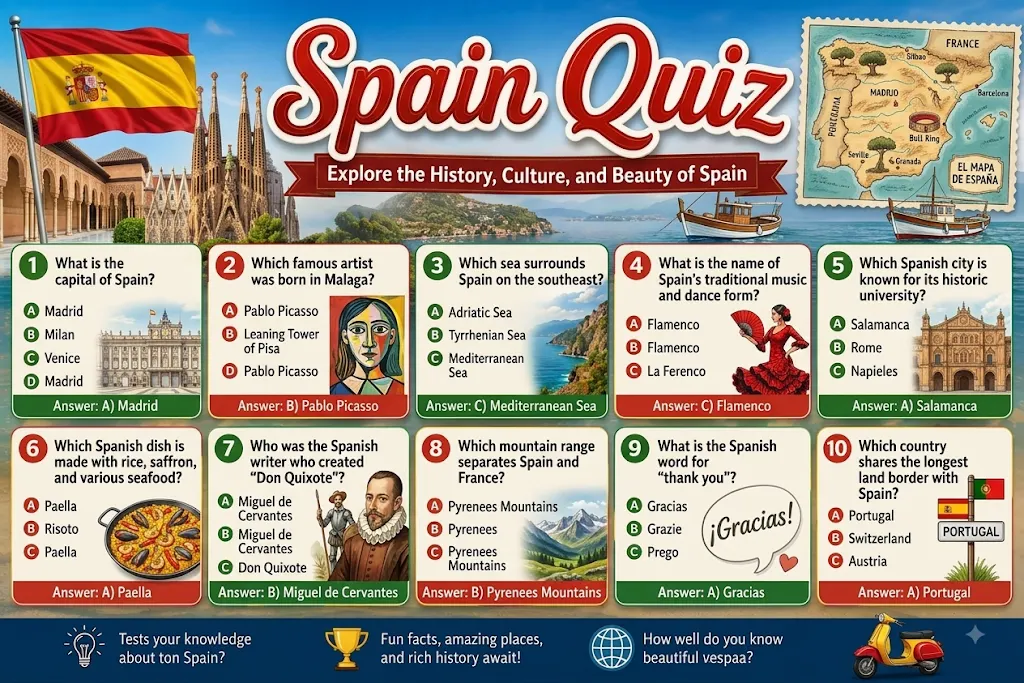
Spain Quiz – How Well Do You Know Spain?
Picture a country where snow-covered mountains, Roman aqueducts, medieval castles, modern football stadiums, sunny beaches, and lively city squares all exist within a day's journey. That's Spain—a nation filled with contrasts, traditions, and stories that stretch back thousands of years.
Some visitors come for Barcelona's architecture. Others dream of Andalusia's white villages, the beaches of the Balearic Islands, or the museums of Madrid. Many simply fall in love with the relaxed lifestyle, local festivals, and regional cuisine.
If you think Spain is only about flamenco and paella, this quiz might surprise you. Let's see how much you really know.
Quick Facts About Spain
| Fact | Information |
|---|---|
| Official Name | Kingdom of Spain |
| Capital | Madrid |
| Continent | Europe |
| Population | About 49 million |
| Currency | Euro (€) |
| Official Language | Spanish |
| Highest Mountain | Mount Teide |
| Longest River | Tagus River |
| Government | Parliamentary Constitutional Monarchy |
| Autonomous Communities | 17 |
| National Day | October 12 |
More Than One Spain
One of the most interesting things about Spain is that it doesn't feel like a single culture.
Catalonia, Galicia, Andalusia, the Basque Country, Valencia, Castile, and many other regions each have their own traditions, festivals, architecture, recipes, and even regional languages.
Travel across the country and you'll quickly notice different styles of music, local customs, and foods. That's one reason Spain remains one of Europe's favorite travel destinations.
Where History Never Feels Far Away
Spain's past is written into its streets.
Roman theaters still host performances. Moorish palaces overlook modern cities. Gothic cathedrals stand beside contemporary museums, while medieval castles continue watching over hilltop villages.
Generations of Romans, Visigoths, Islamic rulers, Christian kingdoms, explorers, artists, and architects all helped shape the Spain we know today.
Instead of preserving history behind glass, Spain often allows visitors to walk directly through it.
A Country That Lives Outdoors
Public squares are at the center of daily life.
People gather in plazas to meet friends, enjoy coffee, watch children play, or simply relax after work. Outdoor cafés remain busy throughout much of the year thanks to Spain's generally mild climate.
Life often moves at a slower pace than visitors expect. Long lunches, evening walks, neighborhood markets, and local festivals continue to be important traditions across the country.
Food Is Regional, Not Just National
Ask someone to name Spanish food and they'll probably mention paella.
In reality, every region has its own specialties.
Valencia is famous for paella, Galicia for seafood, the Basque Country for pintxos, Andalusia for gazpacho, and Castile for roasted meats. Olive oil, fresh vegetables, seafood, cured ham, and local cheeses appear throughout Spanish cuisine.
Meals are often shared with family and friends, making food an important part of everyday culture rather than simply something to eat.
Football Is Part of Everyday Conversation
Few countries have influenced modern football like Spain.
Children grow up playing in neighborhood parks, schoolyards, and beaches. Local clubs are part of community life, while professional teams attract supporters from around the world.
Spain has also achieved remarkable success in international competitions, helping inspire a new generation of players through its emphasis on teamwork and technical skill.
Even people who rarely watch sports usually know the names of Spain's most famous clubs.
Cities That Each Tell a Different Story
Madrid is Spain's energetic capital, filled with museums, parks, and elegant boulevards.
Barcelona is known for its extraordinary architecture, Mediterranean coastline, and creative atmosphere.
Seville combines colorful festivals with centuries of history, while Granada is home to one of Europe's greatest palace complexes.
Bilbao has transformed from an industrial city into a center of modern art, and Santiago de Compostela welcomes pilgrims who have completed one of the world's oldest walking routes.
15 Interesting Facts About Spain
- Spain has 17 autonomous communities.
- It is one of Europe's most mountainous countries.
- The world's oldest active restaurant is located in Madrid.
- Spain produces more olive oil than any other country.
- The Camino de Santiago has attracted pilgrims for centuries.
- Mount Teide is Spain's highest peak.
- Spain has dozens of UNESCO World Heritage Sites.
- The Alhambra is one of Europe's most visited historic monuments.
- Barcelona is famous for Antoni Gaudí's architecture.
- Spain has more than 5,000 miles of coastline.
- The country includes both Atlantic and Mediterranean islands.
- Flamenco originated in southern Spain.
- Spanish is one of the world's most widely spoken languages.
- Madrid is one of Europe's highest capital cities by elevation.
- Spain is among the world's leading producers of wine.
Did You Know?
- Spain has more Blue Flag beaches than almost any other country.
- The Sagrada Família has been under construction since 1882.
- Europe’s only wild monkey population lives on the Rock of Gibraltar, a British Overseas Territory located at Spain’s southern tip.
- The Spanish tomato festival, La Tomatina, began as a local celebration in 1945.
- Spain is home to one of the world's oldest continuously operating universities, the University of Salamanca.
Why Spain Is Worth Exploring
Spain is a country where geography, history, art, language, and everyday traditions naturally connect. Learning about Spain isn't simply about memorizing capitals or rivers—it's about understanding how different cultures have shaped one nation over thousands of years.
This quiz is designed to make that learning enjoyable. Every question introduces another piece of Spain's story, helping you remember not only the answers but also the places and people behind them.
What You'll Learn From This Quiz
By the end of this Spain quiz, you'll have explored:
- Spain's geography
- Historic landmarks
- Regional cultures
- Spanish cuisine
- Famous cities
- Football traditions
- Architecture and art
- Interesting facts about everyday life
Ready for another round?
Jump to a random quiz from the archive.