
Space Quiz: Prove Your Knowledge of the Universe
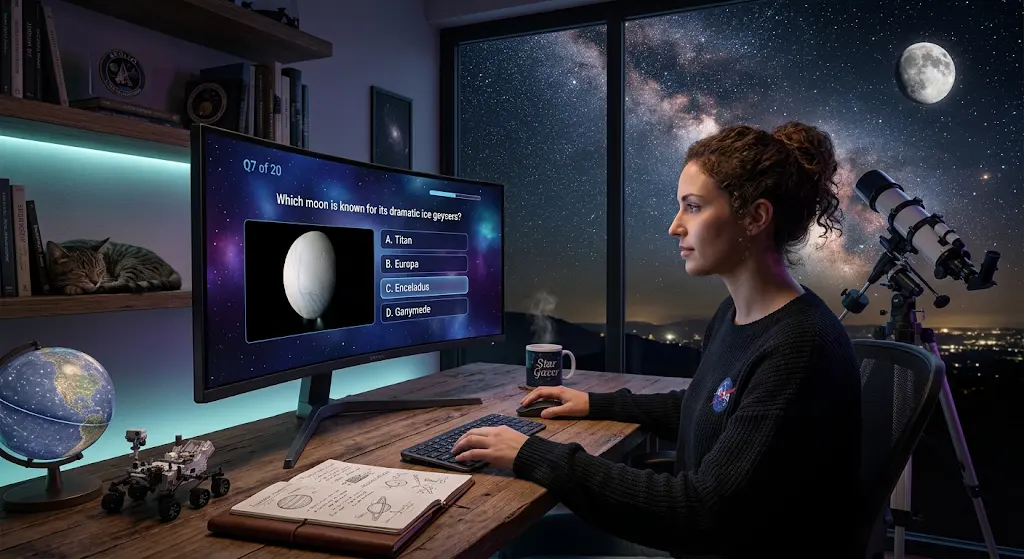
Space Trivia Quiz – Planets, Stars & More
Saturn has nearly three times more moons than Jupiter, and the gap only opened up in 2023. Test what else you know about space here
Ask most people how many moons Jupiter has and you'll get a confident wrong answer, because for most of the space age it really was the moon champion of the solar system. That changed a few years back. Astronomers pointed sharper survey telescopes at Saturn, started spotting tiny objects only a couple of kilometers wide, and the count exploded past 280 — nearly three times Jupiter's total. It's a good reminder that a lot of what gets taught as settled fact in astronomy is really just "settled for now."
Start Space Quiz
🎯 Daily Trivia Challenge • 🧠 10 Questions • ⏱️ 90 Seconds
This quiz pulls from a mix of solar system trivia, spaceflight history, and a few numbers that are easy to get wrong even if you follow space news. You'll get questions about the Apollo missions, robotic explorers still working decades past their expected lifespan, and some genuinely strange facts about scale — how far away things actually are once you stop rounding to "really far." No physics background required, just curiosity.
Sample question explanations
Q: Which planet currently has the most known moons?
Answer: Saturn
Saturn overtook Jupiter for the title in 2023 and hasn't looked back. New imaging techniques let researchers spot faint, kilometer-sized objects that older telescopes simply couldn't resolve, and the count has climbed past 280 since then. Jupiter, by comparison, sits at roughly 100.
Q: How long did it take Apollo 11 to travel from Earth to the Moon?
Answer: About three days
The spacecraft launched on July 16, 1969, and Armstrong and Aldrin touched down on the lunar surface on July 20. Most of that travel time was spent coasting, since the rocket only burned fuel during specific maneuvers rather than the whole trip.
Q: Which spacecraft is the most distant human-made object from Earth?
Answer: Voyager 1
Launched in 1977, Voyager 1 crossed into interstellar space in 2012 and is still sending back data using a transmitter roughly as powerful as a refrigerator light bulb. Signals from Earth now take over 22 hours to reach it.
Q: What's unusual about a day on Venus compared to its year?
Answer: A day on Venus is longer than its year
Venus takes about 243 Earth days to rotate once on its axis, but only 225 Earth days to complete a full orbit around the Sun. It also spins in the opposite direction from most planets, so on Venus the sun would rise in the west.
Q: Roughly how far is one light-year?
Answer: About 5.88 trillion miles
It's the distance light covers in a single year, moving at roughly 186,000 miles per second. The nearest star system to our own, Alpha Centauri, is still more than four light-years away — meaning the light hitting your eyes from it left before most people reading this were born.