
What Is the Smallest Country in the World?
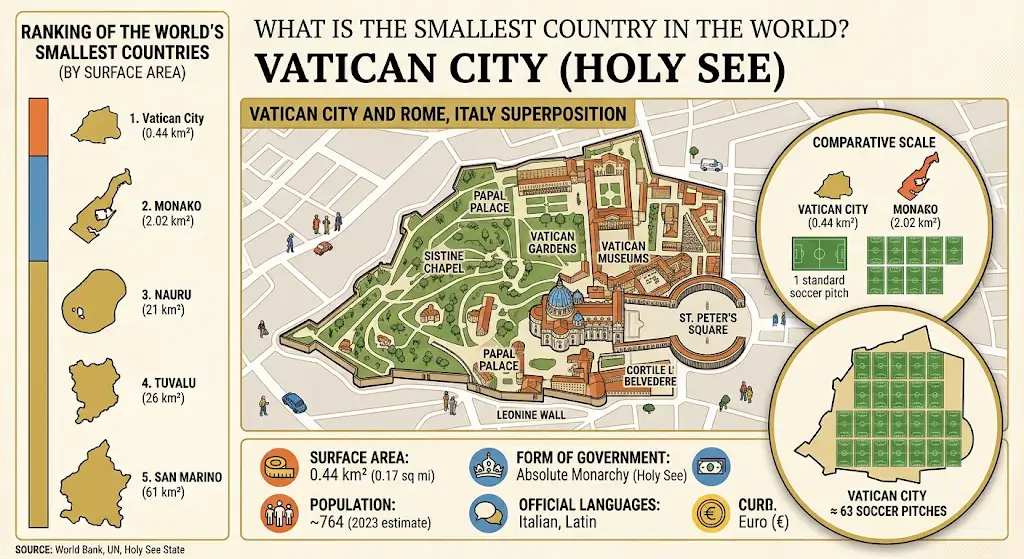
Vatican City is the smallest country in the world, covering about 0.44 to 0.49 square kilometers depending on the source — roughly one-eighth the size of New York's Central Park. It sits entirely inside the city of Rome, Italy, making it the only country on Earth fully enclosed within another city. You could walk its entire border in under 40 minutes.
Despite that footprint, Vatican City functions as a fully sovereign nation. It has its own government, its own laws, its own currency, its own postal system, and even its own small police and security force in the Swiss Guard. It just happens to be smaller than most shopping malls.
Top 10 Smallest Countries by Area
| Rank | Country | Area (km²) | Location |
|---|---|---|---|
| 1 | Vatican City | ~0.44–0.49 | Enclave within Rome, Italy |
| 2 | Monaco | ~2.02 | Western Europe, on the French Riviera |
| 3 | Nauru | ~21 | Micronesia, Pacific Ocean |
| 4 | Tuvalu | ~26 | Polynesia, Pacific Ocean |
| 5 | San Marino | ~60–61 | Enclave within Italy |
| 6 | Liechtenstein | ~160 | Between Switzerland and Austria |
| 7 | Marshall Islands | ~181 | Micronesia, Pacific Ocean |
| 8 | Saint Kitts and Nevis | ~261 | Caribbean |
| 9 | Maldives | ~298 | South Asia, Indian Ocean |
| 10 | Malta | ~316 | Southern Europe, Mediterranean Sea |
For scale: Russia, the largest country in the world, is roughly 39 million times bigger than Vatican City.
Quick Facts
- Vatican City became an independent state on February 11, 1929, under the Lateran Treaty signed between the Holy See and Italy.
- Its population is around 800 people, making it the smallest country by population as well as by area.
- The country has no hospitals, no farmland, and no industry — it runs on donations, museum admissions, and the sale of stamps and coins.
- Citizenship in Vatican City isn't hereditary. It's tied to a person's role or employment there, and it ends when that role ends.
- Monaco, the second-smallest country, is also the most densely populated country in the world.
Did You Know?
Did you know that Vatican City has no permanent residents in the way most countries do? Its roughly 800 inhabitants are mostly clergy, cardinals, Swiss Guard members, and administrative staff — people whose citizenship exists only because of their work there.
Did you know that Nauru, the world's smallest island nation, once had one of the highest per-capita incomes on the planet? That wealth came almost entirely from phosphate mining, a resource that has since been largely depleted.
Did you know that among United Nations member states specifically (Vatican City is not a UN member, only an observer), Tuvalu holds the title of smallest, with a population of roughly 11,000 people spread across a handful of low-lying atolls?
Why Vatican City Ended Up So Small
Vatican City's size isn't an accident of geography the way a small island nation's might be — it's the direct result of a political settlement. For centuries, the Pope ruled over the much larger Papal States across central Italy. That changed in 1870, when Italian unification absorbed those territories, leaving the Pope without any formal sovereign land.
The dispute simmered for nearly 60 years until the Lateran Treaty of 1929 resolved it by carving out a tiny, clearly bounded territory around St. Peter's Basilica and the surrounding Vatican Hill — just enough land to guarantee the Holy See's independence without reviving any claim to a larger papal state. The result is a country whose borders were essentially drawn to be the minimum necessary for sovereignty, not the product of natural expansion or conquest.
What's Actually Inside 0.44 Square Kilometers
Small as it is, Vatican City packs in an unusual amount of significance. St. Peter's Basilica, one of the largest churches on Earth, sits within its walls, along with the Sistine Chapel and its Michelangelo ceiling, the Vatican Museums, and the Apostolic Palace, which serves as the Pope's official residence. The entire country functions as the administrative and spiritual headquarters for the Roman Catholic Church, which counts roughly 1.4 billion baptized members worldwide — meaning a country smaller than most golf courses oversees institutions with global reach.
Smallest Country by Continent
Size records shift depending on which continent you're looking at, since Vatican City's title only applies globally.
| Continent | Smallest Country | Area (km²) |
|---|---|---|
| Europe | Vatican City | ~0.44–0.49 |
| Africa | Seychelles | ~459 |
| Asia | Maldives | ~298 |
| Americas | Saint Kitts and Nevis | ~261 |
| Oceania | Nauru | ~21 |
Semantic Deep Dive: Related Questions People Ask
Is Vatican City an independent country or part of Italy? It's fully independent. Vatican City has its own head of state (the Pope), its own laws, and its own diplomatic relations, even though it sits entirely within Rome.
What is the smallest country by population instead of area? Vatican City again, with roughly 800 residents — making it the rare case of a country holding both the smallest-area and smallest-population titles simultaneously.
What is the smallest UN member state? Tuvalu, since Vatican City participates in the UN only as a permanent observer rather than a full member.
Is Sealand the smallest country in the world? No. Sealand, a self-declared micronation on a former WWII sea platform off the English coast, isn't recognized by any sovereign government, so it doesn't count in official rankings of the world's smallest countries.
What's the smallest country in Africa? Seychelles, an archipelago nation in the Indian Ocean covering roughly 459 square kilometers.
How does Vatican City make money without industry or agriculture? Mainly through donations from Catholics worldwide (known as Peter's Pence), admission fees to the Vatican Museums, and sales of stamps, coins, and publications.
Small Territory, Outsized Influence
Vatican City's story is really a reminder that a country's footprint on a map has almost nothing to do with its global weight. It has no farmland, no factories, no standing army beyond a ceremonial guard, and fewer residents than a single large apartment building — yet it sits at the center of one of the world's largest religious institutions, hosts millions of visitors a year, and maintains formal diplomatic ties with more than 180 countries. Size, in this case, turns out to be almost beside the point.