Shape Sequence Quiz: 10 Picture Patterns to Complete
This shape sequence quiz shows you a row of pictures and asks what comes next, with repeating shapes, arrows that turn, dots and stars that grow, shapes that gain sides, shading that fills a circle, lines that rotate, a dot moving around a square and clocks that move forward, the same kind of picture puzzles used in Raven's Progressive Matrices. Ten picture questions.
Start Shape Sequence Quiz
🎯 Daily Trivia Challenge • 🧠 10 Questions • ⏱️ 90 Seconds
Repeating
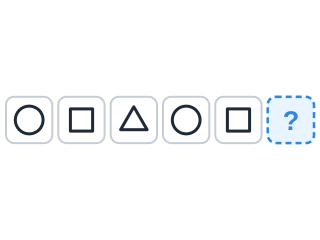
Look at the shapes in the picture. Which shape replaces the question mark?
Rotation
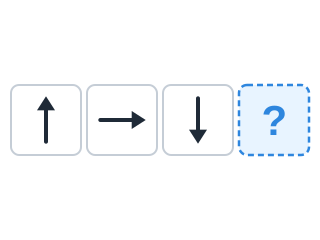
The arrow turns in the same direction each time. Which arrow comes next?
Counting
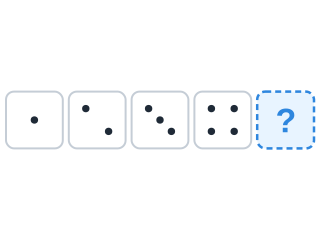
How many dots belong in the empty box?
Sides
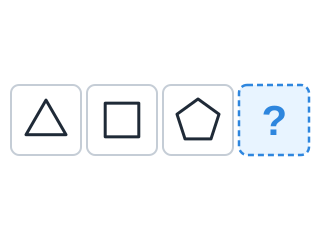
Each shape has one more side than the one before. Which shape comes next?
Shading
Each circle is shaded a little more than the last. What does the next circle look like?
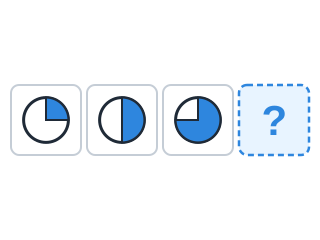
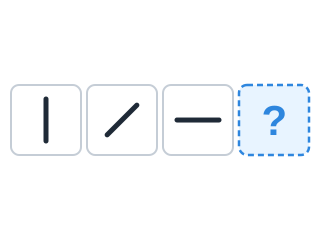
Turning lines
The line turns by the same amount each time. Which line comes next?
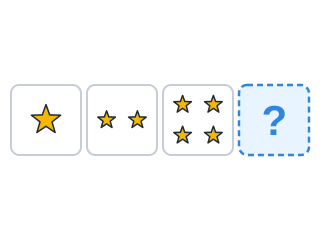
Doubling
How many stars belong in the empty box?
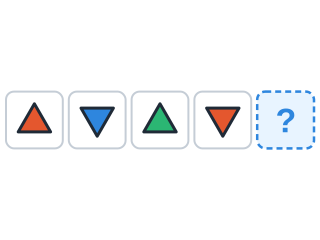
Two rules
The triangles follow two rules at once. Which triangle comes next?
Moving dot
The red dot moves around the square. Where is it next?

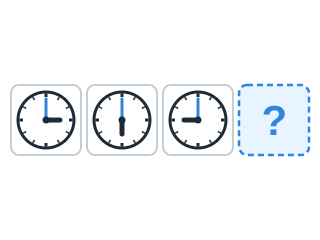
Clocks
Look at the clocks. What time should the next clock show?
Your score
0/10
Scroll down to see the explanation for each question.
Explanations: answer key for all 10 questions
- Q1: Look at the shapes in the picture. Which shape replaces the question mark?
Answer: A triangle
The pattern repeats every three shapes: circle, square, triangle. After circle and square comes the triangle again.
- Q2: The arrow turns in the same direction each time. Which arrow comes next?
Answer: An arrow pointing left
The arrow turns a quarter turn clockwise each step: up, right, down. The next quarter turn makes it point left.
- Q3: How many dots belong in the empty box?
Answer: Five dots
Each box has one more dot than the box before it: 1, 2, 3 and 4. So the next box needs five dots.
- Q4: Each shape has one more side than the one before. Which shape comes next?
Answer: A hexagon
The shapes have 3, 4 and 5 sides: triangle, square and pentagon. A shape with 6 sides is a hexagon.
- Q5: Each circle is shaded a little more than the last. What does the next circle look like?
Answer: A fully shaded circle
The shaded part grows by a quarter each time: one quarter, one half, three quarters. Four quarters make a fully shaded circle.
- Q6: The line turns by the same amount each time. Which line comes next?
Answer: A line from top left to bottom right
The line turns 45 degrees clockwise each step: vertical, sloping, then horizontal. Another 45 degrees gives a line running from top left to bottom right.
- Q7: How many stars belong in the empty box?
Answer: Eight stars
The number of stars doubles each time: 1, 2 and 4. Doubling 4 gives 8 stars.
- Q8: The triangles follow two rules at once. Which triangle comes next?
Answer: A blue triangle pointing up
The direction alternates up and down, while the colors repeat red, blue, green. The fifth triangle points up and is blue.
- Q9: The red dot moves around the square. Where is it next?
Answer: In the bottom left corner
The dot moves clockwise from corner to corner: top left, top right, bottom right. The next corner is bottom left.
- Q10: Look at the clocks. What time should the next clock show?
Answer: 12 o'clock
Each clock is three hours later than the one before: 3, 6 and 9 o'clock. Three hours after 9 o'clock is 12 o'clock.
Shape Sequence Quiz – Seeing the Rule in a Row of Pictures
Shape sequences are picture puzzles. You see a row of shapes that change from one box to the next, and you must work out what belongs in the empty box. Because they use pictures instead of words or numbers, anyone can try them, whatever language they speak. That is why shape puzzles are popular in schools, puzzle books and many aptitude tests.
Most sequences follow one of a few simple rules. A pattern can repeat, like circle, square, triangle. A shape can turn by the same angle each time, like an arrow making quarter turns. Something can grow, such as the number of dots, the number of sides or the shaded part of a circle. Harder puzzles mix two rules at once, for example a color pattern and a direction pattern.
A good method is to look at one feature at a time. First check the shape, then its color, its size, its direction and any small details such as dots. Ask how each feature changes from the first box to the second, then test that idea on the third box. If the rule works everywhere, it will tell you the answer.
Picture puzzles have a long history in testing. In 1938 the British psychologist John C. Raven published Raven's Progressive Matrices, a test built entirely from patterns of shapes. It was designed to measure reasoning without depending on reading skills.
Shapes themselves have been studied for thousands of years. Around 300 BC the Greek mathematician Euclid described triangles, squares and circles in his famous book Elements, which was used in schools for centuries.
Practicing shape sequences trains your eyes to notice detail, helps you stay patient and builds confidence with visual problems at school and at work.
What This Quiz Teaches
This quiz is perfect for students, puzzle fans and visual thinkers.
- Repeating shape patterns
- Rotation by quarter turns and 45 degrees
- Growing counts and doubling
- Shapes that gain sides
- Patterns with two rules at once
- Clock and position patterns
Quick Facts About Shape Puzzles
- A hexagon has 6 sides and an octagon has 8.
- A quarter turn is 90 degrees.
- Raven's Progressive Matrices use no words at all.
- Honeybees build their comb cells as hexagons.
- Euclid's Elements is one of the most printed books in history.
- Shape patterns are often used to teach early math.
Related Quizzes
Ready for another round?
Jump to a random quiz from the archive.