Pattern Recognition Quiz: 10 Patterns in Numbers and Nature
This pattern recognition quiz asks you to spot patterns everywhere, in a string of beads, sunflower spirals and the Fibonacci numbers made famous by Leonardo of Pisa, calendars, number tricks, the QWERTY keyboard, symmetry, spelling, dot triangles, honeycombs and the 9 times table, with a nod to the nature patterns studied by Alan Turing. Ten questions.
Start Pattern Recognition Quiz
🎯 Daily Trivia Challenge • 🧠 10 Questions • ⏱️ 90 Seconds
Colors
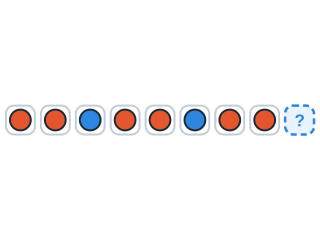
Look at the beads on the string. What color is the missing bead?
Nature
Sunflower seed heads often show spirals in Fibonacci numbers such as 34 and 55. Which of these is also a Fibonacci number?
Calendars
If the 1st of a month is a Monday, what day of the week is the 29th?
Numbers
11 times 11 is 121, and 111 times 111 is 12,321. What is 1,111 times 1,111?
Keyboards
On a standard keyboard, the top row of letters begins Q, W, E, R, T, Y. Which letter comes next?
Symmetry
How many lines of symmetry does this square have?

Words
Pin becomes pine and tap becomes tape. What does hop become?
Dot triangles
The dot triangles grow by a new row each time. How many dots will the next triangle have?

Nature
Honeybees build the cells of their honeycomb in which shape?
Times tables
In the 9 times table, 09, 18, 27 and 36, the tens digit goes up by one each time. What does the ones digit do?
Your score
0/10
Scroll down to see the explanation for each question.
Explanations: answer key for all 10 questions
- Q1: Look at the beads on the string. What color is the missing bead?
Answer: Blue
The beads repeat in groups of three: red, red, blue. The eighth bead is red, so the ninth bead finishes the group with blue.
- Q2: Sunflower seed heads often show spirals in Fibonacci numbers such as 34 and 55. Which of these is also a Fibonacci number?
Answer: 89
In the Fibonacci sequence each number is the sum of the two before it. After 34 and 55 comes 89.
- Q3: If the 1st of a month is a Monday, what day of the week is the 29th?
Answer: Monday
Days of the week repeat every 7 days, and 29 is exactly 28 days, or 4 weeks, after the 1st. So it is also a Monday.
- Q4: 11 times 11 is 121, and 111 times 111 is 12,321. What is 1,111 times 1,111?
Answer: 1,234,321
The pattern climbs and falls: 121, then 12,321, then 1,234,321. It keeps working up to 111,111,111 times itself.
- Q5: On a standard keyboard, the top row of letters begins Q, W, E, R, T, Y. Which letter comes next?
Answer: U
The top letter row of a QWERTY keyboard reads Q, W, E, R, T, Y, U, I, O, P. The layout gets its name from its first six letters.
- Q6: How many lines of symmetry does this square have?
Answer: Four
A square can be folded in half along two straight lines through the middle of its sides and along its two diagonals. That makes four lines of symmetry.
- Q7: Pin becomes pine and tap becomes tape. What does hop become?
Answer: Hope
Adding a silent e to the end changes the short vowel into a long one. Teachers often call this the magic e pattern.
- Q8: The dot triangles grow by a new row each time. How many dots will the next triangle have?
Answer: Ten
The triangles have 1, 3 and 6 dots. The next one adds a row of 4, making 10. These are called triangular numbers.
- Q9: Honeybees build the cells of their honeycomb in which shape?
Answer: Hexagons
Six-sided cells fit together with no gaps and use little wax. Many scientists see the honeycomb as a natural example of an efficient pattern.
- Q10: In the 9 times table, 09, 18, 27 and 36, the tens digit goes up by one each time. What does the ones digit do?
Answer: It goes down by one
The ones digits run 9, 8, 7 and 6, falling by one each step. The two digits of each answer also add up to 9.
Pattern Recognition Quiz – Finding Order Everywhere
Pattern recognition is the ability to notice regularities: things that repeat, grow or follow a rule. It is one of the most basic thinking skills. Babies use it to learn language, scientists use it to find laws of nature, doctors use it to read scans and computers use it to recognize faces and voices.
Patterns appear in many forms. Some are visual, like a string of beads or a tiled floor. Some are in numbers, like the 9 times table or the surprising result of 1,111 times 1,111. Others hide in language, such as the silent e that turns hop into hope, or in everyday objects like calendars and keyboards.
Nature is full of patterns. The Italian mathematician Leonardo of Pisa, known as Fibonacci, introduced Europe to the sequence 1, 1, 2, 3, 5, 8 in his book Liber Abaci in 1202. These numbers often appear in sunflower spirals, pine cones and the arrangement of leaves. Honeybees build hexagonal cells, and snowflakes usually grow with six arms.
In 1952 the British mathematician Alan Turing, famous for his codebreaking and computer science work, published a paper suggesting how chemical reactions could create patterns such as stripes and spots on animals. Such designs are now called Turing patterns.
Good pattern spotters look for what changes and what stays the same. They test their idea on every example before trusting it, because a pattern that fits two cases may fail on the third.
Practicing pattern puzzles strengthens memory, attention and problem solving, and it makes math and science feel more connected to the world around you.
What This Quiz Teaches
This quiz is perfect for curious minds, students and puzzle fans.
- Repeating color patterns
- Fibonacci numbers in nature
- Calendar and keyboard patterns
- Lines of symmetry
- Triangular numbers
- Patterns in the 9 times table
Quick Facts About Patterns
- Snowflakes usually have six arms.
- The QWERTY keyboard layout dates back to typewriters of the 1870s.
- A circle has an endless number of lines of symmetry.
- Zebra stripes help scientists study natural patterns.
- Computers learn to recognize patterns from huge numbers of examples.
- Leonardo of Pisa's Liber Abaci also helped spread Arabic numerals in Europe.
Related Quizzes
Ready for another round?
Jump to a random quiz from the archive.