New Zealand Quiz: Test Your Kiwi & Aotearoa Trivia
New Zealand Trivia Quiz – Facts & History
New Zealand was the first country to give women the vote, in 1893. Test what else you know about its history, wildlife, and culture here.
New Zealand has a habit of getting summed up in a single image — usually sheep, or Hobbiton, or an All Blacks haka — and all of those things are real, but they leave out a country that's stranger and older than the postcard version.
Start New Zealand Quiz
🎯 Daily Trivia Challenge • 🧠 10 Questions • ⏱️ 90 Seconds
Māori History
According to current historical research, during which period did the ancestors of Māori first settle Aotearoa New Zealand?
Early Exploration
What navigation techniques helped Polynesian voyagers reach New Zealand long before European exploration?
European History
What name did Abel Tasman give to the area now known as Golden Bay after a violent encounter with Māori in 1642?
Treaty of Waitangi
Why is the Treaty of Waitangi particularly complex for historians and legal scholars?
Māori Culture
Which important skill brought by Polynesian ancestors was eventually lost in New Zealand, despite pottery traditions existing elsewhere in their Pacific migration?
Natural History
Which extinct New Zealand bird became an important food source for early Māori settlers before being hunted to extinction?
Political History
New Zealand became the first self-governing country in the world to give women the right to vote in national elections in which year?
Language
In what year was te reo Māori formally recognised as an official language of New Zealand?
Colonial History
Why did New Zealand decline to become a state of the Australian Commonwealth in 1901?
Economic History
What technological development in 1882 dramatically expanded New Zealand's ability to export meat to Britain?
Your score
0/10
Scroll down to see the explanation for each question.
Explanations: answer key for all 10 questions
- Q1: According to current historical research, during which period did the ancestors of Māori first settle Aotearoa New Zealand?
Answer: Around 1250–1300 CE
- Q2: What navigation techniques helped Polynesian voyagers reach New Zealand long before European exploration?
Answer: Stars, ocean currents, and prevailing winds
- Q3: What name did Abel Tasman give to the area now known as Golden Bay after a violent encounter with Māori in 1642?
Answer: Murderers' Bay
- Q4: Why is the Treaty of Waitangi particularly complex for historians and legal scholars?
Answer: The Māori and English versions contain important differences in meaning
- Q5: Which important skill brought by Polynesian ancestors was eventually lost in New Zealand, despite pottery traditions existing elsewhere in their Pacific migration?
Answer: Pottery making
- Q6: Which extinct New Zealand bird became an important food source for early Māori settlers before being hunted to extinction?
Answer: Moa
- Q7: New Zealand became the first self-governing country in the world to give women the right to vote in national elections in which year?
Answer: 1893
- Q8: In what year was te reo Māori formally recognised as an official language of New Zealand?
Answer: 1987
- Q9: Why did New Zealand decline to become a state of the Australian Commonwealth in 1901?
Answer: New Zealand had developed its own political identity and feared losing its growing independence
- Q10: What technological development in 1882 dramatically expanded New Zealand's ability to export meat to Britain?
Answer: Successful refrigerated shipping
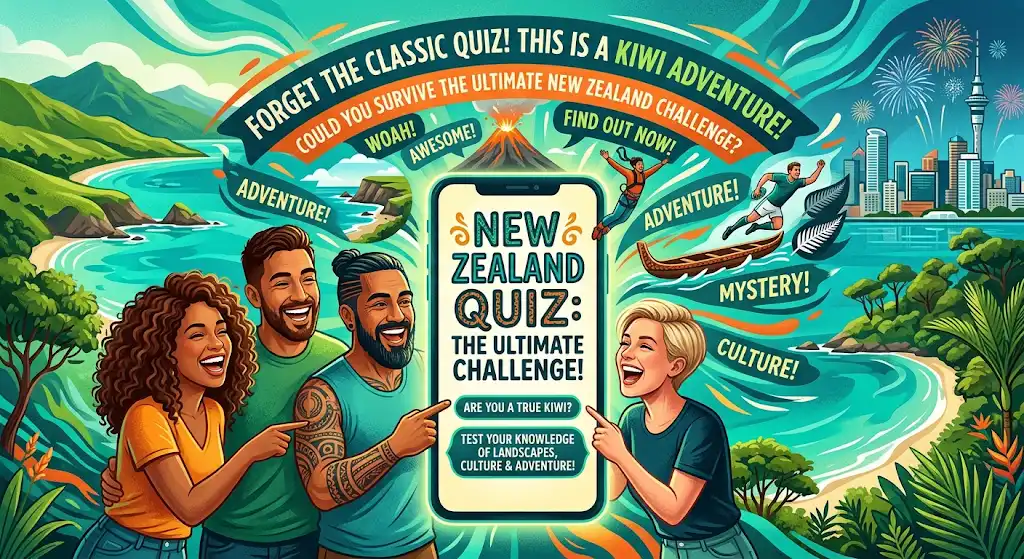
It's one of the last major landmasses humans ever settled, with Polynesian voyagers arriving by canoe sometime around the 1300s, centuries after people had already been living in most other parts of the world. It also broke off from the ancient supercontinent Gondwana so early that entire branches of wildlife evolved there with basically no mammal competition, which is part of why the country ended up with birds that forgot how to fly.
This quiz covers geography, Māori history and language, wildlife, and a handful of pop culture facts that tend to trip people up — including the country most visitors assume is the capital and get wrong.
Fun fact
New Zealand was the first country in the world to give women the right to vote in parliamentary elections, back in 1893 — nearly three decades before the United States and over two decades before most of Europe.
Sample question explanations
Q: What is the capital city of New Zealand?
Answer: Wellington
Auckland is the biggest and most well-known city, so it's the answer most people guess, but Wellington took over as capital in 1865. The government moved it from Auckland partly because Wellington sits closer to the middle of the country, which made it more practical for representatives traveling from the South Island.
Q: What is the Māori name for New Zealand?
Answer: Aotearoa
It's usually translated as "land of the long white cloud," referring to the cloud formations early Polynesian voyagers reportedly spotted while approaching by sea. The name has become increasingly common in official and everyday use alongside "New Zealand" over the past few decades.
Q: What is the kiwi, New Zealand's national bird, unable to do?
Answer: Fly
Kiwis are flightless, nocturnal, and lay eggs that are enormous relative to their body size — sometimes up to 20 percent of the female's weight. With no native land mammals to prey on them for millions of years, they never had much evolutionary pressure to keep their wings functional.
Q: What 1840 agreement is considered New Zealand's founding document?
Answer: The Treaty of Waitangi
It was signed between the British Crown and more than 500 Māori chiefs, though the English and Māori versions of the text didn't say quite the same thing, which has fueled legal and political disputes ever since. February 6, the anniversary of the signing, is now a national holiday.
Q: Which mountain is recognized in Māori tradition as sacred and, since 2014, holds legal personhood status?
Answer: Mount Taranaki
In 2014, Te Urewera became the first natural feature in the world granted legal personhood, and Mount Taranaki followed in 2017, meaning the mountain is legally recognized as a person with its own rights, represented by Māori and Crown-appointed guardians.
What this quiz is about
This one's built around the gap between how outsiders picture New Zealand and how the country actually works — its Indigenous history, its wildlife found nowhere else on Earth, and a few civic firsts that don't get nearly enough credit internationally.
Ready for another round?
Jump to a random quiz from the archive.