Netherlands Quiz: Test Your Knowledge of Dutch Geography & History
Are you a true geography and culture fan? Take this Netherlands trivia quiz to test your knowledge on Dutch history, iconic landmarks, windmills, and fun facts.
Did You Know? The Netherlands is the lowest-lying country in Europe, with over 26% of its land area sitting below sea level. In fact, if the Dutch hadn’t built their world-famous system of dikes, dams, and windmills, half of the country would regularly be underwater. Last Updated: September 7, 2026
Start Netherlands Quiz
🎯 Daily Trivia Challenge • 🧠 10 Questions • ⏱️ 90 Seconds
Dutch Geography
Which province is known for having a large part of its territory below sea level?
Dutch History
Which 1648 treaty formally recognized the independence of the Dutch Republic from Spain?
Dutch Art
Which painter created The Garden of Earthly Delights?
Water Management
What was the primary purpose of the Zuiderzee Works?
Dutch Science
Which Dutch scientist was the first person to observe microorganisms using a microscope?
Dutch Cities
Which Dutch city is traditionally associated with the Peace of Münster negotiations?
Dutch Architecture
Why are many historic Amsterdam canal houses unusually narrow and tall?
Dutch Culture
What is the traditional Dutch celebration known as King's Day primarily associated with?
Dutch Language
Which language is officially recognized alongside Dutch in the province of Friesland?
Unusual Netherlands
Which statement about the Netherlands is geographically unusual?
Your score
0/10
Scroll down to see the explanation for each question.
Explanations: answer key for all 10 questions
- Q1: Which province is known for having a large part of its territory below sea level?
Answer: Flevoland
Flevoland was largely created through land reclamation from the former Zuiderzee. Much of the province lies below sea level, making it one of the world's most notable examples of large-scale reclaimed land.
- Q2: Which 1648 treaty formally recognized the independence of the Dutch Republic from Spain?
Answer: Peace of Westphalia
The Peace of Münster, part of the wider Peace of Westphalia in 1648, formally recognized the Dutch Republic's independence from Spain. It marked the end of the long Eighty Years' War.
- Q3: Which painter created The Garden of Earthly Delights?
Answer: Hieronymus Bosch
Hieronymus Bosch created The Garden of Earthly Delights around the turn of the 16th century. The triptych is famous for its bizarre imagery, symbolic figures, and complex depiction of paradise, earthly life, and hell.
- Q4: What was the primary purpose of the Zuiderzee Works?
Answer: To reclaim land and reduce the threat of flooding
The Zuiderzee Works transformed a large former sea into a freshwater lake called the IJsselmeer while creating extensive polders. The project dramatically changed the geography of the Netherlands and provided new agricultural land.
- Q5: Which Dutch scientist was the first person to observe microorganisms using a microscope?
Answer: Antonie van Leeuwenhoek
Antonie van Leeuwenhoek used powerful handmade microscopes in the 17th century to observe bacteria, protozoa, and other microscopic life. His observations helped establish the foundations of microbiology.
- Q6: Which Dutch city is traditionally associated with the Peace of Münster negotiations?
Answer: Münster
The Peace of Münster was negotiated and signed in the German city of Münster in 1648. It formally ended the war between Spain and the Dutch Republic and formed part of the wider Peace of Westphalia.
- Q7: Why are many historic Amsterdam canal houses unusually narrow and tall?
Answer: Building plots were taxed or priced according to their street frontage
Limited and valuable canal-front property encouraged narrow building plots, while height and depth allowed owners to maximize usable space. The resulting tall, narrow façades became one of Amsterdam's most recognizable architectural features.
- Q8: What is the traditional Dutch celebration known as King's Day primarily associated with?
Answer: The birthday of the reigning monarch
King's Day, or Koningsdag, celebrates the birthday of the reigning Dutch monarch. The country famously turns orange for the festivities, reflecting the historical association of the Dutch royal family with the House of Orange.
- Q9: Which language is officially recognized alongside Dutch in the province of Friesland?
Answer: West Frisian
West Frisian, known locally as Frysk, has official status alongside Dutch in the province of Friesland. It is one of the closest living relatives of the English language.
- Q10: Which statement about the Netherlands is geographically unusual?
Answer: A significant portion of the country consists of reclaimed land
A substantial portion of the Netherlands has been reclaimed from water through polders, dikes, drainage systems, and large engineering projects. The Dutch landscape is therefore partly a product of centuries of deliberate water management.
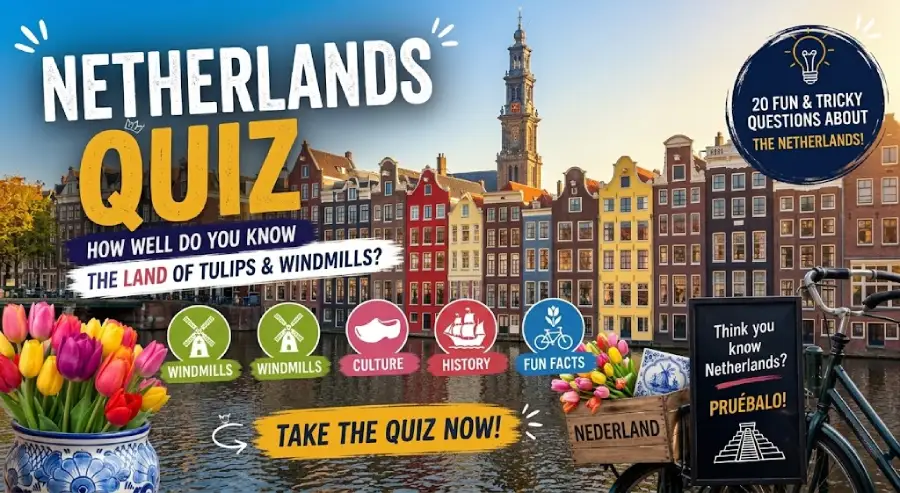
Netherlands Quiz: Test Your Knowledge of the Low Countries
Are you ready to test your knowledge about windmills, tulips, and historic canals? Welcome to the ultimate Netherlands trivia challenge. Designed specifically for geography buffs, culture enthusiasts, and trivia addicts, this quiz takes you on a journey through Dutch history, iconic landmarks, unique traditions, and daily life in modern Holland.
Whether you are preparing for a trip to Amsterdam, studying European geography, or simply love a good trivia session with friends, this quiz challenges how well you really know one of Western Europe's most fascinating nations.
Fast Facts About the Netherlands
The Orange Obsessing: Orange is the national color of the Netherlands due to the Royal House of Orange-Nassau, even though the national flag is red, white, and blue.
Bicycles Outnumber People: There are over 23 million bicycles in the Netherlands for a population of roughly 18 million residents.
Tulip Mania History: In the 17th century, tulip bulbs were so valuable in the Netherlands that they caused the world's first recorded financial asset bubble.
World's Tallest Citizens: On average, Dutch men and women are recorded as the tallest people in the world.
Inventors of Modern Commerce: The Dutch East India Company established the world's first formal stock exchange in Amsterdam back in 1602.
Wooden Clogs (Klompen): Traditional wooden shoes have been worn in the region since the Middle Ages and remain popular among farmers and gardeners for safety and insulation.
The Carrot Evolution: Dutch growers in the 17th century cultivated orange carrots as a tribute to William of Orange, popularizing the orange variety we eat today over yellow and purple carrots.
Grown Under Sea Level: Schiphol Airport near Amsterdam sits more than three meters below sea level on what used to be the bottom of a large lake.
Polder Pioneer Work: The Dutch created entire provinces, such as Flevoland, by reclaiming land directly from the sea through an advanced engineering practice called poldering.
Capital vs. Government: Amsterdam is the constitutional capital city of the nation, but the seat of government, parliament, and the supreme court are located in The Hague.
Gouda and Edam Mastery: The country is one of the world's largest exporters of cheese, named after historical trading towns like Gouda and Edam.
Windmill Power Origins: Traditional Dutch windmills were primarily built to pump water out of low-lying marshes into canals, not to grind grain.
What Does This Quiz Teach & What Is Its Purpose?
This quiz is designed to broaden your global awareness while strengthening your memory of European geography, culture, and history.
By completing this challenge, you will:
Master Essential Geography: Identify key geographic landmarks, major cities, and environmental adaptations unique to the Low Countries.
Understand Cultural Heritage: Discover the origins behind famous symbols like tulips, windmills, orange traditions, and world-class Dutch art.
Learn Engineering Marvels: Gain insights into how land reclamation and flood control systems shaped the modern European landscape.
Enhance Educational Retention: Engage with high-retention facts through interactive question formats that make learning stick faster than standard textbooks.
Ready for another round?
Jump to a random quiz from the archive.