
Mirrors Don't Actually Flip Left and Right, Your Brain Just Insists They Do
A Question That Sounds Simple and Isn't
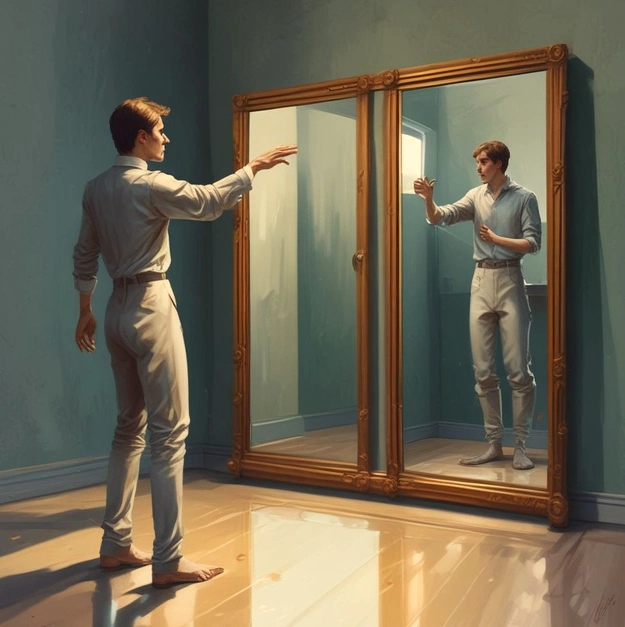
Stand in front of a mirror and raise your right hand, and your reflection appears to raise its left hand instead. It's such a familiar experience that most people never stop to question why, but the moment you try to explain it precisely, the explanation gets surprisingly slippery. The honest answer is that a mirror doesn't reverse left and right at all. It reverses front and back. The left-right confusion is entirely something the human brain is doing, not something the mirror itself is doing.
What a Mirror Actually Does, Physically
A flat mirror reflects light in a very specific, predictable way, each ray of light bounces off the mirror's surface at the same angle it arrived at, reversing only the direction perpendicular to the mirror's surface, meaning depth, the front-to-back axis, gets flipped. Nothing about the mirror's physics treats left and right differently from up and down. If a mirror genuinely reversed left-right specifically, tilting your head sideways in front of one should look strange or inconsistent compared to standing upright, but it doesn't, the reflection behaves consistently no matter how the body is oriented, which is itself a clue that the reversal isn't really a left-right phenomenon at all.
Reflecting on Paper Makes It Obvious
Hold up a piece of paper with the word "LEFT" written on it toward a mirror, and the reflection shows the letters reversed, appearing to read backward. Nothing about left and right was singled out here either, what actually happened is that the front of the page, the side facing the mirror, got swapped with the back, and because reading direction runs horizontally, that front-back swap happens to show up as what looks like a horizontal flip. If the same word were written vertically and reflected, the apparent reversal would show up top-to-bottom instead, immediately clarifying that the mirror isn't doing anything specifically tied to the horizontal axis.
Why Human Bodies Make This Especially Confusing
The reason this effect feels so specifically tied to left and right, rather than up and down, comes down to human anatomy and how people mentally map their own bodies. Human bodies are roughly bilaterally symmetric, a left side and right side that mirror each other reasonably closely, while the front-back and top-bottom axes are clearly, obviously different, a face doesn't look anything like the back of a head, and feet don't resemble a scalp. Because left and right sides of the body look so similar to begin with, the brain has to rely on an internal, learned convention, rather than any obvious physical asymmetry, to determine which hand is which. When we look at a mirror reflection, our brain mentally imagines "becoming" the person in the mirror, rotating our own sense of orientation to match theirs, and that imagined rotation is what actually introduces the left-right swap, not the mirror itself.
The Mental Rotation Trick
Specifically, when people interpret a mirror image of themselves, they instinctively imagine walking around to face the same direction the reflection appears to be facing, essentially performing a mental 180-degree rotation around a vertical axis. That imagined rotation swaps left and right from the observer's own frame of reference, purely because rotating around a vertical axis is exactly the kind of rotation that swaps left-right while leaving top-bottom untouched. If, instead, someone imagined flipping to face the reflection by rotating around a horizontal axis, essentially imagining themselves doing a handstand to align with the reflection, the apparent reversal would show up as top-bottom instead, further reinforcing that the "left-right flip" is really a byproduct of the specific mental rotation the brain defaults to, not something inherent to the mirror.
Cameras and Screens Complicate the Intuition Further
This gets even more counterintuitive once video calls and selfie cameras enter the picture, since digital front-facing cameras often display a mirrored image by default for a more natural, mirror-like viewing experience while framing a shot, but the image actually saved or transmitted is frequently un-mirrored, flipped back to show the scene as it would appear to someone else looking at you rather than as you see yourself in a bathroom mirror. This is part of why text or logos on clothing sometimes appear backward on a live video preview but correctly oriented once a photo is actually saved, a small, practical illustration of how mirroring and un-mirroring are deliberate technical choices layered on top of the same basic optical principle, rather than some fixed, unavoidable property of cameras or screens.
Symmetrical Objects Reveal the Illusion Even Faster
Objects lacking the kind of implied left-right identity a human body has make this whole effect much easier to see clearly. A perfectly symmetrical object, a plain circle, a symmetrical vase, shows no apparent left-right reversal in a mirror at all, because there's no meaningful "left side" or "right side" for the brain to reassign in the first place, front-back swapping simply doesn't manifest as a noticeable left-right effect when the object doesn't have handedness to begin with. It's only with objects, letters, or bodies that carry an inherent sense of directional identity, a hand, a written word, a face, that the mirror's actual front-back reversal gets mentally reinterpreted as a left-right one.
An Optical Fact Wrapped in a Cognitive Habit
The enduring appeal of the mirror puzzle comes from how convincingly it disguises a purely psychological interpretation as a physical property of the mirror itself. The glass or polished surface is doing exactly one consistent thing, every single time, reversing the axis perpendicular to its surface. Left and right only ever seem swapped because human brains, faced with a reflection, default to imagining a specific kind of rotation to make sense of what they're looking at, and that imagined rotation, not the mirror's optics, is where the actual left-right confusion originates.