
Miami Quiz: 10 Fun Questions About Miami, Florida
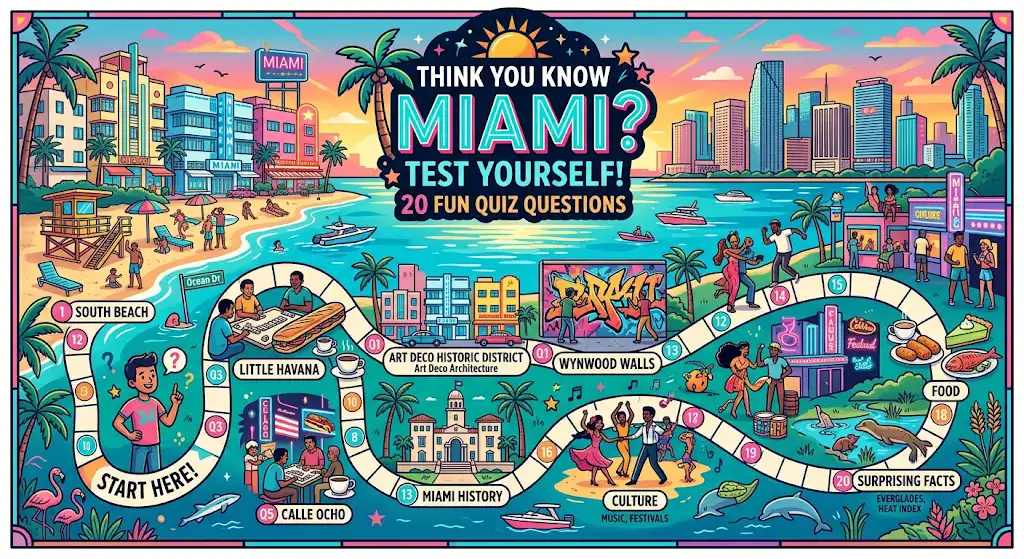
Miami is the only place where your weather app can say “100% chance of rain” and you still put on sunglasses :P. Miami has two seasons: hot and “why is my shirt wet?” 😂
Start Miami Quiz
🎯 Daily Trivia Challenge • 🧠 10 Questions • ⏱️ 90 Seconds
Miami has a reputation for beaches, palm trees, sunshine, and a nightlife scene that seems to have forgotten what bedtime means. But there is much more to this Florida city than South Beach selfies. From the colorful streets of Little Havana and the murals of Wynwood to Art Deco landmarks, historic neighborhoods, Cuban culture, and the wild landscapes of South Florida, Miami has plenty of stories hiding behind its famous skyline. This Miami quiz puts your knowledge to the test with questions about the places, people, history, culture, architecture, food, and natural wonders that helped shape the city.
A Little Miami Humor Before We Start
Miami weather has its own personality.
You can leave the hotel wearing sunglasses, walk a few blocks, get caught in a rain shower, and then be back in bright sunshine before you have finished complaining about it.
In Miami, apparently, even the weather likes to keep things interesting.
What Is This Miami Quiz About?
This Miami quiz is designed for anyone who wants to test their knowledge of one of the most recognizable cities in Florida. The questions cover Miami's history, famous neighborhoods, beaches, architecture, Cuban-American culture, art, food, downtown landmarks, and the natural environment surrounding South Florida. Some questions are straightforward, while others are designed to make you stop and think. You do not need to be a Miami local to play, but knowing the difference between South Beach, Little Havana, and Wynwood certainly will not hurt.
Miami History: A City With a Surprisingly Young Name
Miami may feel like a city with a very long history, but the city itself was officially incorporated in 1896.
That does not mean the Miami area suddenly appeared in the 1890s. Long before modern Miami existed, Indigenous peoples lived in the region, including the Tequesta, whose history is deeply connected to South Florida.
The arrival of Henry Flagler's Florida East Coast Railway played an important role in Miami's early development. The railroad helped connect the area with the rest of Florida and contributed to the rapid growth that followed.
So when a quiz question asks when Miami was incorporated, remember the year 1896.
It is one of those dates that sounds easy until you are staring at four answer choices.
South Beach: More Than Sand and Sunshine
South Beach is probably the first place many people picture when they hear the word Miami.
Located on the southern end of Miami Beach, South Beach is famous for its wide sandy shoreline, Ocean Drive, restaurants, nightlife, and distinctive architecture.
But there is a trick here.
South Beach is not just about the beach.
Its historic streets are filled with colorful buildings, geometric designs, decorative details, and neon signs that helped make Miami's Art Deco architecture famous around the world.
If a Miami quiz question mentions Ocean Drive, pastel-colored buildings, and 1930s architecture, there is a very good chance that Art Deco is hiding somewhere in the answer choices.
Art Deco: Miami's Most Recognizable Architecture
Few architectural styles are as closely associated with Miami Beach as Art Deco.
The Miami Beach Architectural District contains hundreds of historic buildings, many of them dating from the 1930s and 1940s. Their streamlined shapes, rounded corners, geometric decorations, porthole-style windows, and bright colors give the area a look that is difficult to confuse with anywhere else.
The style became one of the defining visual features of Miami Beach.
And honestly, it is hard to imagine Ocean Drive without it.
Art Deco is one of those subjects that makes an excellent quiz category because the buildings may look familiar even when people do not know what the architectural style is called.
That is exactly the kind of question a good quiz should ask.
Little Havana: The Cuban Heart of Miami
If Miami has a neighborhood where culture can be experienced around almost every corner, Little Havana is a strong candidate.
The neighborhood became a major center of Cuban-American life after large numbers of Cuban immigrants arrived in Miami beginning in the 1960s.
Calle Ocho, or Southwest 8th Street, is at the heart of the neighborhood.
Little Havana is known for Cuban food, coffee, music, art, colorful streets, and the lively atmosphere surrounding its restaurants and local businesses.
Then there is Domino Park, where dominoes became part of the neighborhood's social culture.
And, of course, there is cafecito.
A Miami quiz without at least one question about Little Havana would be leaving a very important piece of Miami's identity off the table.
Wynwood: Where the Walls Became Art
Wynwood gives Miami a completely different personality.
The neighborhood became internationally known for its street art, murals, galleries, restaurants, and creative spaces.
The Wynwood Walls helped turn the area into one of the city's best-known destinations for large-scale outdoor art.
Walking through Wynwood can feel less like visiting a traditional art museum and more like wandering through a giant open-air gallery.
The walls are colorful, enormous, and impossible to ignore.
If your quiz question mentions murals, graffiti-style artwork, and an artistic Miami neighborhood, Wynwood should be near the top of your list.
And yes, this is one Miami neighborhood where taking a picture of a wall is completely normal.
Coconut Grove: One of Miami's Historic Neighborhoods
Coconut Grove offers a very different side of Miami.
The neighborhood has roots that go back to the 19th century and is considered one of the city's oldest continuously settled communities.
Instead of the high-energy atmosphere associated with South Beach, Coconut Grove is known for its greenery, waterfront setting, historic character, restaurants, shops, and relaxed atmosphere.
Its history includes strong connections to Bahamian settlers and other early communities that helped shape the area.
This makes Coconut Grove an excellent reminder that Miami did not begin with skyscrapers and luxury hotels.
There was a much older community here long before today's modern skyline appeared.
Coral Gables: Mediterranean Style in South Florida
Coral Gables looks like someone decided Miami needed a little Mediterranean influence.
The city is famous for its Mediterranean Revival architecture, tree-lined streets, planned neighborhoods, and landmarks such as the Biltmore Hotel and Venetian Pool.
Miracle Mile is another well-known part of Coral Gables, offering shops, restaurants, and entertainment in the heart of the city.
The architecture is one of the biggest clues when identifying Coral Gables in a quiz.
If the question gives you Mediterranean-inspired buildings, fountains, courtyards, and elegant streets, do not immediately think South Beach.
You may be in Coral Gables.
Downtown Miami and Brickell: The Modern Skyline
Miami is not all historic buildings and beach houses.
Downtown Miami and Brickell represent the city's modern, high-rise side.
Brickell is often associated with finance, luxury residential towers, restaurants, hotels, and one of the most recognizable urban skylines in South Florida.
Downtown is also home to major cultural attractions and institutions.
The contrast is fascinating.
You can spend part of the day looking at historic Art Deco buildings and later find yourself surrounded by glass skyscrapers and busy city streets.
That contrast is part of what makes Miami such an interesting quiz subject.
Miami's Beaches: The Obvious Answer That Isn't Always the Answer
Miami's beaches are famous, but a good quiz can make even a simple beach question surprisingly tricky.
Miami Beach and the city of Miami are not the same municipality.
Miami is located on the mainland, while Miami Beach occupies barrier islands across Biscayne Bay.
South Beach is part of Miami Beach, not the City of Miami.
That distinction is easy to overlook, especially if you are thinking about Miami as one giant beach destination.
So if a quiz asks where South Beach is located, slow down before choosing Miami.
The answer may be more specific than you think.
Miami's Food Culture: More Than Cuban Sandwiches
Food is one of the easiest ways to understand Miami's cultural diversity.
Cuban cuisine has a major influence, particularly in Little Havana, where Cuban sandwiches, croquetas, pastelitos, and strong Cuban coffee are popular.
But Miami's food scene goes far beyond Cuban cuisine.
The city's Caribbean, Latin American, Haitian, Bahamian, and American influences have created a food culture that is remarkably diverse.
You can find seafood, Caribbean dishes, Latin American specialties, international cuisine, and countless variations on familiar American favorites.
In other words, asking what Miami food is like is a little like asking how many tabs someone has open on their computer.
The answer is probably: too many to count.
Little Haiti: Another Important Piece of Miami
Little Haiti is another neighborhood that demonstrates how much of Miami's identity comes from immigration and cultural exchange.
The area became an important center for Haitian culture, particularly after Haitian immigrants began arriving in large numbers during the late 20th century.
Haitian Creole, Haitian food, music, art, and community traditions all contribute to the neighborhood's identity.
For a Miami quiz, Little Haiti provides an excellent opportunity to move beyond the city's most famous tourist attractions and explore the communities that helped make Miami what it is today.
Miami's Black History: Historic Overtown
Historic Overtown is another neighborhood with an important place in Miami's story.
The area became a major center of Black life, business, entertainment, and culture during the early development of Miami.
During the era of racial segregation, Black entertainers who performed in Miami Beach hotels were often unable to stay there because of discriminatory policies. Many instead stayed and performed in Overtown.
The neighborhood became known for its music and entertainment scene, earning a reputation as the "Little Broadway" of Miami.
Its history is an important reminder that Miami's story includes much more than tourism and beaches.
Biscayne Bay: The Water That Helped Shape Miami
Biscayne Bay is one of the defining geographical features of Miami.
The bay separates the mainland from Miami Beach and the barrier islands while providing the waterfront setting that has influenced the city's development, transportation, recreation, and identity.
When you look at Miami's skyline from the water, you can see how closely the city is connected to Biscayne Bay.
For quiz purposes, remember this simple connection:
Miami + waterfront + Miami Beach separation = Biscayne Bay.
It is one of those facts that seems obvious after you know it.
Before that, it can be surprisingly easy to mix up.
Everglades and South Florida's Wild Side
Now for the part of Miami that does not involve skyscrapers.
The Everglades.
South Florida's famous wetland ecosystem is one of the most distinctive natural environments in the United States.
The Everglades is home to a remarkable variety of wildlife and plants, and the ecosystem plays an important role in the environmental story of South Florida.
Alligators are certainly among its most famous residents, but the Everglades is much more than an alligator habitat.
Its wetlands, waterways, sawgrass landscapes, and wildlife make it one of the region's most important natural treasures.
So if your Miami quiz suddenly changes from Art Deco buildings to wetlands and alligators, do not panic.
The quiz has simply left the city for a moment.
Miami's Multicultural Identity
Perhaps the most interesting thing about Miami is that there is no single culture that explains the entire city.
Cuban and broader Latin American influences are especially visible, but Miami has also been shaped by Haitian, Bahamian, Caribbean, Black American, and many other communities.
That diversity can be seen in neighborhoods, restaurants, music, festivals, architecture, languages, and everyday life.
It is one reason Miami feels different from many other American cities.
The city is not simply Florida with palm trees.
It is a meeting point where different cultures have influenced one another for generations.
Miami Quick Facts
- Miami was officially incorporated in 1896.
- South Beach is part of Miami Beach.
- Ocean Drive is strongly associated with Miami Beach's Art Deco architecture.
- Little Havana is closely associated with Cuban-American culture.
- Calle Ocho means "Eighth Street" in Spanish.
- Wynwood is famous for large-scale murals and street art.
- Coconut Grove is one of Miami's oldest continuously settled communities.
- Coral Gables is known for Mediterranean Revival architecture.
- Brickell is one of Miami's major modern business and residential districts.
- Biscayne Bay separates mainland Miami from Miami Beach.
- The Everglades is one of South Florida's defining natural ecosystems.
- Little Haiti is an important center of Haitian culture in Miami.
- Historic Overtown has deep roots in Miami's Black history and entertainment culture.
Ready for the Miami Quiz?
Now that you have walked through Miami's history, neighborhoods, architecture, food, culture, beaches, and wild side, it is time to find out how much you actually remember.
Some questions may look easy.
Others may make you stare at the screen for a few seconds and think, "I know this... I definitely know this..."
That's when things get interesting.
Grab your best guess, trust your Miami instincts, and see how many of the 20 questions you can answer correctly.
Good luck — and welcome to Miami!