Ultimate Martin Luther King Jr. Quiz: How Well Do You Know MLK?
Martin Luther King Jr. Quiz
20 Questions · Est. Reading 6 MinMartin Luther King Jr. was 26 years old when he got pulled into leading the Montgomery bus boycott almost by accident — he was the new pastor in town, hadn't yet built a political reputation, and was seen as a compromise choice nobody would object to. That boycott lasted 381 days and ended with the Supreme Court striking down bus segregation in Alabama. It also turned a young preacher from Atlanta into the face of a movement he'd spend the rest of his life leading, often at real personal cost: he was arrested nearly thirty times, his home was bombed, and he was stabbed in New York years before he was shot in Memphis.
Start Martin Luther King Jr. Quiz
🎯 Daily Trivia Challenge • 🧠 10 Questions • ⏱️ 90 Seconds
Early Life
What was Martin Luther King Jr.'s birth name before his father later changed both of their names?
Education
Which subject was Martin Luther King Jr. studying when he earned his doctorate from Boston University?
Civil Rights History
Which organization did King help establish in 1957 to coordinate nonviolent civil rights campaigns across the South?
Montgomery
Before the Montgomery bus boycott began, which local organization selected Martin Luther King Jr. as its president?
Literature
Which 1964 book by Martin Luther King Jr. was based largely on his experiences during the Birmingham campaign?
Chicago Campaign
During King's 1966 Chicago campaign, what major issue did he increasingly focus on outside the traditional Southern civil rights struggle?
Nobel Prize
At the age of 35, Martin Luther King Jr. became the youngest recipient of the Nobel Peace Prize at the time. What did he announce he would do with the prize money?
Selma
What specific voting-rights issue was central to the Selma campaign that King joined in 1965?
Later Work
Which issue became increasingly important to King during the final years of his life as he expanded his activism beyond racial segregation?
Final Campaign
What was the main purpose of the Poor People's Campaign that King was organizing shortly before his death?
Your score
0/10
Scroll down to see the explanation for each question.
Explanations: answer key for all 10 questions
- Q1: What was Martin Luther King Jr.'s birth name before his father later changed both of their names?
Answer: Michael King Jr.
- Q2: Which subject was Martin Luther King Jr. studying when he earned his doctorate from Boston University?
Answer: Systematic Theology
- Q3: Which organization did King help establish in 1957 to coordinate nonviolent civil rights campaigns across the South?
Answer: Southern Christian Leadership Conference
- Q4: Before the Montgomery bus boycott began, which local organization selected Martin Luther King Jr. as its president?
Answer: Montgomery Improvement Association
- Q5: Which 1964 book by Martin Luther King Jr. was based largely on his experiences during the Birmingham campaign?
Answer: Why We Can't Wait
- Q6: During King's 1966 Chicago campaign, what major issue did he increasingly focus on outside the traditional Southern civil rights struggle?
Answer: Housing discrimination
- Q7: At the age of 35, Martin Luther King Jr. became the youngest recipient of the Nobel Peace Prize at the time. What did he announce he would do with the prize money?
Answer: Donate it to civil rights organizations
- Q8: What specific voting-rights issue was central to the Selma campaign that King joined in 1965?
Answer: The exclusion of Black voters through discriminatory registration practices
- Q9: Which issue became increasingly important to King during the final years of his life as he expanded his activism beyond racial segregation?
Answer: Economic inequality and poverty
- Q10: What was the main purpose of the Poor People's Campaign that King was organizing shortly before his death?
Answer: To demand economic justice for poor Americans of all races
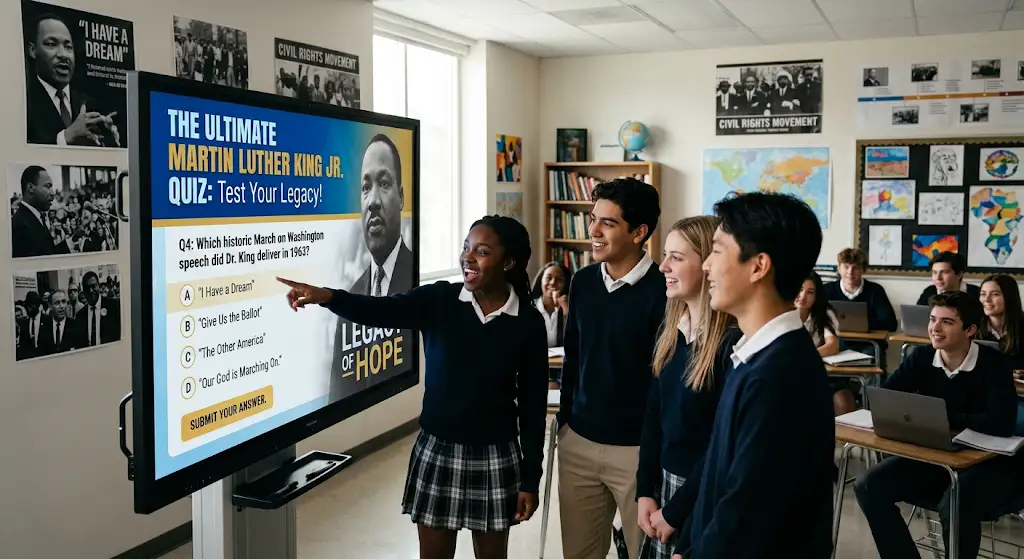
What gets flattened in a lot of textbook summaries is how much organizing work sat underneath the famous moments. The March on Washington took months of coordination between multiple civil rights groups who didn't always agree with each other. The Nobel Prize came the same year Congress passed the Civil Rights Act, but King gave the prize money away to the movement rather than keeping it. This quiz digs into some of that fuller picture — the dates people mix up, the cities that mattered, and a few details that don't make it into the one-paragraph version of his life.
In what city was Martin Luther King Jr. born?
✓ Atlanta, Georgia
He was born on January 15, 1929, in a house on Auburn Avenue that's now part of the Martin Luther King Jr. National Historical Park. His birth name was actually Michael King Jr. — his father changed both their names after a 1934 trip to Germany.
What organization did King help found in 1957 to coordinate protest across the South?
✓ The Southern Christian Leadership Conference (SCLC)
King served as its first president. The group was built around Black churches specifically, since congregations already had organizing structures, meeting spaces, and networks that a brand-new political group would have taken years to build from scratch.
At what landmark did King address the crowd during the 1963 March on Washington?
✓ The Lincoln Memorial
Roughly a quarter of a million people gathered on the National Mall on August 28, 1963. King spoke last, in the late afternoon, after a full day of music and speeches from other civil rights leaders.
How old was King when he received the Nobel Peace Prize in 1964?
✓ 35
He remains one of the youngest people ever to win the prize. He donated the entire $54,000 award to the civil rights movement rather than keeping any of it for himself.
King was assassinated in 1968 while supporting a strike by which group of workers?
✓ Memphis sanitation workers
He'd traveled to Memphis to back a strike over pay and unsafe conditions after two sanitation workers were killed on the job. He was shot on April 4, 1968, while standing on the balcony of the Lorraine Motel.
When is Martin Luther King Jr. Day observed in the United States?
✓ The third Monday of January
Congress passed the holiday in 1983, but it took another fifteen years before all fifty states officially observed it — Arizona and New Hampshire were among the last holdouts, into the late 1990s.
A lot of what King's remembered for happened in about thirteen years, between the Montgomery boycott in 1955 and his death in 1968. However you scored, it's worth sitting with how much organizing, risk, and plain persistence sat behind each of these dates.
End of RecordReady for another round?
Jump to a random quiz from the archive.