
Japanese Food Quiz – Sushi, Ramen & More Trivia
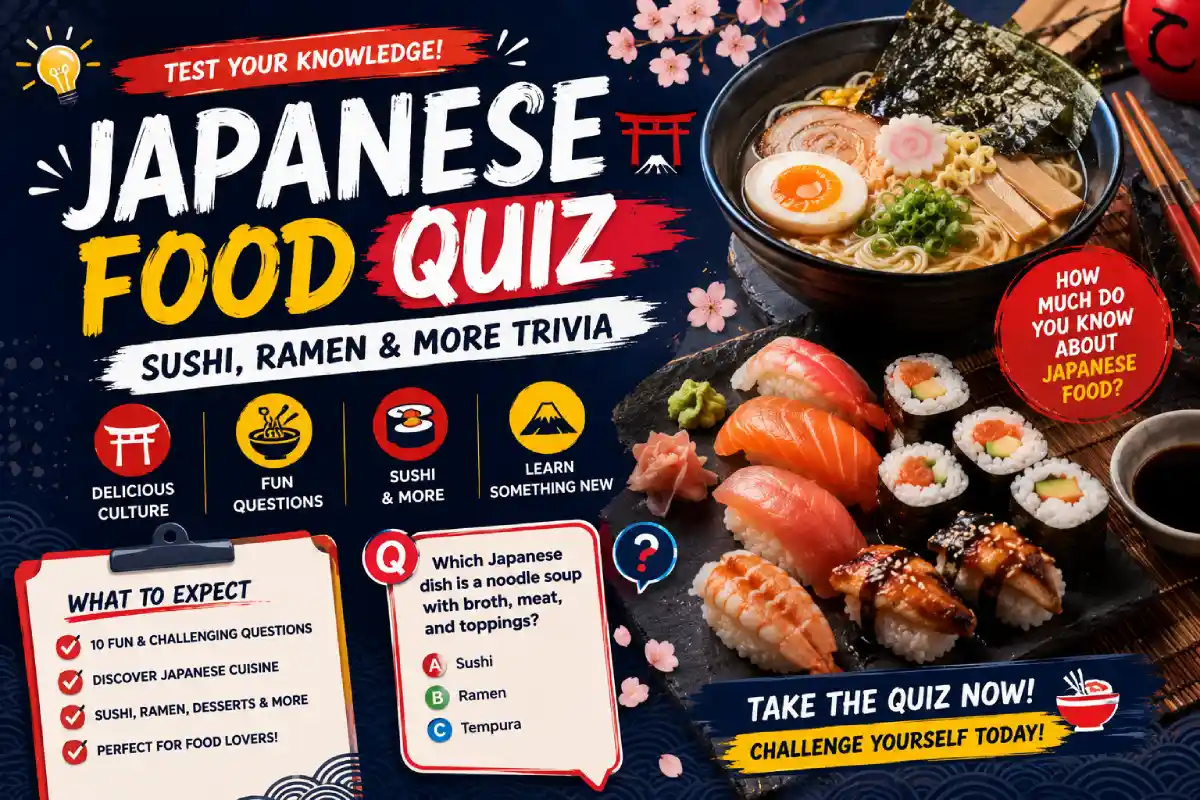
Japanese Food Quiz: How Well Do You Know Japan's Cuisine?
Here's something that catches a lot of people off guard: the wasabi served at most sushi restaurants outside Japan, and honestly at plenty inside Japan too, isn't real wasabi. Actual wasabi root is notoriously hard to grow, expensive, and loses its punch within about 15 minutes of being grated, so the vast majority of what gets served is a mix of horseradish, mustard, and green food coloring doing a convincing impression.
Take this free Japanese food quiz covering sushi, ramen, wagyu beef, and more. How much do you actually know about Japanese cuisine?
Start Japanese Food Quiz
🎯 Daily Trivia Challenge • 🧠 10 Questions • ⏱️ 90 Seconds
That kind of gap between the popular version and the real thing runs through a lot of Japanese food history — tempura actually came from Portuguese missionaries in the 1500s, and instant ramen was invented by a man watching his wife fry noodles in a kitchen shed in 1958, trying to solve a postwar food shortage rather than trying to make a college dorm staple.
This quiz digs into where Japan's most famous dishes actually came from, what separates one type of sushi from another, and a few facts about ingredients that most people eat regularly without knowing the backstory. Bring an appetite.
Fun fact
Tokyo has more Michelin-starred restaurants than any other city on Earth, outnumbering Paris by a wide margin — and a meaningful chunk of them are tiny, counter-only spots with fewer than ten seats, run by a single chef who's been perfecting one dish for decades.
Sample question explanations
Q: Technically speaking, what's the difference between sushi and sashimi?
Answer: Sushi contains vinegared rice; sashimi does not
Sashimi is just sliced raw fish or meat served on its own, with no rice involved at all. "Sushi" actually refers to the seasoned rice itself, which is why a cucumber roll with no fish still counts as sushi, while a plate of raw tuna without rice technically doesn't.
Q: Which country's cuisine originally introduced the deep-frying technique that became tempura?
Answer: Portugal
Portuguese missionaries and traders brought the method to Nagasaki in the 16th century, originally to prepare food for Catholic fasting days when meat was off the menu. Japanese cooks adapted the batter and technique over the following centuries into something distinctly their own.
Q: What is natto, a food famous for dividing opinion even among Japanese people themselves?
Answer: Fermented soybeans
Natto has a strong smell, a sticky texture with long stringy fibers, and a taste that's genuinely polarizing — surveys regularly show it's one of the most loved-or-hated foods within Japan itself, often split along regional lines, with eastern Japan generally eating far more of it than the west.
Q: Who is credited with inventing instant ramen in 1958?
Answer: Momofuku Ando
Ando developed the dry, pre-fried noodle blocks in a small shed behind his house in Osaka, motivated partly by seeing long lines for bowls of ramen during Japan's postwar food shortages. His company, Nissin, later invented Cup Noodles in 1971, adapting the product for the American market after seeing buyers break up the noodles and eat them from paper cups.
Q: What gives authentic Kobe beef its official designation, beyond just coming from Japan?
Answer: It must come from Tajima strain Wagyu cattle raised specifically in Hyogo Prefecture
Only a few thousand cattle qualify for the Kobe label each year, and the certification process is strict enough that a large share of the "Kobe beef" served outside Japan legally can't use the name at all — much of it is regular Wagyu or even unrelated beef marketed loosely under the term.
What this quiz is about
Japanese food gets flattened into a short list of exports — sushi, ramen, maybe matcha lattes — but the reality involves centuries of foreign influence, strict regional rules, and ingredients that are stranger and more specific than most people realize. This one's for anyone who's eaten the food plenty of times but never quite dug into where it all actually came from.