Japan Quiz: Test Your Knowledge of Japanese Culture, Geography & History
From the snowy mountains of Hokkaido to the tropical beaches of Okinawa, Japan offers remarkable diversity in its landscapes, climate, cuisine, and local customs. Every region has its own festivals, specialties, and cultural identity, making the country one of the most fascinating places to explore.
🇯🇵 Start Japan Quiz
🎯 Daily Bing Trivia Challenge • 🧠 10 Questions • ⏱️ 90 Seconds
Traditions
Which Japanese art form focuses on arranging flowers in a simple and meaningful way?
Innovation
Japan's high-speed rail network is best known by what name?
Nature
Which island is the largest and most populated in Japan?
Culture
What is the name of the traditional Japanese tea ceremony that emphasizes respect and mindfulness?
Architecture
Japanese castles were primarily built to serve as...
Wildlife
Which native animal is famous for relaxing in natural hot springs during winter?
Arts
Which traditional Japanese theater style is recognized for its elaborate makeup and dramatic performances?
Cuisine
Which Japanese ingredient is commonly used to make soup stock known as dashi?
Heritage
Which former imperial capital is famous for its thousands of historic temples and shrines?
Technology
Japan is internationally recognized for major innovations in which industry?
Your score
0/10
Scroll down to see the explanation for each question.
Explanations: answer key for all 10 questions
- Q1: Which Japanese art form focuses on arranging flowers in a simple and meaningful way?
Answer: Ikebana
Ikebana is the traditional Japanese art of flower arrangement, emphasizing balance, harmony, and seasonal beauty.
- Q2: Japan's high-speed rail network is best known by what name?
Answer: Shinkansen
The Shinkansen, often called the bullet train, is famous for its speed, safety, and punctuality.
- Q3: Which island is the largest and most populated in Japan?
Answer: Honshu
Honshu is Japan's largest island and is home to major cities such as Tokyo, Kyoto, and Osaka.
- Q4: What is the name of the traditional Japanese tea ceremony that emphasizes respect and mindfulness?
Answer: Chanoyu
Chanoyu, or the Japanese tea ceremony, is a cultural practice centered on hospitality, harmony, and careful preparation.
- Q5: Japanese castles were primarily built to serve as...
Answer: Military fortresses and centers of government
Historic Japanese castles such as Himeji Castle were designed for defense while also serving as political and administrative centers.
- Q6: Which native animal is famous for relaxing in natural hot springs during winter?
Answer: Japanese Macaque
Japanese macaques, also called snow monkeys, are well known for warming themselves in hot springs.
- Q7: Which traditional Japanese theater style is recognized for its elaborate makeup and dramatic performances?
Answer: Kabuki
Kabuki combines music, dance, and elaborate costumes, making it one of Japan's most celebrated performing arts.
- Q8: Which Japanese ingredient is commonly used to make soup stock known as dashi?
Answer: Kombu seaweed
Kombu, a type of edible kelp, is one of the key ingredients used to prepare traditional dashi broth.
- Q9: Which former imperial capital is famous for its thousands of historic temples and shrines?
Answer: Kyoto
Kyoto served as Japan's imperial capital for more than 1,000 years and preserves an extraordinary collection of historic landmarks.
- Q10: Japan is internationally recognized for major innovations in which industry?
Answer: Robotics and advanced manufacturing
Japan is a global leader in robotics, precision engineering, and advanced manufacturing technologies.
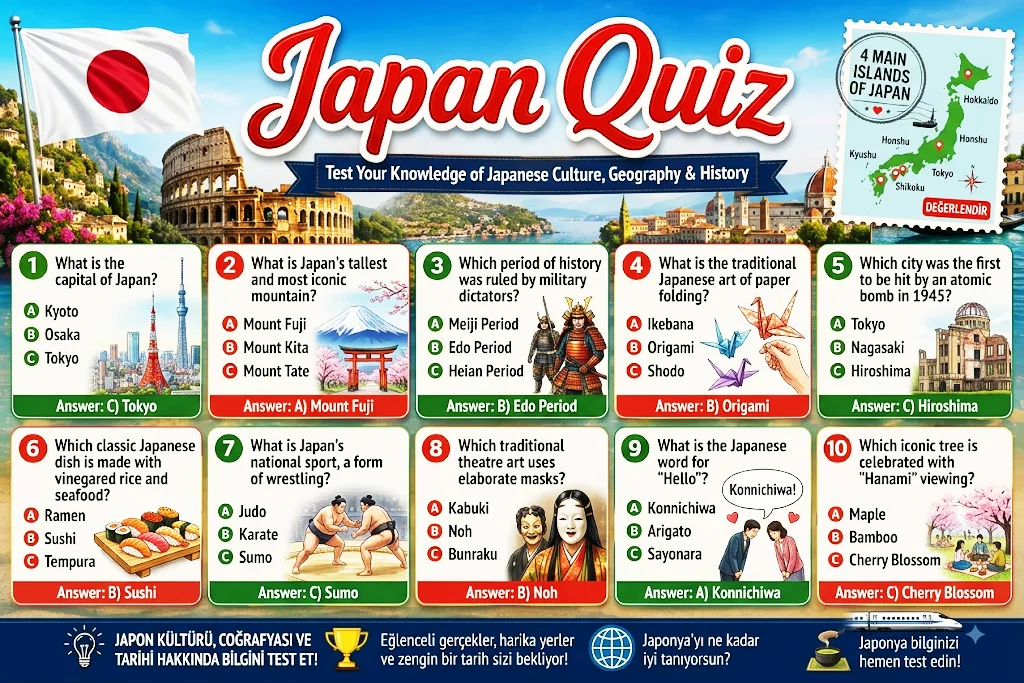
Japan Quiz – Explore the Land of Tradition and Innovation
Some countries are famous for a single landmark or historical event. Japan stands out because it combines centuries-old traditions with some of the world's most advanced technology. Ancient wooden temples can be found just minutes away from futuristic skyscrapers, while quiet bamboo forests exist alongside some of the busiest railway stations on Earth.
Whether you're preparing for a geography challenge, planning a future trip, or simply enjoy learning about different cultures, this quiz is a fun way to test your knowledge while discovering new facts about one of Asia's most unique nations.
| Fact | Information |
|---|---|
| Official Name | Japan |
| Capital | Tokyo |
| Continent | Asia |
| Population | About 124 million |
| Currency | Japanese Yen (JPY) |
| Official Language | Japanese |
| Highest Mountain | Mount Fuji |
| National Flower | Cherry Blossom (Sakura) |
| Largest Island | Honshu |
| Number of Main Islands | 4 |
| Government | Constitutional Monarchy |
| Time Zone | Japan Standard Time (JST) |
A Country Shaped by Nature
Japan is made up of thousands of islands stretching along the Pacific Ocean. Although many people think of Tokyo first, much of the country is covered by forests and mountain ranges. Around seventy percent of Japan is mountainous, leaving relatively little land for large cities or farming.
Volcanoes, earthquakes, and hot springs are all part of everyday life because Japan sits on the Pacific Ring of Fire. Despite these natural challenges, the country has developed advanced engineering and disaster preparedness systems that are recognized around the world.
Seasonal changes also play a major role in daily life. Spring is celebrated for cherry blossoms, summer brings colorful festivals, autumn is known for vibrant red and orange leaves, and winter transforms northern Japan into a destination for skiing and snowboarding.
History That Still Lives Today
Japan's history stretches back thousands of years, and many traditions remain part of modern life. Samurai warriors, powerful shoguns, and imperial dynasties helped shape the country's identity for centuries.
Unlike many historic civilizations, Japan has carefully preserved temples, castles, gardens, and shrines while continuing to develop modern cities filled with innovative architecture and technology.
Today, visitors can experience both worlds in a single day—walking through centuries-old streets in Kyoto before riding a high-speed bullet train to Tokyo.
Culture and Daily Life
Respect, courtesy, and attention to detail are deeply rooted in Japanese culture. Bowing is a common greeting, shoes are often removed before entering homes, and seasonal celebrations remain an important part of community life.
Japanese cuisine extends far beyond sushi. Popular dishes include ramen, tempura, udon, soba, yakitori, okonomiyaki, curry rice, and countless regional specialties. Fresh ingredients and careful presentation are central to Japanese cooking.
Traditional arts such as calligraphy, tea ceremonies, flower arranging, and kabuki theater continue to be practiced alongside modern entertainment including anime, manga, gaming, and J-pop music.
Famous Places Across Japan
Japan offers an incredible variety of destinations for travelers and history enthusiasts alike. Tokyo is known for its vibrant neighborhoods and modern skyline, while Kyoto preserves hundreds of historic temples and peaceful gardens. Osaka is celebrated for its street food and energetic atmosphere, and Hiroshima serves as an important place for learning about peace and history.
Natural attractions are equally impressive. Mount Fuji attracts climbers and photographers every year, while places like Nara Park, Arashiyama Bamboo Grove, and the Japanese Alps showcase the country's scenic beauty.
15 Interesting Facts About Japan
- Japan consists of more than 14,000 islands.
- Mount Fuji is Japan's highest mountain.
- Tokyo is one of the world's largest metropolitan areas.
- Japan has one of the highest life expectancies on Earth.
- More than two-thirds of the country is covered by forests.
- Shinkansen bullet trains are famous for their speed and punctuality.
- Cherry blossom season attracts millions of visitors every spring.
- Japan experiences thousands of earthquakes every year, though most are minor.
- Convenience stores in Japan often provide a wide range of everyday services.
- Vending machines can be found throughout cities, towns, and rural areas.
- Kyoto was Japan's capital for more than one thousand years.
- Japan is home to hundreds of active volcanoes.
- Sumo is Japan's national sport.
- The country has many designated UNESCO World Heritage Sites.
- Japanese craftsmanship is admired for its precision and attention to detail.
Why Japan Is a Great Country to Study
Japan offers an excellent example of how history and innovation can exist side by side. Studying the country helps learners understand geography, natural hazards, engineering, architecture, economics, language, and cultural traditions all within a single nation.
Country quizzes encourage curiosity by connecting places, people, and historical events with memorable facts. As you answer each question, you'll strengthen your understanding of Asia while discovering why Japan continues to inspire millions of visitors, students, and researchers around the world.
What You'll Learn From This Quiz
After completing this Japan quiz, you'll have a better understanding of:
- Japan's geography and major islands
- Famous cities and cultural landmarks
- Traditional customs and festivals
- Japanese food and daily life
- Mountains, volcanoes, and natural landscapes
- Historic sites and modern innovations
- Interesting facts that make Japan unique
Related Quizzes
- Asia Quiz
- Tokyo Quiz
- Mount Fuji Quiz
- World Capitals Quiz
- Famous Landmarks Quiz
- Countries of the World Quiz
Japan Quiz, Japan Trivia, Japan Facts, Japan Geography Quiz, Japan History Quiz, Tokyo Quiz, Japanese Culture Quiz, Japan Country Quiz, Asia Quiz, Japanese Landmarks, Mount Fuji Facts, Learn About Japan, Japan General Knowledge, Japan Questions and Answers.
Ready for another round?
Jump to a random quiz from the archive.