
Inside a Popcorn Kernel, There's a Tiny Pressure Cooker Waiting to Explode
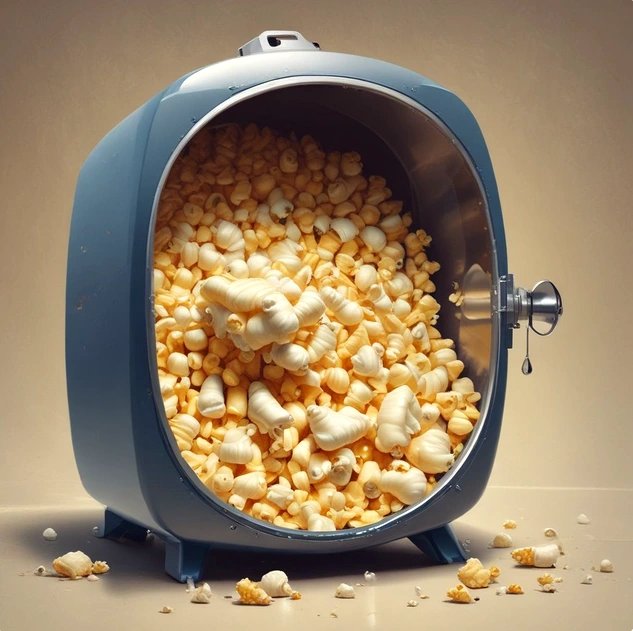
Why does popcorn suddenly expand when heated?
Toss a bag of popcorn kernels in the microwave and a few minutes later, what started as small, hard, unremarkable little seeds has transformed into fluffy white puffs several times their original size. It happens fast, loudly, and with enough force that a kernel can visibly jump when it finally pops. What's actually happening inside that hard little shell is essentially a miniature pressure vessel reaching its breaking point, and the physics behind it is more specific than most people realize.
Every popcorn kernel is built around a small reservoir of moisture, roughly fourteen percent water by weight, sealed inside a dense, hard outer shell called the pericarp. That shell isn't just tough for structural reasons, it's specifically nonporous, meaning it doesn't let moisture escape easily, which turns out to be the entire key to why popcorn behaves the way it does when heated, unlike most other corn varieties that simply dry out and char under similar heat without doing anything dramatic.
As a kernel heats up, the water trapped inside begins converting into steam. Normally, steam would just escape and dissipate, but the pericarp's structure prevents that from happening easily, trapping the expanding steam inside the kernel's tightly sealed shell. As more and more water converts to vapor, pressure inside that small enclosed space climbs dramatically, reaching levels far beyond what the sealed shell can indefinitely contain, somewhere in the range of well over one hundred pounds per square inch by the time the kernel is ready to pop, a genuinely significant amount of pressure packed into something smaller than a fingernail.
At the center of each kernel sits a dense core of starch, and heat doesn't just build pressure, it also transforms that starch itself. Under intense heat, the starch granules inside the kernel gelatinize, essentially softening into something closer to a thick, dense paste rather than the hard, dry material it started as. This matters because the moment the pericarp finally fails under all that accumulated pressure, rupturing at a specific structural weak point, the superheated steam trapped inside doesn't just leak out quietly, it explosively expands outward in a fraction of a second, and that sudden release of pressure violently forces the softened starch out along with it.
The rapid pressure drop that occurs the instant the shell ruptures causes the gelatinized starch to expand almost instantaneously, essentially foaming outward as the trapped steam rushes out and the surrounding air pressure suddenly allows that compressed, softened material to inflate. Within a fraction of a second, that starch cools and solidifies again in its newly expanded, foam-like structure, which is exactly why popped popcorn ends up with that light, airy, almost sponge-like texture rather than staying dense the way the original kernel was.
Temperature matters enormously in this entire process. Popcorn kernels typically won't pop until they reach somewhere around 180 degrees Celsius, roughly 356 degrees Fahrenheit, which is considerably hotter than the boiling point of water alone, precisely because the sealed pericarp allows internal pressure and temperature to climb well beyond what water would normally reach in an open, unsealed environment. This is also exactly why kernels that fail to pop, the frustrating handful left at the bottom of every bag, usually have some kind of small crack, structural flaw, or moisture deficiency in their shell that let pressure escape gradually rather than building up to the critical point needed for a proper explosive pop.
Not all corn varieties can do this either, which is part of why popcorn is genuinely a distinct type of corn rather than just a preparation method applied to any random kernel. Popcorn's specific combination of a particularly hard, moisture-resistant pericarp and a starch composition suited to rapid gelatinization under pressure is a fairly specific genetic trait, one that sweet corn or field corn varieties simply don't share, which is exactly why tossing regular corn kernels in a hot pan doesn't produce anything resembling the fluffy transformation popcorn is known for.
It's a small, oddly satisfying piece of food science hiding inside something most people treat as an afterthought while watching a movie. Each unpopped kernel is essentially a tiny, self-contained pressure cooker, sealed just tightly enough to build genuinely significant internal force, and just weak enough at one particular point to eventually give way all at once, turning stored steam pressure into one sudden, audible burst of expansion.