
In the Deep Ocean, Making Your Own Light Isn't Rare — It's the Norm
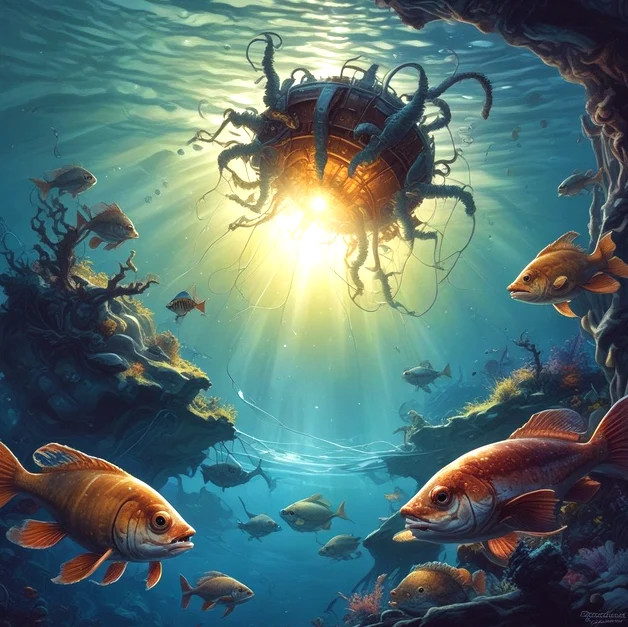
What makes certain deep-sea creatures capable of producing their own light?
Sink below about a thousand meters into the ocean and sunlight essentially disappears entirely, swallowed up by the sheer volume of water above. It's a region scientists sometimes call the midnight zone, and by most intuitive logic, it should be one of the least hospitable environments for anything resembling normal biological activity. Instead, it turns out to be one of the most light-filled places on the planet, just not because of anything coming from above. The creatures living down there produce their own light, and the phenomenon is so widespread that in the deep sea, glowing isn't the exception, it's closer to standard equipment.
The process is called bioluminescence, and at its core it's a chemical reaction happening inside living tissue. Most bioluminescent organisms rely on a molecule called luciferin, which reacts with oxygen in the presence of an enzyme called luciferase. That reaction releases energy in the form of visible light rather than heat, which is part of what makes it so remarkable from a physics standpoint — it's an extraordinarily efficient light-producing process, converting almost all of the reaction's energy directly into light instead of wasting most of it as warmth the way a lightbulb or a candle does.
What's genuinely striking about deep-sea bioluminescence isn't just that it exists, but how many completely unrelated species independently evolved it. Anglerfish, certain species of squid, jellyfish, specific types of shrimp, and countless smaller organisms all produce light through broadly similar chemical mechanisms, despite being separated by enormous evolutionary distances. Scientists generally interpret this as strong evidence that bioluminescence offers such a significant survival advantage in a lightless environment that evolution arrived at the same basic solution repeatedly, through entirely separate evolutionary paths, rather than all these species inheriting the trait from one shared ancestor.
The specific uses of that light vary enormously depending on the species and what problem it's trying to solve. Anglerfish are probably the most famous example, using a glowing lure dangling in front of their mouths to attract smaller, curious prey close enough to strike, essentially turning their own body into bait in an environment where visual curiosity can be fatal. Other species use bioluminescence defensively rather than offensively. Certain squid and small crustaceans release glowing chemical clouds when threatened, creating a bright, disorienting burst that distracts predators for the crucial second or two needed to escape, functioning almost like an underwater smoke bomb made of light instead of smoke.
Some species use light for an even more subtle purpose called counter-illumination. Certain fish and squid produce a soft, downward-facing glow on their undersides specifically matched to the faint light filtering down from far above, effectively canceling out their own silhouette when viewed from below by predators looking upward. It's a form of active camouflage that only makes sense in an environment where light itself, however faint, is still the primary sense predators rely on to hunt.
Communication and mating represent another major function. In pitch darkness, visual signals like flashing patterns become one of the only reliable ways for members of the same species to identify each other, coordinate, or attract mates, since sound and chemical signals have their own limitations at extreme depth and pressure. Some species have developed remarkably specific flash patterns, almost like a rudimentary code, allowing individuals to recognize their own species among the countless other glowing organisms drifting through the same waters.
Interestingly, not all bioluminescent light comes directly from the animal's own cells. Some species, including certain fish, host colonies of bioluminescent bacteria in specialized organs, essentially outsourcing their light production to symbiotic microorganisms that live inside them and produce light in exchange for a stable, nutrient-rich home. The Hawaiian bobtail squid is one of the most studied examples of this kind of partnership, hosting a specific strain of bioluminescent bacteria that only reaches full light-producing capability once it reaches a certain population density inside the squid's light organ.
Given how completely dark the deep ocean is, and how energy-scarce that environment tends to be, it says something significant that so many species dedicate biological resources toward producing their own light rather than avoiding the cost entirely. In a place where food is scarce and energy conservation matters enormously, bioluminescence isn't a luxury trait, it's clearly proven valuable enough, across hunting, defense, camouflage, and communication, that evolution kept reinventing it independently across dozens of unrelated lineages, all converging on the same basic answer to the same basic problem: when the sun can't reach you, you build your own.