
Human Body & Brain: 42 Mind-Blowing Biological Truths & Myths
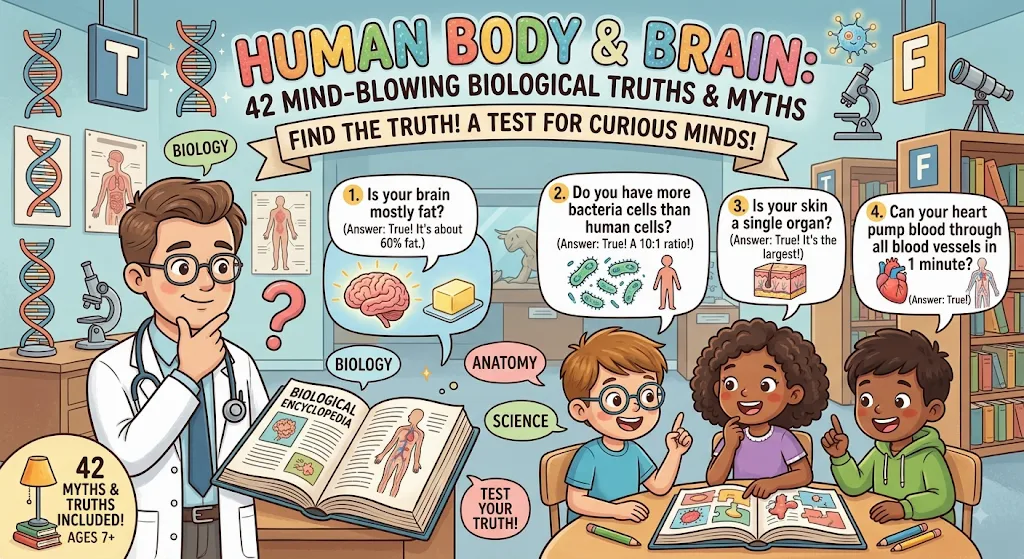
The human organism is an astonishing network of trillions of cells, biochemical signals, and complex electrical impulses. Yet, pop culture, old-school schoolyard rumors, and historical medical folklore have populated our collective consciousness with sweeping misinterpretations of how our bodies and minds actually operate. To pass beyond superficial guesswork, we must look directly at rigorous clinical research and modern physiological science. Below is an exhaustive breakdown of 42 widely accepted medical myths and the fascinating physiological truths standing behind them.
Table of Contents
Human Body & Brain: 42 Anatomy Realities
Shattering clinical urban legends and medical folklore with 42 verified anatomical facts supported by current physiological research.
Part 1: Neurological & Brain Function Misconceptions
Humans Use Only 10 Percent of Their Brain Capacity
Myth: Over ninety percent of human cerebral tissue remains completely dormant and unutilized throughout life.
Fact: Functional magnetic resonance imaging (fMRI) scans confirm that virtually every zone of the brain maintains active metabolic engagement over a 24-hour cycle, even during sleep.
Alcohol Destroys Brain Cells Indiscriminately
Myth: Drinking alcoholic beverages kills thousands of brain cells with every single glass consumed.
Fact: Moderate alcohol consumption alters neurotransmitter efficiency and damages dendrites or nerve cell connections rather than instantly destroying main neuronal cell bodies.
Adult Brains Cannot Generate New Neurons
Myth: Humans are born with a fixed lifetime quota of neurons that continuously die off without replacement.
Fact: Neurogenesis occurs continuously in specific brain structures, particularly the hippocampus, enabling ongoing learning and structural neural adaptation.
Clinical Insight: Aerobic exercise significantly upregulates brain-derived neurotrophic factor (BDNF), actively promoting neurogenesis in adult brains.
Brain Tissue Feels Physical Pain Directly
Myth: Headaches stem from physical pain receptors inside the brain tissue itself.
Fact: The brain lacks nociceptors (pain receptors); headaches originate from irritation in surrounding blood vessels, scalp muscles, and the meningeal membranes.
Left-Brained People Are Analytical While Right-Brained Are Creative
Myth: Personalities are dictated by whether the left or right cerebral hemisphere dominates.
Fact: Complex cognitive tasks require intensive cross-talk and synchronized activation across both hemispheres via the corpus callosum.
Listening to Classical Music Dramatically Boosts Infant Intelligence
Myth: Playing Mozart compositions to babies creates permanent leaps in intellectual capability.
Fact: The "Mozart Effect" was a temporary boost in spatial task performance among college students, having no long-term impact on infant cognitive development.
Memory Functions Like a Precise Video Recorder
Myth: Past experiences are stored safely in detail and played back accurately upon recall.
Fact: Human memory is reconstructive; every time a memory is retrieved, the brain rebuilds the narrative, introducing subtle alterations and biases.
Subliminal Messaging Can Control Consumer Behavior
Myth: Flash-frame movie ads subconsciously force viewers to buy specific products.
Fact: Controlled psychological studies show that while subliminal cues can trigger minor priming effects, they cannot compel complex purchasing decisions.
Brain Training Apps Prevent Age-Related Cognitive Decline
Myth: Daily digital puzzle games provide broad protection against dementia and mental aging.
Fact: Playing puzzle software only makes users better at those specific games, without transferring broad cognitive benefits to general daily functioning.
Schizophrenia Involves a Literal Split Personality
Myth: Schizophrenic individuals alternate between multiple distinct internal identities.
Fact: Dissociative Identity Disorder involves multiple personalities, whereas schizophrenia is characterized by psychosis, delusions, and disorganized thought patterns.
Part 2: General Anatomy & Skeletal Realities
Hair and Fingernails Continue Growing After Death
Myth: Post-mortem biological processes cause nails and hair to sprout on corpses.
Fact: Cellular growth ceases immediately upon death; skin dehydration causes surrounding flesh to shrink and recede, exposing more nail and hair length.
Humans Shed All Body Cells Every Seven Years
Myth: Every single cell in the human body is completely replaced and renewed over a seven-year cycle.
Fact: While skin cells, gut linings, and red blood cells turn over quickly, cardiac muscle cells, neurons, and eye lens cells remain with individuals for an entire lifetime.
Deoxygenated Blood Inside Human Veins Is Blue
Myth: Blood returning to the heart inside veins is colored blue until it encounters oxygen in the lungs.
Fact: Human blood is always various shades of red due to hemoglobin; veins appear blue purely because of how skin tissue filters light wavelengths.
Shaving Body Hair Causes It to Grow Back Thicker and Darker
Myth: Razors alter hair follicles, making future hair strands denser and coarser.
Fact: Shaving cuts hair at the thickest part of the shaft, creating a blunt tip that feels coarser as it emerges, without altering follicle density.
Knuckle Cracking Causes Arthritis in Finger Joints
Myth: Popping knuckles wears away cartilage and triggers degenerative hand arthritis.
Fact: The popping sound is nitrogen gas bubbles collapsing inside synovial joint fluid; clinical studies show no link between cracking and arthritis.
Reading in Dim Light Permanently Ruins Vision
Myth: Straining eyes under low lighting conditions leads to permanent blindness or ruined eyesight.
Fact: Low light causes temporary eye fatigue and strain due to muscular adjustment of the iris, but it causes zero permanent structural eye damage.
Sitting Close to Television Screens Destroys Eyesight
Myth: Watching TV from a short distance damages ocular health and causes myopia.
Fact: While close viewing causes temporary eyestrain, it does not alter the physical structure of the eye lens or cause permanent vision loss.
Humans Lose Most Body Heat Through Their Heads
Myth: Uncovered heads account for the vast majority of human body heat loss in cold weather.
Fact: Heat escapes proportionally from all exposed skin areas; the head accounts for high heat loss only because people typically leave their heads uncovered while bundling up.
Swallowed Chewing Gum Remains Inside the Stomach for Seven Years
Myth: Ingested gum sticks to stomach linings and lingers in the digestive tract for years.
Fact: Stomach acids cannot digest gum base polymers, but normal digestive peristalsis moves the material through and out of the body within days.
Eating Carrots Grants Night Vision Capabilities
Myth: Consuming large quantities of carrots allows humans to see clearly in pitch darkness.
Fact: Carrots contain beta-carotene which supports general retinal health, but they cannot surpass normal biological human visual thresholds in darkness.
Fingernails Grow Faster Than Toenails
Myth: Hand fingernails outpace foot toenails in continuous keratin growth speed.
Fact: Fingernails grow approximately four times faster than toenails, largely due to superior blood circulation and proximity to the core of the body.
Adult Bones Total Exactly 206 Across the Skeleton
Myth: Every adult human skeleton possesses a fixed, universal count of 206 bones.
Fact: Babies are born with nearly 270 bones that fuse during development, and anatomical variations like extra ribs or fused vertebrae create minor population differences.
Fingerprints Are Completely Unique Across the Entire Global Population
Myth: Scientific proof establishes that no two human beings have ever shared matching fingerprints.
Fact: While biometric individuality is exceptionally high, standard forensic fingerprint comparisons rely on partial matching thresholds rather than absolute mathematical uniqueness.
Human Appendix Is a Useless Evolutionary Remnant
Myth: The vermiform appendix serves zero biological purpose in modern humans.
Fact: Immunological research shows the appendix acts as a safehouse reservoir for beneficial gut bacteria, helping replenish intestinal flora after illness.
Part 3: Sensory Perception & Metabolic Realities
Humans Possess Exactly Five Basic Senses
Myth: Sight, hearing, smell, taste, and touch constitute the entire sensory catalog of the human body.
Fact: Neuroscientists recognize multiple additional senses, including proprioception (body awareness), thermoception (temperature), and nociception (pain).
The Tongue Is Mapped Into Specific Taste Regions
Myth: Sweet, salty, sour, and bitter tastes are detected exclusively by separate localized zones on the tongue.
Fact: All taste buds across the tongue surface can detect all basic taste modalities equally, refuting the classic tongue map diagram.
Humans Need to Drink Eight Glasses of Water Daily
Myth: Health mandates require every adult to consume eight 8-ounce glasses of water every day.
Fact: Daily fluid requirements vary widely based on body size, activity level, and climate, and much of our hydration comes directly from ingested food.
Reading in Moving Vehicles Causes Permanent Eye Damage
Myth: Glancing at books inside cars or trains damages visual acuity.
Fact: The motion mismatch between vestibular balance sensors and visual focus creates motion sickness, but causes no structural ocular harm.
Stress Directly Causes Grey Hair Growth
Myth: Emotional trauma or severe worry can turn an entire head of hair grey overnight.
Fact: While extreme stress accelerates stem cell depletion in hair follicles over months, individual existing hair shafts cannot change pigment once grown.
Finger Skin Wrinkles in Water Due to Fluid Absorption
Myth: Pruney fingers in baths occur because skin absorbs water like a sponge.
Fact: Finger wrinkling is an active autonomic nervous system response that constricts blood vessels to improve grip on wet objects.
Humans Swallow Eight Spiders Annually During Sleep
Myth: Sleeping individuals unintentionally ingest multiple spiders crawling across their faces each year.
Fact: This statistic originated from a satirical 1993 internet list demonstrating how easily false urban legends spread online; spiders actively avoid vibrations of sleeping humans.
Sugar Intake Hyperactivates Children
Myth: Feeding children sugary snacks causes instant behavioral hyperactivity.
Fact: Double-blind clinical trials show no physiological link between sugar consumption and hyperactivity; parental expectation drives the perceived behavioral change.
Full Moons Trigger Psychological Crises and ER Surges
Myth: Lunar cycles increase rates of human psychiatric admissions, crimes, and emergency room visits.
Fact: Comprehensive statistical reviews across police and hospital records demonstrate zero correlation between lunar phases and human behavioral anomalies.
Yawning Contagion Signals Oxygen Deprivation
Myth: Yawns are triggered when blood oxygen levels drop, signaling the body to inhale more air.
Fact: Physiological experiments confirm that changing oxygen or carbon dioxide levels does not alter yawning frequency; yawning functions primarily in brain temperature regulation.
Humans Can Sweat Out Toxins Through Skin Pores
Myth: Saunas and heavy sweating detoxify the body by flushing heavy metals through sweat glands.
Fact: Sweat is composed of 99% water and electrolytes; bodily detoxification is handled almost entirely by the liver and kidneys.
Antibiotics Cure Viral Infections Like the Common Cold
Myth: Prescription antibiotics shorten viral illnesses and relieve flu symptoms.
Fact: Antibiotics target bacterial cell walls exclusively and have zero therapeutic effect against viral pathogens.
Cold Weather Directly Causes Common Colds
Myth: Chilly temperatures and freezing rain cause viral respiratory infections.
Fact: Colds are caused by rhinovirus transmission indoors during winter months when people gather closely in unventilated spaces.
Reading in the Dark Causes Progressive Blindness
Myth: Low-light reading damages retinal tissue permanently.
Fact: Ciliary eye muscles tire from focusing adjustments in low light, leading to temporary fatigue rather than permanent visual impairment.
Fingernails Continue Growing After Biological Death
Myth: Post-mortem biological activity keeps keratin cells multiplying.
Fact: Dehydration causes skin to retract backward from the nail bed, creating the illusion of nail elongation.
Spicy Foods Cause Stomach Ulcers
Myth: Eating hot peppers and spiced meals erodes the stomach lining.
Fact: Peptic ulcers are caused by bacterial infections of Helicobacter pylori or chronic NSAID use, not dietary capsaicin.
Hair Turns Grey Overnight From Sudden Terror
Myth: Extreme shock instantly drains color from all scalp hair.
Fact: Existing hair shafts cannot change color rapidly; rapid greying is usually alopecia areata targeting pigmented hairs while sparing white strands.
Humans Only Use Five Percent of Their Heart Capacity
Myth: Most cardiac muscle tissue rests during normal daily activities.
Fact: The human heart beats continuously without rest intervals, adjusting cardiac output dynamically to sustain systemic blood perfusion.
Frequently Asked Questions
No, neuroimaging studies demonstrate that virtually the entire brain is active almost all the time, even during sleep or simple resting states.
No, cell division and growth cease immediately upon death. The illusion of growth is caused by the dehydration and shrinking of surrounding skin tissues.