
How a Tabletop Model Convinced Audiences They Were Looking at a Skyscraper
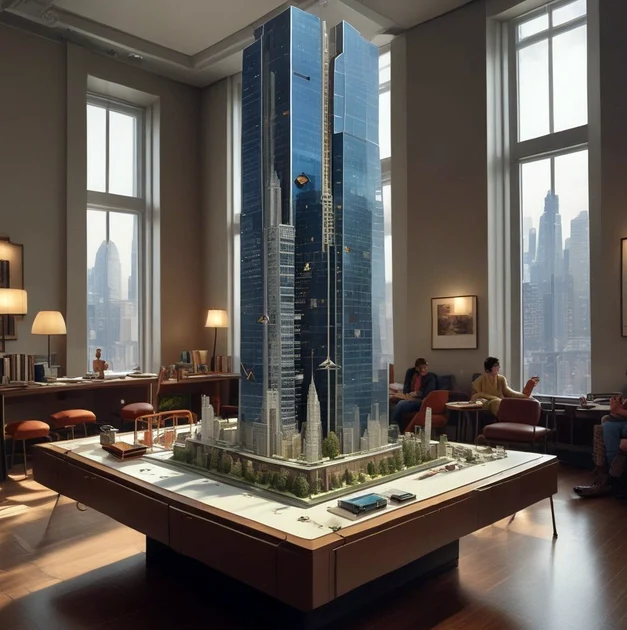
Watch an old disaster movie or a classic science fiction film from decades before computer graphics existed, and there's a good chance you're looking at something that, in reality, could have fit on a dining room table. Entire cities crumbling, spaceships gliding through the void, monsters towering over buildings, much of it built at a fraction of real-world scale and photographed in ways specifically designed to trick the eye into ignoring that fact entirely. The technique behind this is called forced perspective, and long before digital effects took over, it was one of filmmaking's most reliable tools for making the small look enormous.
The core idea behind forced perspective isn't really about the miniature itself, it's about controlling exactly how the camera sees it. Human depth perception relies heavily on visual cues, relative size, distance, the way objects seem to shrink the farther away they are, and forced perspective techniques exploit those same cues deliberately, arranging camera position, lens choice, and framing so a model reads as full-sized without needing any digital manipulation at all.
One of the most fundamental tricks involves camera distance and lens selection working together. Placing a camera very close to a small model, while using a lens that flattens depth and minimizes the visual cues that would normally reveal scale, can make a miniature appear to occupy far more physical space than it actually does. Combine that with careful lighting, matching shadows and highlights to whatever the model is supposed to represent in real-world scale, and the illusion becomes considerably harder for an audience to consciously detect, even though on a purely technical level, they're staring at something built to fit inside a studio soundstage.
Miniature work reached a particularly high level of sophistication in films built around large-scale destruction or expansive environments, disaster movies, war films, and early science fiction being some of the most common genres relying heavily on the technique. Models of buildings, ships, or entire city blocks were constructed with obsessive attention to proportional detail, sometimes incorporating working mechanical elements specifically so they could be filmed collapsing, exploding, or moving in ways that read convincingly on camera. Getting the destruction itself to look realistic actually required its own specialized knowledge, since materials break and shatter differently at small scale than they do at full size, meaning effects teams had to choose specific materials, like certain types of foam, plaster, or balsa wood, that would fracture and crumble in a way that visually matched how real, full-scale materials behave when filmed and played back at normal speed.
Motion posed its own challenge too, since anything moving in a miniature environment tends to look obviously fake if filmed at standard speed, movement reads as inherently small and quick compared to how something of equal apparent size would move in reality. Filmmakers frequently solved this by overcranking the camera, recording at a higher frame rate than normal, which, when played back at standard speed, slows the footage down and makes model movement appear heavier, more deliberate, and considerably closer to how a full-scale object would actually behave.
Forced perspective wasn't limited purely to miniature models either, the same underlying principle shows up in techniques used to make actors themselves appear differently sized relative to each other, without any digital manipulation involved. Positioning one actor much closer to the camera than another, while carefully controlling background elements and camera angle, can create a convincing illusion that one performer towers over another, or appears significantly smaller, even when both actors are standing at completely ordinary heights just a few feet apart from one another in actual physical space.
The technique's popularity declined somewhat with the arrival of increasingly sophisticated computer-generated imagery, which offered filmmakers more flexibility and, in many cases, lower long-term costs compared to building and destroying physical models repeatedly. Even so, forced perspective and traditional miniature work never fully disappeared, plenty of contemporary filmmakers specifically choose practical, camera-based techniques over digital effects, arguing that physical models interacting with real light and real camera movement tend to produce a tactile, believable quality that's genuinely difficult to fully replicate through purely digital means, regardless of how advanced rendering technology becomes.
What makes forced perspective particularly interesting from a filmmaking standpoint is how much of the illusion depends entirely on human visual assumptions rather than any inherent property of the model itself. The audience isn't being shown a full-sized object, they're being shown a specific, carefully engineered set of visual cues that the human brain automatically interprets as full scale, based on assumptions about distance, proportion, and lighting that hold true in ordinary life but can be deliberately manipulated under controlled filming conditions. It's less a trick played on the camera and more a trick played directly on human perception, using nothing but physical craftsmanship, precise camera placement, and a solid understanding of how people instinctively judge size and distance without ever consciously thinking about it.