
Honeybees Have Been Doing Interpretive Dance Longer Than Humans Have Had Language
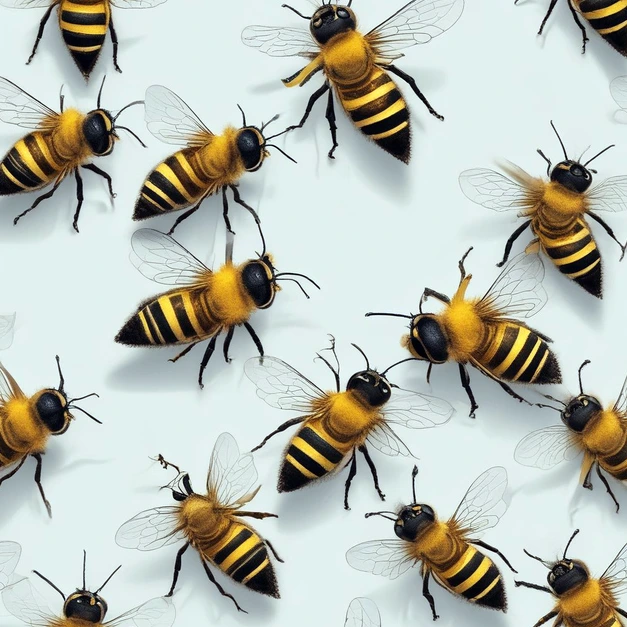
Which insect communicates the location of food through a distinctive dancing pattern?
Somewhere inside a beehive, a forager bee returns from a successful trip and immediately starts moving in tight, deliberate figure-eight patterns on the surface of the honeycomb. To a casual observer, it looks like nothing more than restless fidgeting. To the other bees crowded around watching, it's precise, actionable information, essentially a spoken set of directions compressed into physical movement, and it's one of the more genuinely astonishing communication systems found anywhere outside human language.
This behavior is called the waggle dance, and honeybees use it specifically to tell other members of the colony where to find a good food source, sometimes located miles away from the hive. The dance was first decoded scientifically in the mid-20th century by Austrian biologist Karl von Frisch, whose decades of careful observation eventually earned him a share of the Nobel Prize in Physiology or Medicine, an unusually prestigious recognition for research centered almost entirely on watching bees wiggle.
The mechanics of the dance are remarkably specific once you break them down. A bee performing the waggle dance moves in a rough figure-eight pattern, but the central, straight-line portion of that figure eight, the part where the bee vigorously shakes or "waggles" its abdomen while moving forward, is where the real information gets encoded. The angle of that straight waggle run relative to vertical on the honeycomb corresponds directly to the angle of the food source relative to the sun's current position outside the hive. If the bee waggles straight up, for example, that indicates the food source lies in the same direction as the sun. Angle that waggle run forty-five degrees to the left of vertical, and it's communicating that foragers need to fly forty-five degrees to the left of the sun's direction to reach the same spot.
Distance gets encoded too, through the duration of the waggle run itself. Longer waggle phases correspond to food sources located farther away, while shorter, quicker waggle runs indicate the food is relatively close to the hive. Other bees crowding around the dancer don't just watch passively either, they physically follow along, often placing their antennae directly against the dancing bee to pick up on the vibrations and movement more precisely, essentially reading the dance through touch and physical alignment rather than relying purely on sight in the low light conditions typically found deep inside a hive.
What makes this system particularly impressive is how it accounts for a constantly shifting reference point. The sun moves across the sky throughout the day, which means the same food source requires a different waggle angle depending on exactly when the dance is performed. Bees compensate for this automatically, recalculating the correct angle relative to the sun's current position each time they dance, even though the actual food source hasn't moved an inch. Researchers have found that bees seem to track the sun's movement internally using some form of biological clock, adjusting their communicated angles accordingly throughout the day without needing to directly re-observe the sun's position each time.
The waggle dance isn't limited purely to food sources either. Colonies preparing to swarm and relocate to a new home use a very similar dance system to evaluate and communicate potential new nest sites, with scout bees essentially "voting" through the enthusiasm and repetition of their dances, more vigorous, longer dances tend to draw more attention and recruit more bees to investigate a particular candidate site, functioning almost like a decentralized democratic process playing out entirely through movement.
Not every bee species uses this exact system, and researchers studying different bee populations have found regional and species-level variation in dance dialects, subtle differences in how distance gets translated into waggle duration between different honeybee subspecies, suggesting the system, while broadly universal among honeybees, isn't perfectly standardized across every population worldwide.
It's a genuinely strange thing to sit with: an insect with a brain smaller than a grain of rice has developed a communication system precise enough to convey both direction and distance information to other members of its colony, compensating in real time for the sun's movement across the sky, all without anything resembling language in the way humans understand it. The waggle dance remains one of the clearest examples in the natural world of complex, symbolic communication existing entirely outside vertebrate biology, a reminder that sophisticated information-sharing doesn't require a nervous system anything close to human scale to pull off.