
Goosebumps Are Your Body Trying to Fluff Fur You No Longer Have
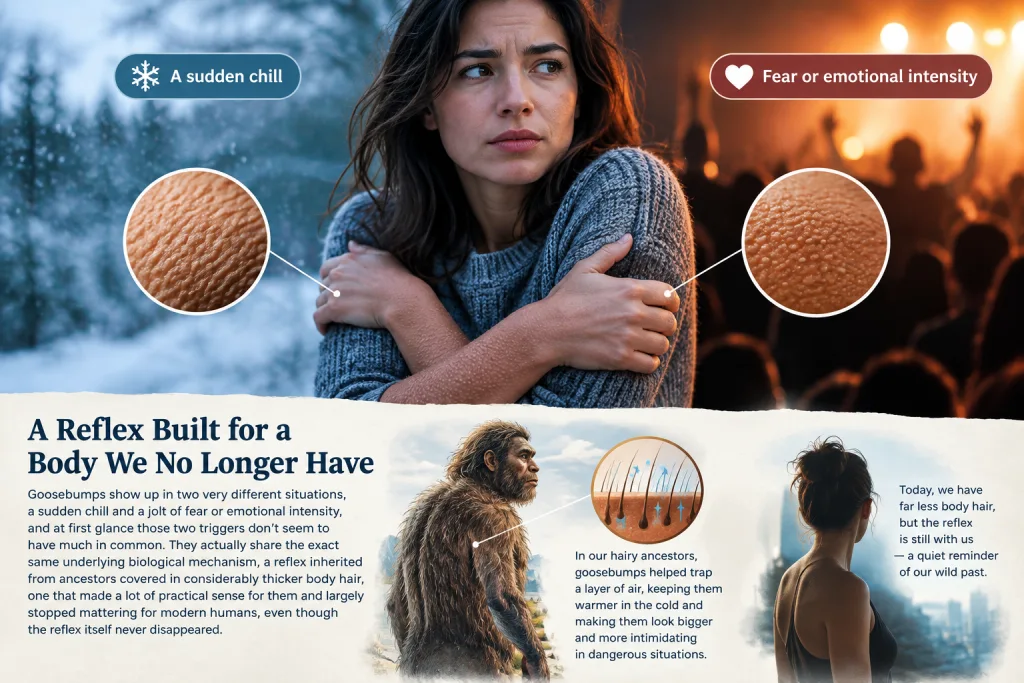
A Reflex Built for a Body We No Longer Have
Goosebumps show up in two very different situations, a sudden chill and a jolt of fear or emotional intensity, and at first glance those two triggers don't seem to have much in common. They actually share the exact same underlying biological mechanism, a reflex inherited from ancestors covered in considerably thicker body hair, one that made a lot of practical sense for them and largely stopped mattering for modern humans, even though the reflex itself never disappeared.
The Muscle Behind Every Single Bump
Each hair on the human body is attached to a tiny muscle called the arrector pili, and when that muscle contracts, it pulls the hair follicle upright, causing the skin immediately around it to pucker slightly, producing the small, raised bumps commonly known as goosebumps. This muscle contraction is controlled by the sympathetic nervous system, the same branch of the nervous system responsible for the broader fight-or-flight response, which is exactly why goosebumps show up during both cold exposure and emotionally intense or startling situations, both scenarios activate the same underlying nervous system pathway, just triggered by different types of stimuli.
Why Cold Triggers It: An Old Insulation Strategy
In cold conditions, this reflex originally served a genuinely useful thermoregulatory purpose for ancestors with considerably denser body hair. When arrector pili muscles contract and pull hair upright, it increases the amount of air trapped between individual hairs and close to the skin's surface, and trapped air acts as a natural insulating layer, helping retain body heat more effectively than flattened hair would. This is essentially the same underlying principle behind how many other mammals fluff up their fur in cold weather, birds do something functionally similar by puffing out their feathers, all trapping additional insulating air to reduce heat loss in cold conditions.
Why It Doesn't Actually Warm Modern Humans
Modern human body hair, though, is far too short, fine, and sparse across most of the body to meaningfully trap any significant amount of insulating air, which means goosebumps triggered by cold today produce essentially no practical warming benefit whatsoever. The reflex fires exactly the way it always has, the nervous system pathway triggering arrector pili contraction remains fully intact and functional, but the actual physical outcome that made the reflex useful in the first place, meaningful heat retention through trapped air among thick fur, simply doesn't apply anymore given how much human body hair has reduced over the course of evolutionary history.
Why Fear and Emotion Trigger the Same Response
The second major trigger, fear, awe, or intense emotional experiences, connects to a slightly different evolutionary explanation, though it relies on the exact same physical mechanism. In many mammals, this same arrector pili reflex serves a defensive purpose during moments of perceived threat, causing fur to stand on end, which makes an animal appear visibly larger and potentially more intimidating to a predator or rival, a phenomenon commonly observed in animals like cats, whose fur visibly puffs out dramatically when startled or threatened. Humans retain this identical underlying reflex, triggered by the same sympathetic nervous system activation during moments of fear or heightened emotional arousal, even though modern human body hair is far too sparse to produce any comparable size-increasing visual effect the way it does for a frightened cat.
An Evolutionary Leftover, Not a Malfunction
Goosebumps in humans essentially represent a fully intact ancestral reflex operating on a body that's evolved past the physical trait, substantial body hair, that originally made the reflex functionally useful. This kind of leftover trait is technically referred to as a vestigial reflex, a response that continues occurring reliably because the underlying neurological and muscular pathway never disappeared, even though the specific physical outcome it once produced no longer serves any meaningful practical purpose. It's not a malfunction or a biological mistake exactly, it's simply an old system that evolution never bothered fully removing, since a reflex causing tiny, harmless skin bumps carries essentially no survival cost significant enough to have been selected against over time.
Why the Same Trigger Shows Up During Music or Powerful Moments
Interestingly, goosebumps triggered by strong emotional or aesthetic experiences, listening to a particularly moving piece of music, watching an emotionally powerful scene in a film, aren't fully explained by the simple fear-based defensive reflex alone, and researchers studying this specific phenomenon believe it likely connects to broader patterns of heightened emotional or physiological arousal more generally, rather than fear specifically. Some studies have found that people who experience goosebumps more readily during emotionally powerful music also tend to show differences in certain brain regions associated with emotional processing, suggesting a meaningful, if still not completely understood, connection between this ancient physical reflex and how intensely certain individuals experience specific emotional or aesthetic responses.
Other Animals Still Get the Full Benefit
Comparing the human version of this reflex against other animals makes the vestigial nature of the response particularly clear. A frightened or cold cat, dog, or various other mammals experience a genuinely functional version of this exact same reflex, their considerably denser fur actually does trap meaningful insulating air or does visibly increase apparent body size when raised, producing the real, practical benefit the reflex originally evolved to provide. Humans go through the exact same internal physiological process, the identical nervous system signal, the identical muscular contraction, but without nearly enough body hair remaining to produce any comparable functional result, just small, harmless bumps and slightly raised, barely visible fine hairs.
A Small, Harmless Echo of a More Useful Past
Goosebumps end up being one of the more accessible, everyday examples of evolutionary leftover behavior still operating in the human body, a complete, functioning reflex arc, nervous system trigger, muscular contraction, skin response, persisting essentially unchanged from ancestors who actually benefited from it, even though the specific physical trait that made it useful, substantial body hair, largely disappeared somewhere along the evolutionary path leading to modern humans. The reflex never got the message that its original job became obsolete, so it just keeps firing exactly the way it always has, whether the trigger is a genuinely cold room or nothing more than a particularly moving passage of music.