
For Some People, Music Literally Has a Color
Sound and Sight, Genuinely Fused Together
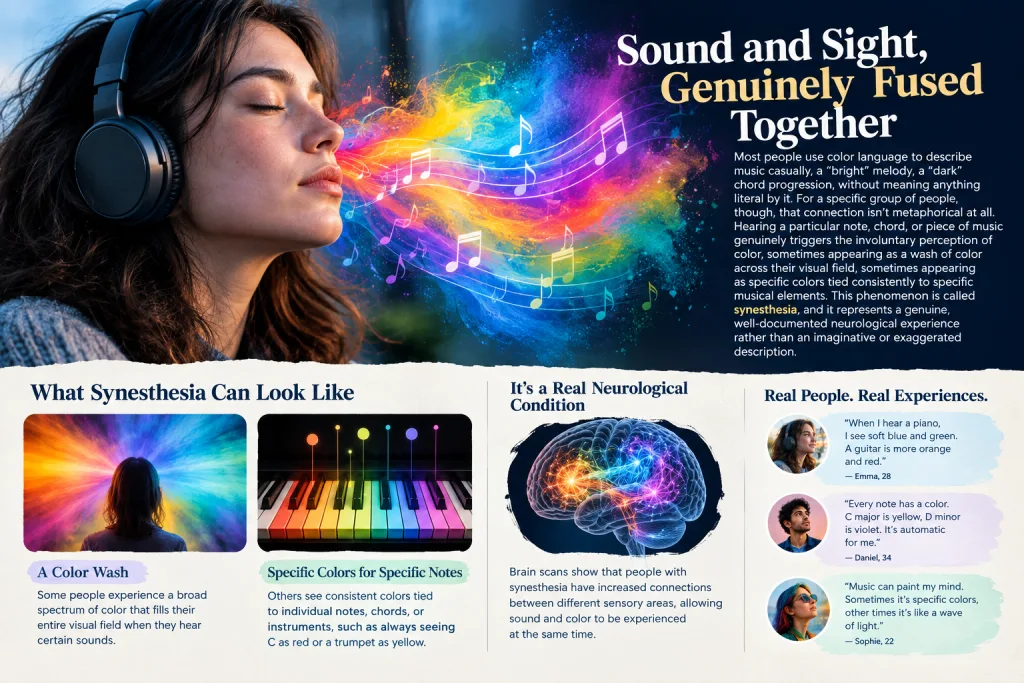
Most people use color language to describe music casually, a "bright" melody, a "dark" chord progression, without meaning anything literal by it. For a specific group of people, though, that connection isn't metaphorical at all. Hearing a particular note, chord, or piece of music genuinely triggers the involuntary perception of color, sometimes appearing as a wash of color across their visual field, sometimes appearing as specific colors tied consistently to specific musical elements. This phenomenon is called synesthesia, and it represents a genuine, well-documented neurological experience rather than an imaginative or exaggerated description.
A Broader Category With Music-Color as One Specific Type
Synesthesia itself is actually a fairly broad term describing any condition where stimulation of one sensory pathway involuntarily triggers an experience in a completely different sensory pathway, and it comes in numerous distinct forms beyond just sound and color. Some synesthetes experience specific letters or numbers as having inherent, consistent colors, a condition called grapheme-color synesthesia. Others experience taste sensations triggered by specific words, or physical sensations of touch triggered by watching someone else get touched. The music-to-color variant, sometimes referred to specifically as chromesthesia, is simply one particular, well-studied expression of this broader phenomenon, involving sound specifically as the triggering sense and color specifically as the resulting perceptual experience.
Genuinely Involuntary, Not a Choice or a Habit
A defining characteristic separating true synesthesia from simple imagination or learned association is that the experience is entirely involuntary and remarkably consistent over time. A synesthete who perceives a specific musical note as a particular shade of blue will generally continue perceiving that exact same note as that same shade of blue reliably, across different days, months, or even years, without consciously choosing or controlling the association in any way. Researchers studying synesthesia have specifically tested this consistency by asking synesthetes to describe their color associations at different points in time, sometimes separated by extended periods, and finding remarkably stable, repeatable results, a level of consistency that would be extremely difficult to fake or produce through simple imagination or deliberate association.
What's Actually Happening Inside the Brain
The leading scientific explanation for synesthesia involves what researchers describe as unusual cross-activation between brain regions that would normally process sensory information relatively independently of each other. In typical brain function, auditory processing and visual processing happen through largely separate neural pathways, but in synesthetic brains, some degree of additional neural connectivity or cross-communication appears to exist between these regions, causing activation in the auditory processing areas to also trigger activation in nearby or connected visual processing regions. Some neuroimaging studies have found that synesthetes show measurably different patterns of brain connectivity and activation compared to non-synesthetes specifically in regions associated with sensory processing, lending physical, observable support to what synesthetes have long described purely through subjective personal experience.
How Common Synesthesia Actually Is
Estimates of how many people experience some form of synesthesia vary considerably depending on the specific study and methodology used, but research generally suggests it affects somewhere between two and four percent of the general population, though the specific music-color variant represents just one subset within that broader group, meaning true chromesthesia specifically is considerably rarer still. Synesthesia also appears to run in families more often than would be expected by chance alone, suggesting a meaningful genetic component contributing to the condition, though researchers haven't fully identified the specific genetic mechanisms responsible, and environmental or developmental factors likely play some role as well.
Notable Musicians and Artists Who Have Described It
Several well-known musicians and composers throughout history have publicly described experiencing some form of synesthesia, adding a layer of real-world, high-profile documentation to what might otherwise seem like a purely obscure or abstract scientific curiosity. Composers including Franz Liszt and Nikolai Rimsky-Korsakov reportedly associated specific musical keys with specific colors, and more recently, contemporary musicians have described similar experiences, some incorporating their synesthetic perceptions directly into their creative and compositional process, using perceived colors as a genuine tool for thinking about and organizing musical structure and emotional tone.
Does Synesthesia Change How People Experience Music?
For people who experience genuine music-color synesthesia, the color perception generally isn't described as a distraction or an intrusive, unwanted sensation, but rather as a normal, integrated part of how they experience sound in the first place, many synesthetes report having simply assumed everyone else experienced music the exact same way until learning otherwise, sometimes not until well into adulthood. Some synesthetic musicians and composers describe actively using their color perceptions as a compositional or interpretive tool, for instance, deliberately choosing certain harmonic progressions partly because of the specific color combinations those progressions produce for them personally, effectively treating their synesthetic perception as an additional creative resource rather than simply an unusual neurological quirk.
Why Researchers Find Synesthesia Scientifically Valuable
Beyond its inherent novelty, synesthesia holds genuine scientific value for researchers studying how the human brain processes and potentially integrates different types of sensory information more broadly. Understanding exactly how and why certain brains develop this additional cross-sensory connectivity offers potential insight into the more general question of how sensory processing pathways develop and interact within the brain during childhood development, research that carries implications extending well beyond synesthesia itself, into broader questions about neural plasticity, sensory integration, and how individual variation in brain wiring can produce meaningfully different subjective experiences of the exact same external stimulus.
A Genuinely Different, Consistent Way of Experiencing Sound
Music-color synesthesia offers a compelling reminder that human sensory experience isn't as uniformly standardized across every individual as most people casually assume, for a specific portion of the population, sound and color aren't separate, independently processed experiences at all, they're genuinely, involuntarily fused together at a neurological level, producing a consistent, lifelong way of experiencing music that most other people can only try to imagine through comparison or metaphor, without ever actually perceiving it themselves.