
Florida Quiz: 10 Fun Questions About the Sunshine State
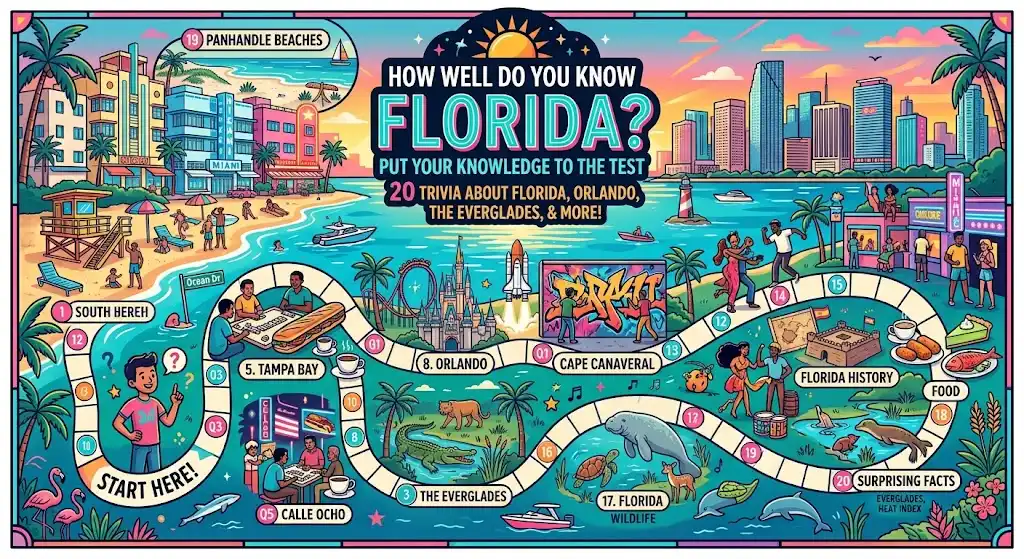
Florida has two kinds of weather forecasts: “It might rain” and “It will definitely rain, but don't worry, it'll probably stop before you find your umbrella.” 🌴 And if you ever lose something at a Florida beach, don't panic — the sand has already claimed it as permanent property. 😂
Start Florida Quiz
🎯 Daily Trivia Challenge • 🧠 10 Questions • ⏱️ 90 Seconds
Florida is sunshine, swamps, theme parks, hurricanes, alligators, oranges, space launches, historic towns, and some of the strangest roadside attractions in America. This quiz takes you beyond the usual tourist clichés and into the history, geography, wildlife, cities, food, culture, and odd little facts that make Florida unlike anywhere else.
What Is This Florida Quiz About?
This Florida quiz covers the many sides of the Sunshine State, from the Everglades and Florida's famous beaches to Miami, Orlando, Tampa, the Florida Keys, St. Augustine, NASA's Space Coast, and the state's unusual wildlife. You'll encounter questions about Florida's history, geography, famous landmarks, Cuban-American culture, theme parks, sports, food, and natural wonders. Some answers may seem obvious at first glance, while others are designed to catch anyone who has only learned Florida from vacation brochures.
So don't just pick the answer that sounds the most Florida.
Sometimes the strangest answer really is the right one.
Florida Geography: More Than a Long Strip of Beaches
Florida is the southeasternmost state in the continental United States and is surrounded by water on three sides.
The state has the Gulf of Mexico to the west and south and the Atlantic Ocean to the east. That geography helps explain Florida's enormous coastline and its long-standing connection to fishing, boating, tourism, and beach life.
Florida is also a peninsula, meaning much of the state extends into the water.
That makes geography questions particularly fun here because Florida's shape is almost impossible to mistake on a map.
And yes, someone has probably looked at a map of Florida and said, “Who left the oven door open?”
Florida's History: One of America's Oldest European Settlements
Florida's history goes much further back than theme parks and retirement communities.
Indigenous peoples lived throughout the region long before Europeans arrived. Among the best-known groups connected to Florida's early history were the Timucua, Calusa, Apalachee, and later the Seminole.
Spanish explorer Juan Ponce de León reached Florida in 1513, and Spain established a lasting presence in the region.
St. Augustine was founded in 1565 by Pedro Menéndez de Avilés and is widely recognized as the oldest continuously inhabited European-established settlement in the continental United States.
That makes Florida history an excellent quiz category.
Because if someone asks you for America's oldest city, don't automatically start thinking about Boston, New York, or Philadelphia.
Florida has been waiting patiently for that question.
St. Augustine: America's Historic Florida
St. Augustine looks very different from Miami.
Instead of towering modern buildings and crowded nightlife, you'll find historic streets, Spanish colonial architecture, old stone fortifications, and centuries of stories.
The city's most famous historic structure is the Castillo de San Marcos, a massive stone fort overlooking Matanzas Bay.
Construction began in 1672 under Spanish rule, making it one of the oldest masonry forts in the continental United States.
The city's European history is one of the reasons St. Augustine is such an important part of Florida's identity.
For a quiz, remember this combination:
St. Augustine + Spanish colonial history + old fort = major Florida history clue.
The Everglades: Florida's Wild Side
If Florida had a completely different personality hiding behind the beaches, it would probably be the Everglades.
The Everglades is a vast subtropical wetland ecosystem in southern Florida and one of the state's most important natural treasures.
It is home to alligators, crocodiles, manatees, birds, turtles, fish, and many other species.
The Everglades is also unusual because it is not simply a swamp. It is a complex ecosystem of wetlands, sawgrass marshes, mangrove areas, waterways, and coastal environments.
And then there are the alligators.
Florida apparently looked at ordinary wildlife and decided it needed something with more teeth.
Florida's Alligators: The State's Most Famous Reptile
Alligators are so closely associated with Florida that they almost feel like unofficial state employees.
The American alligator lives throughout much of the state, particularly in freshwater environments.
Florida is also home to the American crocodile, which is less widespread and is primarily associated with southern Florida.
That distinction can make a surprisingly good quiz question.
If the question asks about Florida's two famous crocodilian species, don't assume they're interchangeable.
One is an alligator.
The other is a crocodile.
Florida apparently decided that one large reptile wasn't enough.
Miami: Florida's International Personality
Miami is one of Florida's most recognizable cities and has a cultural identity shaped by communities from around the world.
Its Cuban-American influence is particularly visible in neighborhoods such as Little Havana, where Calle Ocho, Cuban food, coffee, music, art, and community traditions have become important parts of Miami's identity.
Miami Beach and South Beach add another layer, with beaches, Art Deco architecture, nightlife, and a skyline that looks like it was designed specifically for postcards.
Miami is also one of those places where “casual” can apparently mean wearing sunglasses indoors.
Orlando: The Theme Park Capital
Orlando is famous around the world for its theme parks and family attractions.
Walt Disney World Resort, Universal Orlando Resort, and other major attractions have transformed Central Florida into one of the world's best-known vacation destinations.
But Orlando is more than theme parks.
The city and surrounding region also have museums, restaurants, sports venues, lakes, parks, and a growing cultural scene.
Still, if someone says “Orlando” and your brain immediately thinks of roller coasters, you're not exactly taking a wrong turn.
Walt Disney World: A Florida Icon
Walt Disney World Resort opened near Orlando in 1971 and became one of the most influential tourist destinations in Florida.
The resort includes multiple theme parks, hotels, entertainment districts, water parks, and recreational areas.
Magic Kingdom was the first park to open at the resort.
For quiz purposes, don't confuse Walt Disney World with Disneyland.
Disneyland is in California.
Walt Disney World is in Florida.
Florida quiz writers love this distinction because somebody always mixes them up.
The Florida Keys: Islands at the End of the Road
The Florida Keys form a chain of tropical islands extending southwest from the southern tip of the Florida peninsula.
Key West is the best-known city in the Keys and sits at the end of the Overseas Highway.
The Keys are famous for fishing, boating, coral reefs, sunsets, seafood, and laid-back island culture.
Key West is also historically associated with writers, artists, and larger-than-life personalities.
If Florida's mainland feels busy, the Keys seem to say:
“Relax. You're on island time now.”
Key West: The Southernmost City
Key West is one of Florida's most distinctive destinations.
It is famous for colorful architecture, historic homes, seafood, sunsets, and its literary history.
Ernest Hemingway lived and wrote in Key West during the 1930s, and his former home is now a popular historic attraction.
The city is also famous for its quirky atmosphere.
Key West has somehow managed to make “watching the sunset” feel like a scheduled event.
And honestly, people seem perfectly happy with that arrangement.
Florida Beaches: The Sunshine State's Main Attraction
Florida has beaches on both the Atlantic and Gulf coasts, and they can look remarkably different depending on where you are.
The Gulf Coast is known for calmer waters and famous white-sand beaches, while the Atlantic Coast includes major destinations such as Daytona Beach, Palm Beach, Fort Lauderdale, and Miami Beach.
The Florida Panhandle also has some of the state's best-known beaches.
So when a quiz asks you to identify a Florida beach, pay attention to the clues.
Florida has far too many beaches to simply guess “Miami.”
Florida's Gulf Coast
The Gulf Coast gives Florida a different kind of beach experience.
Cities and communities such as Tampa, St. Petersburg, Sarasota, Naples, and Clearwater are associated with beaches, boating, fishing, seafood, and Gulf sunsets.
The Gulf waters are generally warmer and calmer than many Atlantic beaches, making the region especially popular for swimming and recreation.
Florida's Gulf Coast is also known for its barrier islands and coastal wildlife.
In other words, Florida somehow managed to put beaches on both sides of itself and still leave room for a giant swamp in the middle.
Tampa Bay: Sports, Culture, and the Gulf
Tampa is one of the largest cities on Florida's Gulf Coast and an important center for business, culture, sports, and tourism.
The Tampa Bay region includes St. Petersburg and Clearwater and is known for beaches, museums, professional sports, restaurants, and waterfront attractions.
Tampa also has a strong Cuban and Spanish influence, particularly in the historic Ybor City district.
Ybor City became famous for its cigar industry and immigrant communities, including Cuban, Spanish, and Italian residents.
That makes Tampa another Florida city with a surprisingly deep cultural story.
Ybor City: Florida's Cigar-Making History
Ybor City was founded in the late 19th century by Vicente Martinez-Ybor and became a major center of cigar manufacturing.
Cuban immigrants and other communities played a significant role in the neighborhood's development.
Factories once produced millions of cigars there, and cigar-making became one of the defining industries of Tampa.
Today, historic buildings, restaurants, nightlife, and cultural attractions help preserve the area's distinctive character.
If your quiz question mentions Tampa, cigars, Cuban immigrants, and historic streets, Ybor City is probably the clue you're looking for.
Florida's Space Coast: Where the State Reaches the Stars
Florida isn't just about beaches and theme parks.
It has also played a central role in America's space program.
Cape Canaveral and Kennedy Space Center on Florida's east coast have been closely associated with NASA launches and American space exploration.
The Space Coast earned its nickname because of this connection.
From historic Apollo missions to modern rocket launches, Florida has been one of the most important launch locations in American space history.
It is one of the coolest contrasts in the state:
One minute you're looking at an alligator.
The next, you're watching a rocket head into space.
Very Florida.
Kennedy Space Center
Kennedy Space Center Visitor Complex offers visitors a chance to learn about America's space program, including the Apollo missions, space shuttle program, and modern exploration.
The center is located on Merritt Island near Cape Canaveral.
One of the most famous rockets associated with the Apollo program is the Saturn V, which carried astronauts toward the Moon.
If a Florida quiz suddenly starts talking about rockets, astronauts, launch pads, or Apollo, your thoughts should probably leave the beach and head toward the Space Coast.
Florida's Orange Industry
Florida is strongly associated with oranges and citrus farming.
The state's warm climate made it one of the most important citrus-producing regions in the United States.
Orange juice became one of Florida's most recognizable agricultural products and an unofficial breakfast symbol.
Florida's citrus industry, however, includes much more than oranges. Grapefruit, tangerines, and other citrus fruits have also been important crops.
So if someone asks what Florida is famous for producing, don't forget the fruit.
Florida's agricultural résumé is longer than its beach résumé.
Florida Food: More Than Theme Park Snacks
Florida's food culture reflects the state's geography and diverse population.
Cuban sandwiches are strongly associated with South Florida and Tampa, while seafood is popular throughout the coastal regions.
Key lime pie is one of the state's most famous desserts and is particularly associated with the Florida Keys.
Stone crab is another Florida specialty, especially associated with South Florida.
And then there are oranges.
Florida basically decided that its food identity should include seafood, Cuban sandwiches, tropical fruit, and dessert.
Not a bad plan.
Key Lime Pie: Florida's Famous Dessert
Key lime pie is one of Florida's most recognizable desserts.
Traditional versions use Key lime juice, sweetened condensed milk, and egg yolks, usually served in a graham cracker crust.
The dessert is closely associated with the Florida Keys.
One important quiz detail is the difference between Key limes and the more common Persian limes found in many grocery stores.
So if a question asks which dessert is strongly associated with the Florida Keys, you know where to look.
And yes, this is one quiz question where knowing dessert can actually count as studying.
Florida Man: The Internet's Strange Relationship With the State
Florida has developed an unusual reputation online thanks to countless bizarre news headlines involving the phrase “Florida Man.”
The meme became popular because of the strange and often unbelievable stories that appeared in news reports.
But here's the important part for a quiz: “Florida Man” is not an official Florida tradition, cultural group, or government program.
It is an internet meme.
Florida's real identity is far more interesting than the meme suggests.
Still, the state has probably learned to live with it.
After all, once the internet gives you a reputation, you might as well keep the alligators.
Florida's Unique Wildlife
Florida's wildlife is unusually diverse because of its warm climate, wetlands, forests, coastal ecosystems, and offshore waters.
Manatees are among the state's best-known animals and are often found in warm freshwater springs and coastal waters.
Florida is also home to dolphins, sea turtles, alligators, crocodiles, panthers, pelicans, and many species of birds.
The Florida panther is particularly important because it is one of the state's most endangered native mammals.
Florida wildlife questions can be tricky because the obvious answer is not always the right one.
When in doubt, look at the habitat.
Florida's Springs
Florida is famous for its natural springs, many of which have exceptionally clear water.
The state has one of the largest concentrations of freshwater springs in the world.
These springs are connected to Florida's extensive underground aquifer system and provide important habitats for wildlife.
Some springs are also popular for swimming, kayaking, snorkeling, and wildlife viewing.
Florida's springs are a great reminder that the state isn't simply beaches and amusement parks.
There is a whole freshwater world underneath the palm trees.
Florida Quick Facts
Florida became a U.S. state in 1845.
St. Augustine was founded in 1565.
Florida is the southeasternmost state in the continental United States.
Florida is a peninsula surrounded by water on three sides.
The Everglades is one of the state's most important natural ecosystems.
Florida is home to both alligators and American crocodiles.
Miami is strongly influenced by Cuban-American culture.
Orlando is internationally known for its theme parks.
Key West is the southernmost city in the continental United States.
The Florida Keys extend southwest from the Florida peninsula.
Tampa's Ybor City has deep roots in the cigar industry.
Cape Canaveral and Kennedy Space Center are central to Florida's space history.
Florida is one of America's best-known citrus-producing states.
Key lime pie is strongly associated with the Florida Keys.
Manatees are among Florida's best-known native animals.
The Florida panther is one of the state's most endangered mammals.
Florida has hundreds of freshwater springs.
Florida has beaches on both the Atlantic and Gulf coasts.
Ready for the Florida Quiz?
You've now traveled from Spanish forts to rocket launches, from Little Havana to the Florida Keys, and from Art Deco streets to alligator country.
Now comes the part where reading about Florida doesn't help anymore.
The questions are waiting.
Some will reward what you already know. Others may depend on a tiny detail you almost skipped. And at least a few should make you think twice before clicking an answer.
So forget the sunscreen for a moment, put your Florida knowledge to work, and see how many you can get right.
Good luck — and watch out for the alligators.