
Extraordinary Women Quiz | 10 Questions You May Not Know
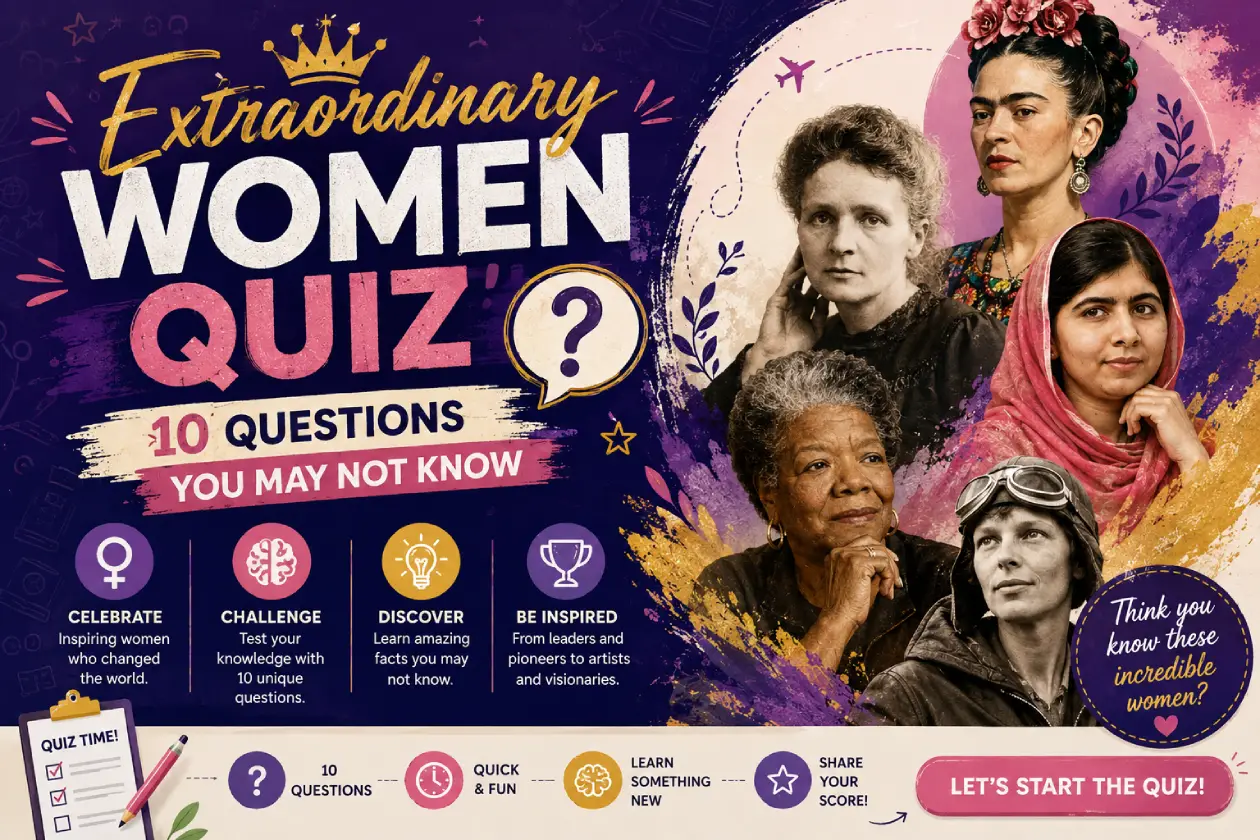
Extraordinary Women Who Changed the World
How well do you know the women whose achievements reshaped science, technology, aviation, mathematics, activism, and history? This quiz goes beyond the most familiar names and takes you into the stories of remarkable women whose accomplishments are often overlooked.
🌎 A Global Test of Knowledge
From the United States and United Kingdom to India, Kenya, and beyond, these questions highlight women who achieved extraordinary things under very different circumstances. Some broke barriers in laboratories, others challenged expectations in the skies, while others transformed communities through education, technology, or environmental work.
The questions are deliberately challenging, so don't worry if you don't recognize every name. Each answer comes with a Did You Know? fact that reveals another fascinating piece of the story.
Discover breakthroughs that changed scientific thinking.
Meet women who ventured where few had gone before.
Explore achievements that reached far beyond national borders.
Ready for the challenge?
Choose carefully — some of these questions are designed to test even serious history and trivia fans.
Start Extraordinary Women Quiz
🎯 Daily Trivia Challenge • 🧠 10 Questions • ⏱️ 90 Seconds
🗓️ Last Updated: August 17, 2026
Extraordinary Women Quiz: Can You Get All 10 Right?
Think you know the world's most extraordinary women? These questions go beyond the usual famous names and test your knowledge of lesser-known achievements in science, aviation, computing, resistance movements, environmental activism, and archaeology.
1. Which extraordinary woman became the first person ever to win Nobel Prizes in two different scientific fields?
A) Marie Curie
B) Dorothy Hodgkin
C) Irène Joliot-Curie
Marie Curie remains the only person to have received Nobel Prizes in two different scientific disciplines. She won Physics in 1903 and Chemistry in 1911, making her achievements extraordinary even by Nobel Prize standards.
2. Which pioneering American woman became the first African American woman to earn a Ph.D. from the University of Pennsylvania?
A) Mary McLeod Bethune
B) Sadie Tanner Mossell Alexander
C) Ida B. Wells
Sadie Tanner Mossell Alexander earned her Ph.D. in economics in 1921. She later became a lawyer and was a strong advocate for civil rights, economic opportunity, and equal access to education.
3. Which British mathematician made important contributions to chaos theory and later became the first woman president of the London Mathematical Society?
A) Mary Cartwright
B) Joan Clarke
C) Kathleen Lonsdale
Mary Cartwright's mathematical work with J. E. Littlewood helped reveal behavior in nonlinear systems that later became important to the study of chaos. She became the first woman to serve as president of the London Mathematical Society in 1961.
4. Which woman wrote what is widely regarded as the first published computer algorithm, long before modern computers were built?
A) Grace Hopper
B) Ada Lovelace
C) Jean Bartik
Ada Lovelace's famous notes on Charles Babbage's Analytical Engine included a method for calculating Bernoulli numbers. Her notes also imagined that machines could work with more than numbers, anticipating ideas that became central to modern computing.
5. Which American aviator became the first woman to fly solo across the Atlantic in 1928?
A) Bessie Coleman
B) Louise Thaden
C) Amelia Earhart
Amelia Earhart first crossed the Atlantic as a passenger in 1928. Four years later, she returned to the challenge and became the first woman to complete a solo nonstop transatlantic flight.
6. Which Indian woman became internationally famous for performing extremely complex mathematical calculations mentally?
A) Shakuntala Devi
B) Anandibai Joshi
C) Rukmini Devi Arundale
Shakuntala Devi became famous for extraordinary mental arithmetic and performed calculations in front of audiences around the world. Guinness World Records documented one of her remarkable multiplication feats in 1982.
7. Which New Zealand-born woman became one of the most decorated Allied servicewomen for her work with the French Resistance?
A) Violette Szabo
B) Nancy Wake
C) Virginia Hall
Nancy Wake was known by the Gestapo code name "The White Mouse" because of her ability to evade capture. During World War II, she helped organize resistance activities and assisted Allied personnel in occupied France.
8. Which Hollywood actress co-invented a frequency-hopping communication system during World War II that later influenced wireless technology?
A) Hedy Lamarr
B) Marlene Dietrich
C) Lauren Bacall
Hedy Lamarr and composer George Antheil patented a frequency-hopping system in 1942. The idea was designed to make radio-guided signals harder to interfere with and later became associated with the development of spread-spectrum communications.
9. Which Kenyan activist founded the Green Belt Movement and became the first African woman to receive the Nobel Peace Prize?
A) Ellen Johnson Sirleaf
B) Wangari Maathai
C) Leymah Gbowee
Wangari Maathai founded the Green Belt Movement in 1977, encouraging communities to plant trees while addressing environmental and social challenges. In 2004, she became the first African woman to win the Nobel Peace Prize.
10. Which British Egyptologist was among the women who worked professionally in Egyptian archaeology during the early 20th century?
A) Lilian Evelyn Griffith
B) Gertrude Bell
C) Agatha Christie
Lilian Evelyn Griffith was an English Egyptologist and archaeologist who worked on excavations and archaeological research in Egypt. Her career reflects the important, but often overlooked, contribution of women to the development of modern Egyptology.
How Many Did You Know?
These women changed science, technology, aviation, mathematics, environmental activism, and history in ways that are easy to overlook. If you knew several of these answers, your extraordinary-women knowledge is seriously impressive!