
Diamonds Are Just Carbon That Survived an Extreme Ordeal
The Same Element, Two Wildly Different Outcomes
Diamonds and graphite, the soft, gray material inside a pencil, are made of exactly the same element, carbon, and nothing else. That fact tends to surprise people the first time they hear it, since the two materials couldn't look or behave more differently, one is the hardest known natural substance on Earth, the other flakes apart if you rub it against paper. The difference between them has nothing to do with chemical composition and everything to do with how their carbon atoms are arranged, and that arrangement is dictated almost entirely by the specific conditions carbon happens to experience while it's forming.
Extreme Pressure and Heat Deep Within the Earth
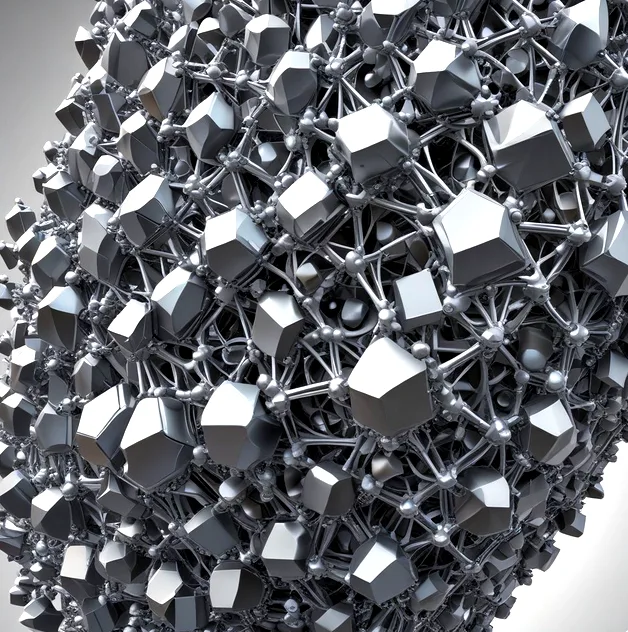
Diamonds form under a very specific and narrow set of conditions found only deep within the Earth's mantle, generally at depths of around 150 to 200 kilometers below the surface, where temperatures reach somewhere between 900 and 1,300 degrees Celsius and pressure climbs to roughly 45 to 60 kilobars, a level of pressure difficult to conceptualize in everyday terms but roughly comparable to the crushing weight of an entire mountain range concentrated onto a small area. Under these extreme conditions, carbon atoms that would otherwise arrange themselves into graphite's loose, layered structure instead get forced into diamond's much more tightly packed, rigid crystal lattice, an arrangement where each carbon atom bonds strongly to four neighboring atoms in a stable, three-dimensional structure.
Why the Crystal Structure Makes All the Difference
This structural difference is really the entire explanation for why diamond behaves so differently from graphite despite sharing identical chemistry. Graphite's carbon atoms arrange themselves into flat, sheet-like layers that are only weakly bonded to each other, which is exactly why graphite feels soft and flakes apart easily, those layers slide against one another with very little resistance. Diamond's carbon atoms, by contrast, form an extremely strong, interconnected three-dimensional lattice with no comparable weak points, which is precisely why diamond ranks as the hardest naturally occurring material on Earth, there's simply no easy direction for the structure to give way or slide apart under stress.
Carbon Needs a Source Before It Can Become Anything
Before any of this structural transformation can happen, the carbon itself has to originate from somewhere, and geologists generally believe diamond-forming carbon comes from a few different sources deep within the Earth, including ancient organic material subducted into the mantle through tectonic plate movement, as well as carbon already naturally present within the mantle itself from the planet's earlier formation. Regardless of its original source, that carbon needs to encounter the right combination of pressure, temperature, and sufficient time within the mantle's specific diamond-stability zone before it has any chance of crystallizing into diamond rather than simply remaining carbon in some other chemical form entirely.
Time Is Just as Important as Pressure
Diamond formation isn't a quick process by any reasonable human timescale, most diamonds found today are estimated to have formed somewhere between one billion and three billion years ago, meaning the diamonds currently being mined and sold commercially were forming deep within the Earth long before complex life had even developed on the planet's surface. This extraordinarily long formation timescale reflects how slowly geological processes generally unfold at these depths, the correct pressure and temperature conditions need to persist consistently over an enormous span of time for carbon atoms to gradually organize themselves into diamond's specific crystal structure.
Getting From the Mantle to the Surface
Forming deep within the mantle solves only part of the puzzle, diamonds also need a mechanism to actually reach the Earth's surface where they can eventually be discovered and mined, since the depths where diamonds form are far too deep for conventional mining access. This transport happens through violent volcanic eruptions originating from deep within the mantle, specifically through a type of volcanic rock formation called kimberlite pipes, named after the town of Kimberley in South Africa where this geological formation was first extensively studied. These eruptions occur relatively rapidly in geological terms, carrying diamonds upward from the mantle to the surface quickly enough that the diamonds don't have time to convert back into a more stable form under the dramatically lower pressure conditions they encounter along the way.
Why Not All Deep Carbon Becomes Diamond
Diamond formation requires hitting a genuinely narrow and specific window of pressure and temperature conditions, deviate meaningfully outside that window, and carbon will settle into a different structural form entirely rather than diamond, which is part of why diamonds remain relatively rare despite carbon itself being a fairly abundant element throughout the Earth. The mantle contains plenty of carbon overall, but only a small fraction of it ever encounters precisely the right combination of depth, pressure, temperature, and sufficient time required to actually crystallize into diamond rather than remaining in some other, more common carbon-based mineral form.
Diamonds From Beyond Earth Entirely
Interestingly, geological formation deep within Earth's mantle isn't the only way diamonds can form at all, extremely small diamonds have also been discovered within certain meteorites, formed through entirely different mechanisms involving intense shock pressure generated during massive impact events in space, sometimes even predating the formation of our solar system itself. These extraterrestrial diamonds tend to be microscopic, nothing resembling the larger, gem-quality diamonds mined on Earth, but their existence demonstrates that the same fundamental principle, extreme pressure reorganizing carbon into its densest possible structural form, isn't unique to Earth's interior specifically, it's a broader physical process that can occur wherever carbon encounters sufficiently intense pressure conditions, whether deep within a planet or during a violent cosmic collision.
An Ordinary Element Transformed by Extraordinary Conditions
What makes diamond formation such a compelling geological story isn't really the element involved, carbon is common and unremarkable in most of its other forms, it's the extraordinary specificity of the conditions required to transform that ordinary element into something so structurally different and prized. Immense pressure, sustained high temperature, and an almost incomprehensible span of geological time all have to align precisely, deep within a part of the planet no human has ever directly seen, before a diamond can exist at all, and then an entirely separate, dramatic volcanic event has to occur just to bring that diamond close enough to the surface for anyone to ever find it.