
What Is the Capital of the United Kingdom?
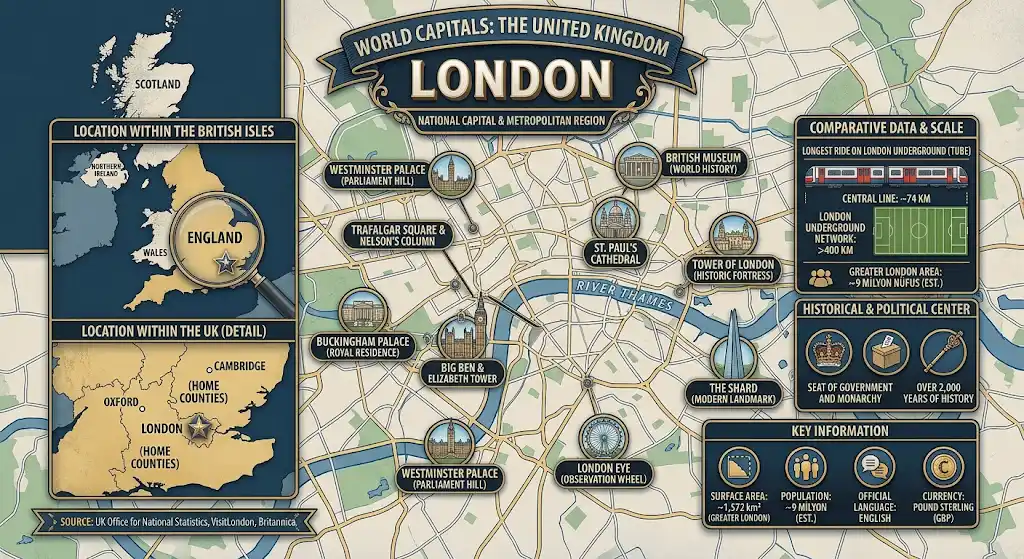
London is the capital of the United Kingdom. It's also the capital of England specifically, the seat of the UK Parliament, the home of the monarchy, and by a wide margin the largest city in the country — Greater London's population sits close to 9 million, roughly eight times larger than Birmingham, the UK's second city.
Few capitals anywhere carry this much layered history. London's roots go back nearly two thousand years, to a Roman settlement called Londinium founded around 43 CE on the banks of the River Thames. Long before "United Kingdom" existed as a political entity, London was already a major city — which makes it one of the rare capitals that predates the very country it now governs.
Quick Facts
- Greater London's population is estimated at roughly 9 million in 2026, making it the UK's largest city by a wide margin.
- London sits on the River Thames in southeastern England, about 50 miles (80 km) upstream from the North Sea.
- The city's founding traces to 43 CE, when Roman forces established Londinium under Emperor Claudius.
- Over 300 languages are spoken across London, reflecting a population where more than a third of residents were born outside the UK.
- The "City of London" and "Greater London" are not the same thing — the City itself is a small historic district with fewer than 17,000 residents, sitting inside the much larger metropolitan area.
London's Layered Identity
Confusion trips up a lot of visitors here, and it's worth untangling. "The City of London" refers to a tiny, ancient square-mile district — the original Roman and medieval core — which today functions as a global financial hub with a resident population smaller than a single large apartment complex. "Greater London," by contrast, is the sprawling metropolitan region most people mean when they say "London," made up of 32 boroughs plus the City itself, home to close to 9 million residents.
Political capital status applies to Greater London as a whole. The UK Parliament sits at the Palace of Westminster, the Prime Minister's residence at 10 Downing Street sits a short walk away, and Buckingham Palace anchors the monarchy nearby — all within a few kilometers of each other along the Thames, but scattered across different boroughs rather than confined to the old City core.
A City Shaped by Survival
Rome eventually withdrew from Britain, and London's fortunes rose and fell for centuries afterward through Anglo-Saxon settlement, Viking raids, and Norman conquest. By the medieval period, though, its position on the Thames had made it Britain's dominant trading center, and that economic weight is what eventually pulled political power toward it as well.
The 20th century tested the city more severely than almost any period before it. During the Blitz of 1940–41, Nazi Germany's sustained bombing campaign killed an estimated 43,000 Londoners and injured tens of thousands more, flattening entire neighborhoods. The city rebuilt afterward into the global financial and cultural center it is today, carrying visible scars of that history alongside medieval churches, Georgian terraces, and modern skyscrapers within the same few square miles.
London by the Numbers
| Fact | Detail |
|---|---|
| Founded | c. 43 CE, as Roman Londinium |
| Location | River Thames, southeastern England |
| Greater London population (2026 est.) | ~9 million |
| City of London population | ~16,700 |
| Second-largest UK city | Birmingham (~1.1 million) |
| Foreign-born share of population | ~37% |
| Languages spoken across the city | 300+ |
Did You Know?
More billionaires call London home than any other city in the world, and the city's private wealth accounts for a striking share of the UK's total — a legacy of its status as a global financial center dating back centuries.
Chicken tikka masala, now often cited as one of Britain's most popular dishes, was actually invented in the UK rather than in India, a small culinary footnote that says a lot about how thoroughly immigration has reshaped the country's culture from its capital outward.
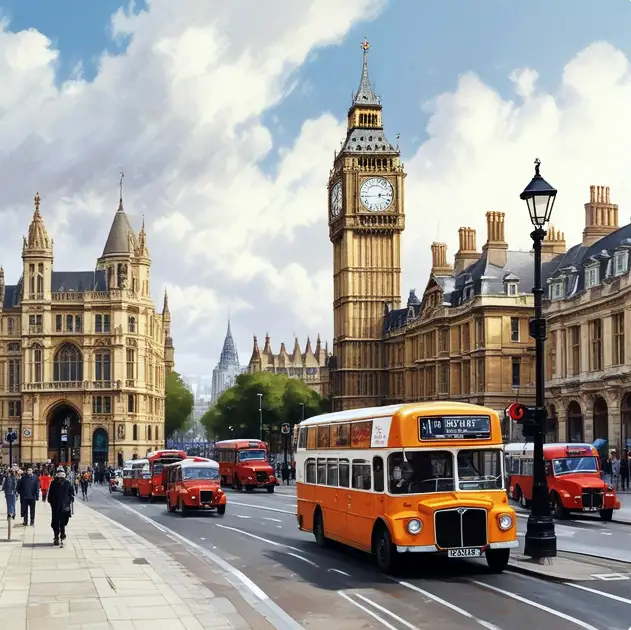
"Big Ben" doesn't technically refer to the clock tower at Westminster at all — the name properly belongs to the massive bell inside it, even though popular usage has long since blurred the distinction.
Related Questions People Ask United Kingdom
Is London the capital of England or the United Kingdom? Both. London serves as the capital of England specifically and, because England's institutions are so deeply tied to the UK's national government, as the capital of the United Kingdom as a whole.
What's the difference between the City of London and Greater London? The City of London is a small historic district of roughly one square mile with a tiny resident population, functioning mainly as a financial center. Greater London is the full metropolitan area of 32 boroughs plus the City, home to millions.
Where does the UK Parliament actually meet? At the Palace of Westminster, situated on the north bank of the Thames in central London, alongside the iconic clock tower housing Big Ben.
How does London compare in size to other UK cities? By a huge margin, it's the largest. Birmingham, the UK's second city, has a population of roughly 1.1 million — meaning London holds close to eight times as many people.
Why is London considered such a diverse city? Centuries of trade, empire, and more recent immigration have made London one of the most linguistically and ethnically diverse cities in Europe, with well over a third of residents born outside the UK and hundreds of languages spoken across its neighborhoods.
A Capital That Never Stopped Growing
Few cities anywhere have carried political power for as long, or survived as much disruption, as London has. From a Roman river outpost to a medieval trading hub to the seat of an empire and now a modern global capital, its role has shifted repeatedly while its geographic center — the Thames, the old City core, the seats of government clustered nearby — has stayed remarkably fixed. That continuity is part of why London still feels less like a single decision made at one point in history and more like the accumulated result of two thousand years refusing to relocate.