
What Is the Capital of Canada?
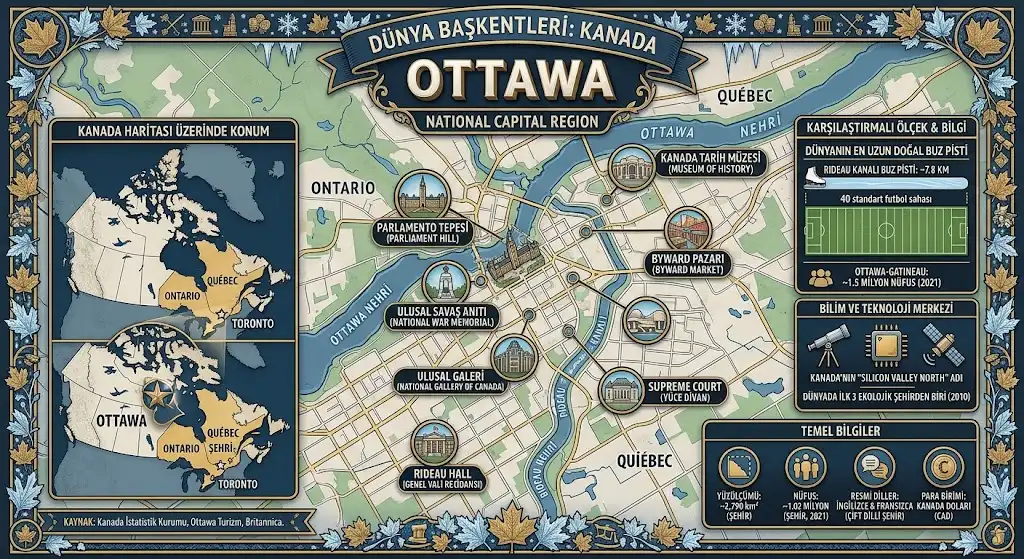
Ottawa is the capital of Canada. It's a common source of confusion, since Toronto and Montreal are both far bigger and better known internationally — but neither one runs the country. That job has belonged to Ottawa, a city in eastern Ontario along the Ottawa River, since Queen Victoria settled the matter back in 1857.
A lumber town of barely 7,700 people is what Ottawa amounted to when it got the nod. Rivals like Montreal, Quebec City, and Toronto were larger, wealthier, and far more established. What Ottawa had instead was location: it sat right on the border between English-speaking Upper Canada and French-speaking Lower Canada, making it a rare choice that didn't obviously favor one side over the other.
Quick Facts
- Ottawa sits in eastern Ontario, directly across the Ottawa River from Gatineau, Quebec.
- The city's population is roughly 1.2 million as of 2026, while the broader Ottawa–Gatineau metro area — which spans two provinces — holds close to 1.6 million people.
- Queen Victoria formally selected Ottawa as the capital on December 31, 1857.
- Parliament first sat in Ottawa in 1866, a year before Canada became a country through Confederation in 1867.
- Ottawa is the only census metropolitan area in Canada that crosses a provincial boundary, linking Ontario and Quebec.
A Royal Decision Nobody Fully Expected
Between 1841 and 1857, the Province of Canada couldn't settle on a permanent home for its government. Parliament had already bounced between Kingston, Montreal, Toronto, and Quebec City over that period, and every attempt to pick a permanent seat collapsed into regional bickering. Frustrated legislators eventually did something unusual: they asked Queen Victoria to make the call for them, effectively outsourcing a domestic political fight to the monarchy.
Her decision, announced on the last day of 1857, stunned plenty of Canadians. Popular legend says she simply liked landscape paintings of the area, or even that she picked the spot with a hatpin — colorful stories, though the real reasoning was more practical. Ottawa's location on the Ontario-Quebec border kept it neutral in the English-French rivalry that had derailed every previous attempt. It also sat safely inland from the U.S. border at a time when tensions with America still shaped Canadian defense planning, and it already had rail and canal access thanks to the Rideau Canal and the Bytown and Prescott Railway.
Not everyone accepted the outcome quietly. Opposition politicians pushed back within months, and both Toronto and Quebec City kept holding their own legislative sessions for years afterward, refusing to fully concede. Construction of the new Parliament Buildings began in 1859 regardless, and by the time Canada became a self-governing nation in 1867, Ottawa's position as the seat of government was locked in for good.
From Lumber Camp to National Capital
Before politics reshaped it, Ottawa's economy ran almost entirely on timber. The city's earliest growth came from the Rideau Canal, originally built for military transport but used far more for moving lumber, goods, and people through the region. Once the government arrived, that identity shifted fast. Grand Gothic Revival–style Parliament Buildings rose on a hill overlooking the river, and what had been a rough logging settlement rebuilt itself around a permanent civil service.
Urban planning played a role too. A 1937 plan by French architect Jacques Gréber reshaped Ottawa with parks, greenbelts, and a layout suited to a national capital rather than an industrial river town — much of which still defines the city's character today.
Ottawa by the Numbers
| Fact | Detail |
|---|---|
| Capital selected | December 31, 1857 (by Queen Victoria) |
| First Parliament session held | 1866 |
| Canadian Confederation | July 1, 1867 |
| City population (2026 est.) | ~1.2 million |
| Metro area (Ottawa–Gatineau) population | ~1.6 million |
| Province | Ontario (metro area spans into Quebec) |
| Ranking among Canadian cities | 4th largest metro area |
Did You Know?
A hatpin story still circulates about Queen Victoria's decision, even though there's no real evidence behind it — historians generally point instead to Ottawa's neutral, defensible position between rival regions.
Toronto and Quebec City were so unhappy with the outcome that both kept running their own parliamentary sessions for several years after the Queen's announcement, effectively ignoring the ruling.
Ottawa–Gatineau is unique among Canadian metro areas for straddling two provinces at once, which is why the region uses two different area codes and operates under both Ontario and Quebec provincial law depending on which side of the river you're standing on.
Related Questions People Ask Canada
Why isn't Toronto the capital of Canada? Toronto was one of several rival cities competing for the title in the 1840s and 1850s, but the same regional rivalry that ruled out Montreal and Quebec City worked against Toronto too. Ottawa won largely by being nobody's first choice and therefore nobody's enemy.
Is Ottawa in Ontario or Quebec? Ottawa itself sits entirely within Ontario. Its twin city across the river, Gatineau, is in Quebec, and together they form the Ottawa–Gatineau metropolitan area.
How big is Ottawa compared to Toronto and Montreal? Much smaller. Toronto's metro population runs over 6 million and Montreal's over 4 million, while Ottawa–Gatineau sits around 1.6 million — making it Canada's fourth-largest metro area rather than one of its biggest two.
When did Ottawa officially become the capital? Queen Victoria's selection came on December 31, 1857, though Parliament didn't actually convene there until 1866, and Canada itself didn't formally become a country until Confederation in 1867.
What river runs through Ottawa? The Ottawa River, which also forms the natural boundary between Ontario and Quebec at that point, with the Rideau Canal joining it near downtown.
A Compromise City That Became the Real Thing
Ottawa's whole existence as Canada's capital traces back to a fight nobody could win outright. Rather than handing the title to Montreal's wealth, Toronto's growth, or Quebec City's history, the decision landed on a modest border town that satisfied nobody's ambition but offended nobody's pride either. More than 160 years later, that accidental-seeming choice has held up as one of the more durable political compromises in Canadian history.