
What Is the Capital of Australia?
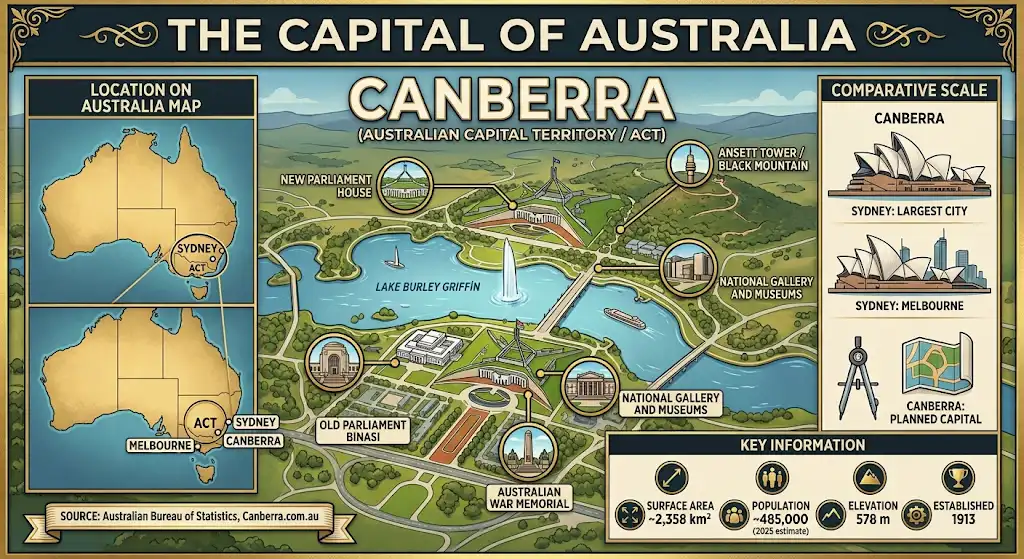
Canberra is the capital of Australia. Not Sydney, despite the Opera House and the Harbour Bridge showing up in nearly every postcard of the country. Not Melbourne either, even though it held the title on a temporary basis for over two decades. Canberra, a city most visitors have never heard of, has been Australia's official seat of government since 1927.
Ask a random group of people to name Australia's capital and most will guess Sydney. It's one of the more persistent geography mix-ups worldwide, right up there with people assuming Rio de Janeiro is Brazil's capital (it's Brasília). Sydney's global visibility simply overshadows the much smaller, purpose-built city that actually runs the country.
Quick Facts
- Canberra sits in the Australian Capital Territory (ACT), a separate federal district carved out of New South Wales.
- The city's population runs around 460,000–470,000, making it Australia's eighth-largest city — smaller than most people expect a national capital to be.
- Construction began after 1913, but Canberra wasn't fully functioning as the seat of government until Parliament relocated there from Melbourne in 1927.
- The name comes from an Aboriginal word, widely believed to mean "meeting place."
- Walter Burley Griffin, an American architect, won the international design competition for the city's layout in 1912.
A Compromise Built From Scratch
Rivalry, not geography, is really what put Canberra on the map. When the Australian colonies federated into a single nation in 1901, Sydney and Melbourne each expected to become the new capital. Sydney had the age and prestige — it was the country's first European settlement. Melbourne had the population and the money, fueled by a 19th-century gold rush that had made it briefly one of the wealthiest cities on Earth. Neither side would back down, and neither side could be picked without insulting the other.
The framers of the Australian Constitution settled the standoff with a clause rather than a vote. Section 125 required the permanent capital to sit within New South Wales, yet at least 100 miles (160 km) from Sydney — far enough to keep it out of Sydney's shadow, still technically on New South Wales soil to soften Sydney's loss. Melbourne, meanwhile, got to serve as the temporary seat of government while the new city was being built, which took the sting out of losing the permanent title.
Choosing the Site
Government surveyors spent years combing the countryside between the two rival cities before settling on the Yass-Canberra district in 1908. Surveyor Charles Scrivener led the search, and the region won out for a mix of practical reasons: a broad inland valley ringed by hills, a temperate climate, and a reliable water source in the Molonglo River. Long before European surveyors ever arrived, the Ngunnawal people had lived on that same land for tens of thousands of years, and the city's name is thought to descend from a local word for "meeting place" — a coincidence that turned out to be fitting.
Lady Denman, wife of Australia's Governor-General at the time, formally named the city on March 12, 1913, at a foundation ceremony held on the site.
Griffin's Vision for the City
An international design competition drew entries from architects around the world, and the winning plan came from Walter Burley Griffin, an American landscape architect who had never set foot in Australia before submitting it. His design leaned on garden-city principles: wide radiating avenues, deliberate sightlines toward the surrounding hills, and a large artificial lake at the city's center. That lake, now named Lake Burley Griffin in his honor, still anchors the layout of the city today, with Parliament House, national museums, and government buildings arranged around its shores.
Few capital cities anywhere were planned this deliberately from the ground up. Most grew organically over centuries; Canberra was drawn on paper first and built to match.
Canberra by the Numbers
| Fact | Detail |
|---|---|
| Site selected | 1908 |
| City officially named | March 12, 1913 |
| Became seat of federal government | 1927 |
| Population | ~460,000–470,000 |
| Location | Australian Capital Territory, inland New South Wales |
| Distance from Sydney | ~280 km (about 170 miles) |
| Distance from Melbourne | ~470 km (about 290 miles) |
| Designer | Walter Burley Griffin |
Did You Know?
Canberra is sometimes called the "Bush Capital," a nod to how much of the surrounding landscape — nature reserves, grassland, and eucalypt forest — remains largely untouched despite the city growing around it.
One of Canberra's more colorful early figures, American-born politician King O'Malley, played a leading role in getting the capital project off the ground, and reportedly spun a tall tale about why he'd left the U.S. rather than admit the real reason.
Parliament House, opened in 1988, was built into a hill rather than on top of one — the roof is grass-covered, and visitors can walk right over the top of the building without realizing what's underneath their feet.
Related Questions People Ask
Why isn't Sydney the capital of Australia? Sydney lost out because of rivalry, not size or importance. Political tension with Melbourne over which city deserved the title made a compromise necessary, and neither existing city could claim the win.
Was Melbourne ever the capital of Australia? Yes, on a temporary basis. Melbourne served as the seat of government from federation in 1901 until Canberra was ready to take over in 1927.
How far is Canberra from Sydney and Melbourne? Roughly 280 km from Sydney and about 470 km from Melbourne, placing it almost directly between the two.
Is Canberra part of a state? No. It sits within the Australian Capital Territory, a self-governing federal territory that is legally separate from New South Wales, even though it's geographically surrounded by it.
What does the name Canberra mean? It's generally believed to derive from an Aboriginal word meaning "meeting place," describing the significance the area held for the Ngunnawal people long before European settlement.
Is Canberra Australia's largest city? Not even close. Sydney and Melbourne are both many times larger. Canberra ranks around eighth by population among Australian cities, making it one of the smallest national capitals relative to its country's biggest cities.
A Capital Designed to Belong to No One City
What makes Canberra's story stand out isn't the size of the city or the fame of its landmarks — it's the fact that it exists at all because two larger, older cities refused to lose to each other. Rather than handing the title to either Sydney or Melbourne, Australia built something new on neutral ground, planned in advance down to the placement of its lake and avenues. More than a century later, that compromise still holds: the seat of government belongs to neither rival, and to the whole country instead.