
16 Bizarre Historical Paradoxes That Sound Completely Fake
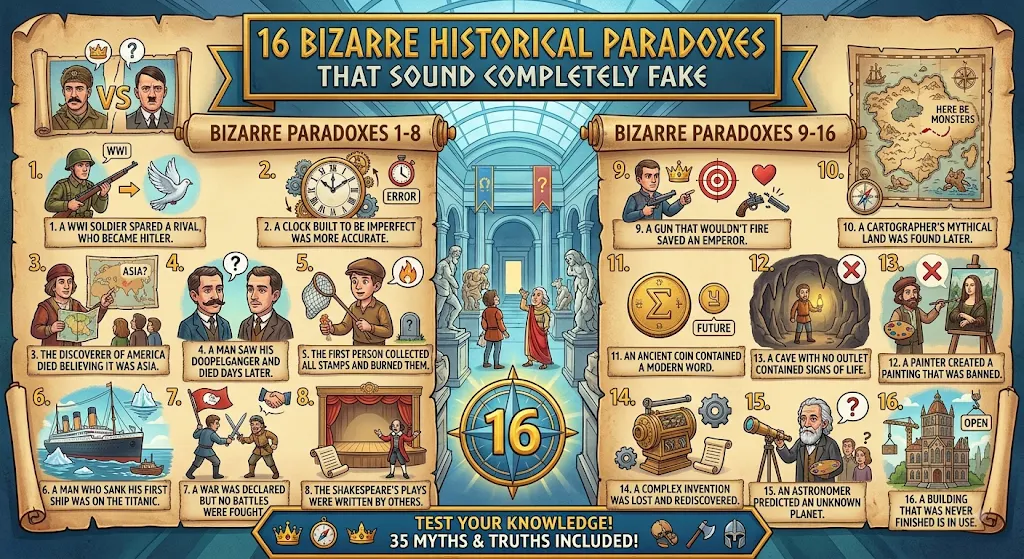
When we look back at world history, textbook publishers usually leave out the bizarre, awkward, and surprisingly funny details. From ancient timelines that disrupt our common sense to ridiculous military misadventures, here are 16 verified historical facts that feel like urban legends—but are completely true.
Why Does History Feel So Strange?
Many famous historical figures lived during eras we rarely associate together. When you cross-reference dates across civilizations, surprising facts start to emerge!
1. Cleopatra Lived Closer to the Moon Landing Than to the Pyramids
When people picture ancient Egypt, they often lump the Great Pyramids and Cleopatra into the same era. However, the chronological gap between them is massive.
The Great Pyramid of Giza was completed around 2560 BCE, whereas Cleopatra VII was born much later in 69 BCE. The Apollo 11 moon landing occurred in 1969 CE.
The Math: Cleopatra lived approximately 2,500 years after the construction of the Great Pyramids, but under 2,000 years before Neil Armstrong walked on the moon.
2. Napoleon Bonaparte Was Once Chased by Thousands of Hungry Rabbits
After signing the Treaties of Tilsit in 1807, Emperor Napoleon wanted to celebrate with a grand rabbit hunt. His chief of staff procured thousands of domestic rabbits and released them into an open field.
Instead of running away in fear when the hunt began, the tame farm rabbits mistook Napoleon and his generals for farmhands bringing food. The horde swarmed the military leaders, forcing the conqueror of Europe to hastily retreat to his carriage.
3. Oxford University Predates the Entire Aztec Civilization
Teaching at Oxford existed as early as 1096, and by 1167 it was a fully established center of learning. In contrast, the Aztec Empire was officially founded in 1325 with the construction of Tenochtitlan.
By the time the Aztecs built their famous island capital in Central America, scholars at Oxford had already been sitting for academic examinations for over two centuries.
4. Australia Fought a Military Campaign Against Emus—And Lost
In 1932, over 20,000 large emus migrated into Western Australia's agricultural heartland, destroying wheat crops. The Australian government responded by deploying military personnel equipped with machine guns.
The birds proved exceptionally fast, breaking into small groups whenever soldiers opened fire. After several weeks of wasted ammunition and minimal bird casualties, the military officially withdrew, leaving local farmers to rely on basic fencing instead.
5. Ancient Romans Cleaned Togas and Teeth with Human Urine
In the Roman Empire, urine was highly valued for its natural ammonia concentration. Specialized workers called fullones collected liquid waste from public restrooms to launder wool garments and lift tough stains.
Furthermore, some Roman citizens used imported Spanish urine as an ingredient in early tooth-cleaning mixtures, believing ammonia helped break down stubborn dental plaque.
6. The Great Fire of London in 1666 Officially Injured Fewer Than 10 People
The Great Fire of London destroyed over 13,000 houses, dozens of churches, and swept through most of the medieval city center. Remarkably, the officially recorded death toll was extremely low—fewer than ten fatalities were documented.
While many working-class deaths were likely unrecorded, the documented survival rate remains one of the most surprising outcomes of a major historical urban disaster.
7. Ancient Mayans Used Horned Nesting Wasps as Battle Grenades
Mayan warriors turned local wildlife into tactical weapons. During siege warfare, they filled fragile clay gourds with live, aggressive stinging wasps and hornets.
When thrown over enemy fortress walls, the gourds shattered, releasing angry swarms directly onto opposing troops and creating chaos inside defended positions.
8. A 19th-Century Surgeon Had a Surgery with a 300% Mortality Rate
Before modern anesthesia, speed was vital in surgical procedures. Dr. Robert Liston was famous for performing rapid limb amputations in under three minutes.
During one infamous operation, Liston worked so quickly that he accidentally cut through his assistant's fingers, slashed a spectator's coat, and amputated the patient's leg. Both the patient and assistant died of infection, while the spectator reportedly died of shock—making it the only known surgery in history with a 300% mortality rate.
9. Ice Age Humans Made Musical Instruments Out of Mammoth Bones
Tens of thousands of years ago, early human communities carved complex flutes out of bird bones and mammoth ivory. Archeologists in Europe have excavated playable bone flutes dating back over 35,000 years.
This proves that creative musical culture was already an integral part of human social life long before agricultural settlements or written languages existed.
10. The US Government Intentionally Poisoned Alcohol During Prohibition
During the 1920s Prohibition era, people continued buying industrial alcohol diverted by bootleggers to make illegal spirits. To discourage consumption, federal officials ordered chemical manufacturers to add lethal compounds like methanol to industrial alcohol supplies.
Despite the added toxins, people continued drinking the altered liquor, resulting in thousands of severe illnesses and deaths before Prohibition ended in 1933.
11. Ancient Spartans Used Heavy Iron Bars Instead of Coins as Currency
While neighboring Greek city-states minted gold and silver coins, Sparta intentionally utilized long, heavy iron rods as money.
This iron currency was intentionally bulky and heavy—a small amount required an ox-cart to transport—to deter hoarding, discourage foreign trade, and keep Spartan society focused strictly on military training.
12. The Original Eiffel Tower Was Intended to Be Demolished After 20 Years
Gustave Eiffel designed his iconic iron tower as a temporary entrance arch for the 1889 World's Fair in Paris. The original permit allowed the tower to stand for just 20 years before being dismantled for scrap metal.
The structure was saved because the French military found it extremely useful as a giant radio telegraph transmitter tower during early 20th-century communications tests.
13. Benjamin Franklin Proposed Making the Wild Turkey the National Bird
In a famous letter to his daughter, Founding Father Benjamin Franklin criticized the choice of the Bald Eagle as the national symbol of the United States, calling it a bird of "bad moral character" that stole food from other birds.
Franklin praised the wild turkey as a far more respectable, native American bird with courage and integrity—though he never officially petitioned Congress to make the change.
14. Ancient Egyptians Used Dead Mice to Treat Toothaches
In ancient Egypt, medical practitioners attempted to ease severe toothache pain by placing mashed, freshly deceased mice directly against the affected teeth or gums.
In certain cases, physicians mixed crushed mouse remains with other natural ingredients to form soothing poultices aimed at drawing out inflammation.
15. The Pitch Drop Experiment Has Been Running Continuously Since 1927
In 1927, Professor Thomas Parnell at the University of Queensland set up an experiment to prove that pitch (a derivative of tar) is actually a fluid at room temperature, despite feeling solid.
The pitch flows so slowly that only 9 drops have fallen in nearly a century, making it the world's longest-running continuously active laboratory experiment.
16. Minnesota Was Once Saved from a Grasshopper Plague by a Day of Prayer
In 1877, millions of Rocky Mountain locusts descended upon Minnesota, destroying severe portions of agricultural crops. Traditional containment efforts failed completely.
Governor John S. Pillsbury declared April 26, 1877, a statewide day of prayer. Miraculously, a sudden drop in temperature followed shortly after, freezing millions of locust larvae and ending the plague before crops were ruined for the season.
Explore More Fun Facts
History is full of unpredictable moments. Check back regularly as we update our Fun Facts section with new historical, scientific, and cultural deep-dives!