Australia Quiz – Test Your Knowledge of Australian Geography, Wildlife & Culture
Australia Quiz – Test Your Knowledge Australian Geography
Take this quiz to see how much you know about Australia's geography and landscapes, famous landmarks, culture, and natural wonders while learning new facts along the way.
Last Updated: September 7, 2026.
🇦🇺 Start Australia Quiz
🎯 Daily Bing Trivia Challenge • 🧠 10 Questions • ⏱️ 90 Seconds
Australian Geography
Which Australian state or territory contains the largest part of the Great Artesian Basin?
Aboriginal Australia
What does the term 'Dreaming' broadly refer to in many Aboriginal Australian cultures?
Australian Wildlife
Why can wombats produce unusually cube-shaped droppings?
Australian History
What was the primary purpose of the Australian gold rushes of the 1850s?
Australian Environment
Why is Lake Hillier famous?
Australian Science
Which Australian scientist shared the 1915 Nobel Prize in Physics for work on X-ray crystallography?
Australian Cities
Which Australian city is located farther south than any other mainland state capital?
Australian Exploration
Which explorer was the first European to successfully cross the Australian continent from south to north?
Australian Culture
What is a 'bush tucker' food?
Unusual Australia
Which Australian feature is unusual because it is a major mountain range located almost entirely within a tropical region?
Your score
0/10
Scroll down to see the explanation for each question.
Explanations: answer key for all 10 questions
- Q1: Which Australian state or territory contains the largest part of the Great Artesian Basin?
Answer: Queensland
Queensland contains the largest portion of the Great Artesian Basin, although the enormous groundwater system extends into several other states and territories. It is one of Australia's most important sources of underground water.
- Q2: What does the term 'Dreaming' broadly refer to in many Aboriginal Australian cultures?
Answer: Traditional systems of ancestral stories, laws, and relationships
The Dreaming is a broad English term used for diverse Aboriginal systems of ancestral stories, laws, creation, identity, and relationships with Country. Different Aboriginal nations have their own languages, traditions, and understandings.
- Q3: Why can wombats produce unusually cube-shaped droppings?
Answer: Their intestines have different elasticity in different sections
Research has found that wombat intestines have regions with different elasticity, which helps shape the material into cubes as it passes through. The unusual shape may help the droppings stay in place when used to mark territory.
- Q4: What was the primary purpose of the Australian gold rushes of the 1850s?
Answer: To search for commercially valuable gold deposits
Gold discoveries in places such as Victoria and New South Wales attracted enormous numbers of migrants during the 1850s. The resulting population growth helped transform Australia's economy and accelerated the development of several major cities.
- Q5: Why is Lake Hillier famous?
Answer: Its water can appear naturally bright pink
Lake Hillier on Western Australia's Middle Island is famous for its striking pink coloration. Scientists associate the color with microorganisms and chemical conditions in its highly saline environment.
- Q6: Which Australian scientist shared the 1915 Nobel Prize in Physics for work on X-ray crystallography?
Answer: William Lawrence Bragg
William Lawrence Bragg shared the 1915 Nobel Prize in Physics with his father, William Henry Bragg. Their work established how X-rays could be used to investigate crystal structures and became fundamental to modern structural science.
- Q7: Which Australian city is located farther south than any other mainland state capital?
Answer: Melbourne
Melbourne is the southernmost mainland state capital of Australia. Hobart is farther south, but it is located on the island of Tasmania rather than the Australian mainland.
- Q8: Which explorer was the first European to successfully cross the Australian continent from south to north?
Answer: John McDouall Stuart
John McDouall Stuart led the first successful south-to-north crossing of the Australian mainland in 1861–1862. His route helped establish a practical path across the interior and later influenced the route of the Overland Telegraph Line.
- Q9: What is a 'bush tucker' food?
Answer: A traditional food sourced from Australia's native plants and animals
Bush tucker refers broadly to foods traditionally gathered, hunted, or prepared by Aboriginal and Torres Strait Islander peoples. Examples include native fruits, seeds, herbs, and certain meats, although specific foods and traditions vary greatly between communities.
- Q10: Which Australian feature is unusual because it is a major mountain range located almost entirely within a tropical region?
Answer: The Great Dividing Range
The Great Dividing Range stretches for thousands of kilometers along Australia's eastern side, including large sections in tropical Queensland. Its immense length and varied climates make it one of the country's most significant physical features.
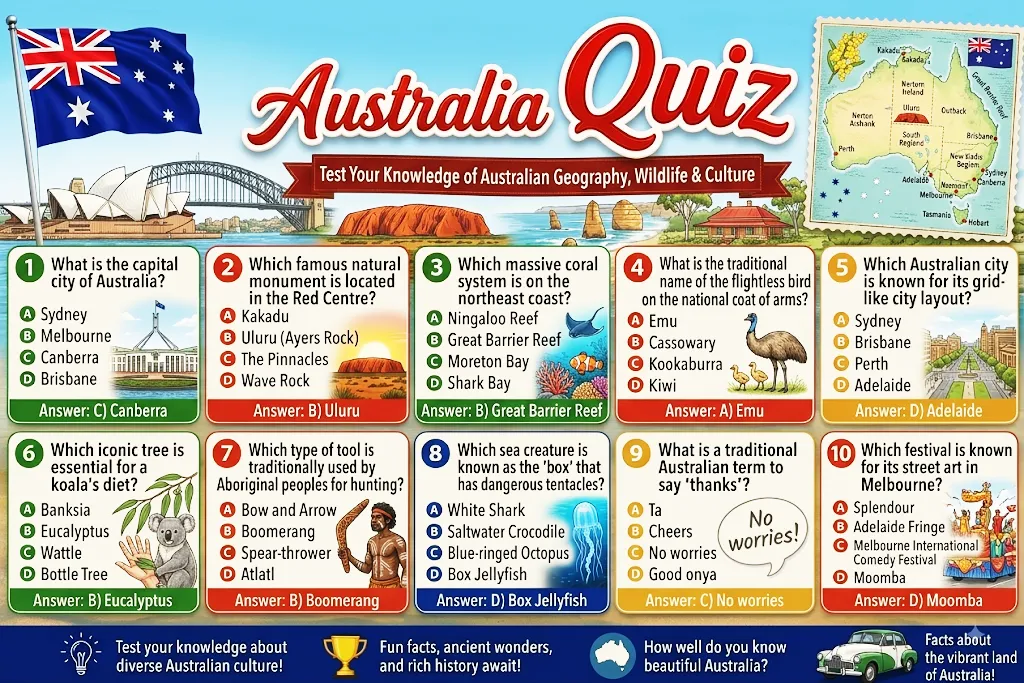
Few countries are as instantly recognizable as Australia. Home to unique wildlife, vast deserts, colorful coral reefs, and vibrant coastal cities, Australia is unlike anywhere else on Earth. Because the continent was separated from the rest of the world for millions of years, many of its plants and animals evolved independently, creating species found nowhere else.
Australia is much more than kangaroos and the Sydney Opera House. It's a country where tropical rainforests, ancient rock formations, alpine mountains, and some of the world's longest beaches exist within a single nation. Whether you're interested in geography, wildlife, history, or travel, Australia offers countless fascinating stories waiting to be discovered.
Quick Facts About Australia
| Fact | Information |
|---|---|
| Official Name | Commonwealth of Australia |
| Capital | Canberra |
| Largest City | Sydney |
| Continent | Australia (Oceania) |
| Population | About 27 million |
| Currency | Australian Dollar (AUD) |
| Official Language | No official language at the federal level (English is the national language in practice) |
| Highest Mountain | Mount Kosciuszko |
| Largest Desert | Great Victoria Desert |
| National Animal | Red Kangaroo |
| Government | Federal Parliamentary Constitutional Monarchy |
Geography and Natural Wonders
Australia is both a country and a continent, making it one of the most geographically unique places in the world. Much of the interior, known as the Outback, consists of deserts, grasslands, and rocky landscapes that receive very little rainfall.
Along the eastern coast lies the Great Dividing Range, while the northeast is home to the world-famous Great Barrier Reef—the largest coral reef system on Earth. Northern Australia features tropical rainforests and wetlands, whereas the southern regions experience cooler climates with fertile farmland and mountain ranges.
Australia's diverse environments support thousands of plant and animal species, many of which cannot be found anywhere else.
A Story That Began Thousands of Years Ago
Australia has one of the world's oldest continuous cultures. Aboriginal and Torres Strait Islander peoples have lived on the continent for more than 60,000 years, developing rich traditions, languages, and deep connections to the land.
European exploration expanded during the 18th century, eventually leading to the establishment of modern Australia. Since then, the country has grown into a multicultural nation known for its democratic institutions, strong economy, and high quality of life.
Today, Indigenous heritage continues to play an important role in Australia's national identity.
Wildlife Found Nowhere Else
Australia is famous for its extraordinary wildlife. Kangaroos, koalas, wombats, platypuses, echidnas, and Tasmanian devils are among the many animals that evolved in isolation over millions of years.
Marine life is equally impressive. Dolphins, sea turtles, humpback whales, colorful reef fish, and giant manta rays can all be found in Australian waters.
National parks and conservation programs help protect these unique ecosystems for future generations.
Culture and Everyday Life
Australia is one of the world's most multicultural countries. People from hundreds of cultural backgrounds contribute to its food, music, arts, and festivals.
Outdoor living plays an important role in Australian life. Surfing, hiking, camping, cricket, Australian rules football, rugby, and beach activities are popular across the country.
Australian cuisine reflects this diversity, blending Indigenous ingredients with influences from Europe, Asia, and the Pacific.
Famous Places Across Australia
Sydney is known for its iconic Opera House and Harbour Bridge, while Melbourne is celebrated for its arts, sporting events, and café culture.
Queensland attracts visitors to the Great Barrier Reef and tropical islands. Uluru, located in the Northern Territory, is one of Australia's most recognizable natural landmarks and holds profound cultural significance for Indigenous Australians.
Tasmania offers ancient forests, rugged coastlines, and unique wildlife found nowhere else.
15 Interesting Facts About Australia
- Australia is the world's sixth-largest country.
- The Great Barrier Reef is visible from space.
- More than 80% of Australia's mammals are found nowhere else.
- Canberra was purpose-built to serve as the nation's capital.
- Australia has more than 10,000 beaches.
- The Outback covers most of the country's interior.
- Kangaroos outnumber people in many parts of Australia.
- Uluru changes color throughout the day depending on the sunlight.
- Australia is home to the world's oldest tropical rainforest.
- The platypus is one of only a few mammals that lay eggs.
- Melbourne has repeatedly ranked among the world's most livable cities.
- Australia experiences opposite seasons from the Northern Hemisphere.
- The Sydney Opera House is a UNESCO World Heritage Site.
- Australia is surrounded by the Indian and Pacific Oceans.
- Cricket is one of the country's most popular sports.
Did You Know?
- Australia is the only continent without an active volcano on its mainland.
- Wild camels in Australia form one of the world's largest camel populations.
- The world's longest straight railway track crosses southern Australia.
- More than 500 national parks protect Australia's landscapes.
- Pink lakes can be found in several parts of the country due to naturally occurring algae.
Why Australia Is Worth Learning About
Australia provides an excellent example of how geography influences wildlife, climate, and everyday life. Its isolation helped create ecosystems unlike any other on Earth, while its multicultural society demonstrates how people from different backgrounds can contribute to a shared national identity.
By exploring Australia through quizzes, learners improve their understanding of continents, biodiversity, environmental conservation, and world geography in an enjoyable and memorable way.
What You'll Learn From This Quiz
After completing this Australia quiz, you'll know more about:
- Australian geography
- Unique wildlife
- Indigenous cultures
- Famous cities
- National parks
- Mountains and deserts
- The Great Barrier Reef
- Interesting facts about Australia
Ready for another round?
Jump to a random quiz from the archive.