
Astronauts Come Home a Little Taller, and It's Not Just an Illusion
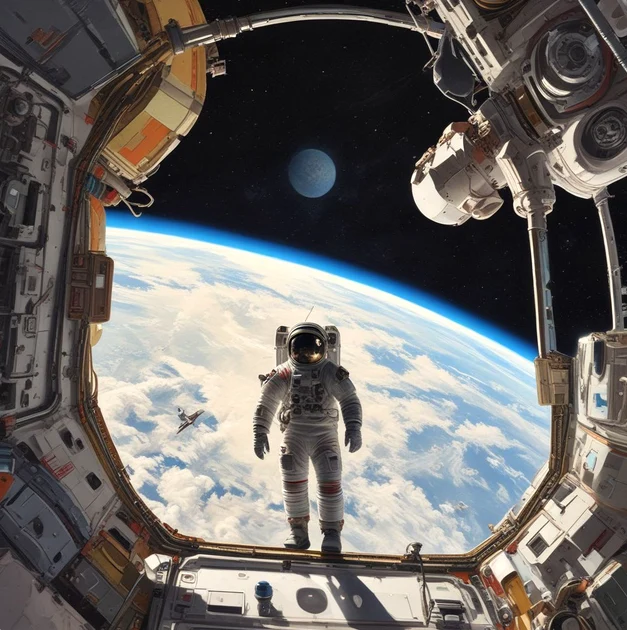
Why can astronauts become slightly taller while spending time in microgravity?
Astronauts don't just come back from space with incredible stories and slightly disorienting balance issues — some of them come back measurably taller. Not dramatically so, but enough that NASA and other space agencies actually track it, because the change, while temporary, reveals something interesting about how much our bodies quietly fight gravity every single day without us noticing.
On Earth, the human spine isn't a rigid column stacked neatly on top of itself. It's built from vertebrae separated by cushioning discs made of cartilage, and those discs are constantly being compressed by the simple, unglamorous fact of standing, sitting, and walking around under the planet's gravitational pull. Over the course of a normal day, that compression is subtle but constant, which is part of why people are often measurably shorter in the evening than they were first thing in the morning — the discs get squeezed down gradually as the hours pass, then slowly rehydrate and expand overnight while lying flat.
Now take away gravity almost entirely, which is essentially what happens aboard the International Space Station. Without that constant downward pressure compressing the spine, those same discs expand more than they ever would during a good night's sleep on Earth. The vertebrae drift slightly further apart, the natural curvature of the spine relaxes, and the cumulative effect over weeks or months in orbit is a noticeable increase in height — astronauts have reported gains of roughly two inches, though the exact amount varies depending on the individual and the length of the mission.
This isn't purely a cosmetic curiosity either. Spinal expansion in microgravity has real physiological consequences, and not always pleasant ones. Many astronauts report back pain during the adjustment period, both when their spine is stretching out in orbit and later when gravity reasserts itself and compresses everything back down after landing. The unfamiliar lengthening puts strain on surrounding muscles, ligaments, and nerves that spent months adapting to an elongated spinal structure, and some of that discomfort can linger for days or weeks post-mission.
Height isn't the only thing affected either — it's really just the most visible symptom of a much larger set of changes happening throughout the body in microgravity. Fluids that normally get pulled downward by gravity redistribute more evenly, leading to the puffier faces astronauts often develop in orbit, sometimes nicknamed "puffy face syndrome" informally within the space community. Meanwhile, bone density and muscle mass, both of which rely heavily on resistance and load-bearing activity to maintain themselves, tend to decline during extended stays in space, which is exactly why astronauts follow rigorous daily exercise routines on specialized equipment designed to simulate resistance that gravity would otherwise provide for free.
The height change reverses once astronauts return to Earth. Gravity reasserts its familiar compression fairly quickly, and within days to weeks, spinal discs settle back toward their pre-flight state, and astronauts gradually shrink back down to something close to their normal terrestrial height. It's not a permanent transformation, more like a temporary suspension of one of gravity's quieter, everyday jobs.
What makes this phenomenon particularly interesting from a scientific standpoint is how much it reveals about long-duration spaceflight challenges, especially with future missions to Mars under serious discussion. A round trip to Mars would mean many months, potentially years, of cumulative time in microgravity or reduced gravity environments, which raises real questions about spinal health, bone density loss, and musculoskeletal strain that mission planners have to account for long before anyone straps into a spacecraft. The extra couple of inches astronauts gain temporarily in orbit isn't just a fun fact for trivia nights — it's a small, measurable signal of everything else quietly happening to the human body when the planet's gravity briefly lets go.